Migrating the GitHub Copilot runtime to Rust, using Copilot
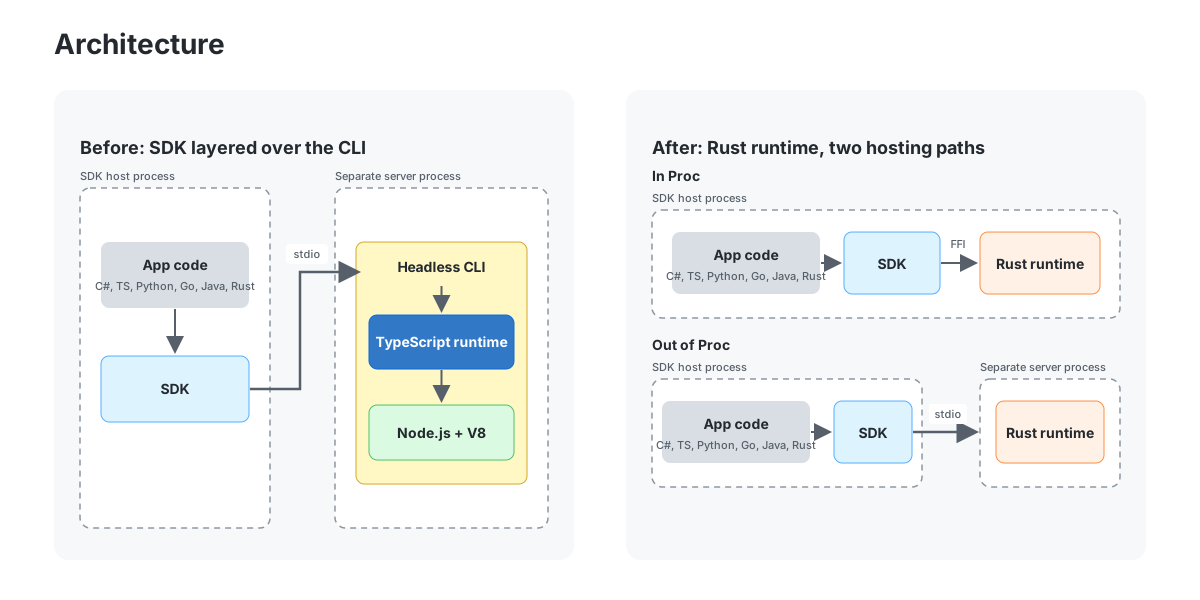
For years, the idea of rewriting a production system of nearly 800,000 lines of code in a new language felt like a fantasy reserved for sci-fi novels or massive, multi-year enterprise migrations. It was an endeavor so daunting that most teams would settle for patching old code rather than replacing it, fearing the risk of introducing subtle bugs during the transition. Yet, the decision to migrate the GitHub Copilot runtime to Rust changed everything, proving that the age of manual, heroic refactoring is over. This wasn't just a code swap; it was a fundamental shift in how we approach the architecture of complex software, turning what was once a monumental mountain into a manageable climb.
The primary driver for this migration was the inherent performance and safety profile of Rust, a language designed to catch memory errors at compile time rather than leaving them to crash production systems at runtime. In the previous implementation, running a large-scale LLM model required significant overhead, and the fear of a memory leak could derail the entire user experience. By porting the runtime to Rust, we weren't just chasing benchmarks; we were building a foundation where safety is a feature, not an afterthought, ensuring that the delicate balance between AI intelligence and system stability remains unbreakable under heavy load.
But the real game-changer was the role Copilot itself played in the migration. In the past, rewriting code required human engineers to meticulously read, understand, and translate every line, a process that consumed immense mental energy and calendar time. This time, we leveraged Copilot to act as a co-pilot in the literal sense, generating the boilerplate, handling the syntax translation, and suggesting complex logic patterns in real-time. The tool didn't just speed up typing; it fundamentally altered the workflow, allowing developers to focus on architecture and verification rather than the drudgery of syntax conversion.
The results speak for themselves, as the migration delivered a runtime that is significantly faster and more resilient than its predecessors. We saw a dramatic reduction in latency, which is critical when users expect instant code completions, and a robustness that handles edge cases with precision. The transition, which once seemed like an insurmountable task requiring years of downtime and resources, was accomplished with a fraction of the expected effort, demonstrating that modern AI agents can bridge the gap between legacy systems and next-generation performance.
This achievement underscores a broader truth about the future of software engineering: the barrier to entry for massive infrastructure overhauls is collapsing. When an AI agent can understand context, manage state, and write production-grade code, the definition of a "rewrite" changes from a high-risk gamble to a strategic upgrade. The Copilot runtime now stands as a testament to what is possible when human intent and machine capability are aligned, proving that the tools we build today can help us build the systems of tomorrow with unprecedented speed and confidence.
On Bluesky? Meet HomeSky.
Follower analytics, a growth toolkit, scheduling and AI posting — built for Bluesky. Connect your account and use everything free for 60 days.
Try HomeSky free →