Migrating the GitHub Copilot runtime to Rust, using Copilot
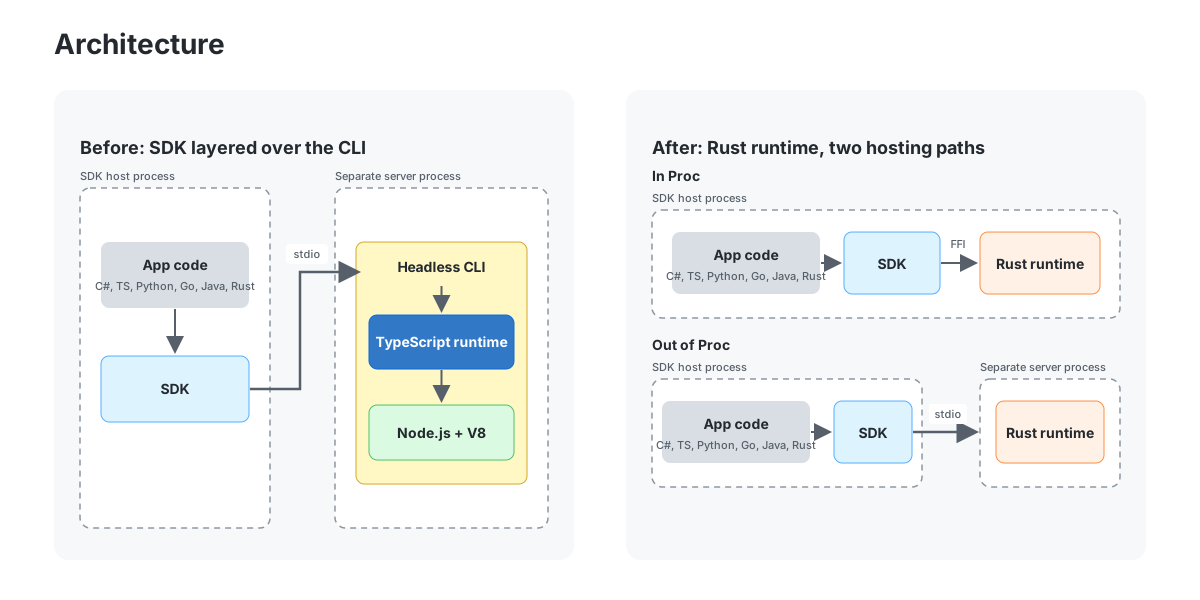
For years, the idea of rewriting a massive codebase in Rust felt like a fantasy reserved for hobbyists with infinite caffeine and weekends to spare. The GitHub Copilot agent runtime, sitting comfortably at over 800,000 lines of production Rust, is the result of a shift that wasn't possible before the advent of modern AI agents. Before this, the sheer scale of the migration meant it was simply too expensive to attempt, both in terms of engineering hours and the risk of breaking critical functionality. The team had to find a way to automate the heavy lifting without sacrificing the safety and performance guarantees that Rust provides.
The solution was paradoxical yet elegant: they used Copilot to migrate Copilot. It wasn't just about spinning up a large language model to spit out code snippets; it was about orchestrating a sophisticated agent capable of understanding the entire ecosystem of the project. The team had to define precise constraints, establish a rigorous testing framework, and create a feedback loop where the agent could propose changes, the system could validate them against existing test suites, and the agent could iteratively refine its output. This was not a "prompt and pray" approach; it was a carefully engineered pipeline where human oversight remained essential to guide the agent's logic and ensure architectural integrity.
Porting this magnitude of code revealed just how much modern AI has evolved from a code completion tool to a collaborative pair programmer capable of high-level reasoning. The process wasn't seamless, but the sheer volume of work that could be handled by an agent made the timeline feasible. Instead of months or years of manual refactoring, the migration leveraged the agent's ability to contextualize thousands of files simultaneously, identifying patterns and refactoring opportunities that would have been invisible to a human eye scanning the codebase linearly. It demonstrated that the future of large-scale software engineering isn't about replacing engineers, but about amplifying their capability to tackle problems of previously impossible scope.
The technical challenges went beyond simple syntax translation. Rust's strict type system and ownership model require a level of precision that traditional C++ or Java code lacks, making automated refactoring particularly treacherous. The Copilot agent had to learn the idioms of Rust deeply enough to not just write functions, but to respect the memory safety guarantees and concurrency patterns that define the language. Every line of generated code had to pass through a gauntlet of lints, unit tests, and integration checks before being merged, ensuring that the resulting runtime was as robust as the original implementation.
Looking back, this migration stands as a testament to how rapidly the landscape of software development is changing. What once required a massive army of engineers working for years can now be approached with a focused team and a powerful, AI-driven workflow. The success of porting the Copilot runtime to Rust validates the strategy of using agents for agent development, creating a self-reinforcing cycle where the tools we build are increasingly capable of building better versions of themselves. It's a small but significant step toward a future where the boundaries of what we can build in a single release are defined only by imagination, not by the sheer volume of human hours available.
On Bluesky? Meet HomeSky.
Follower analytics, a growth toolkit, scheduling and AI posting — built for Bluesky. Connect your account and use everything free for 60 days.
Try HomeSky free →