Migrating the GitHub Copilot runtime to Rust, using Copilot
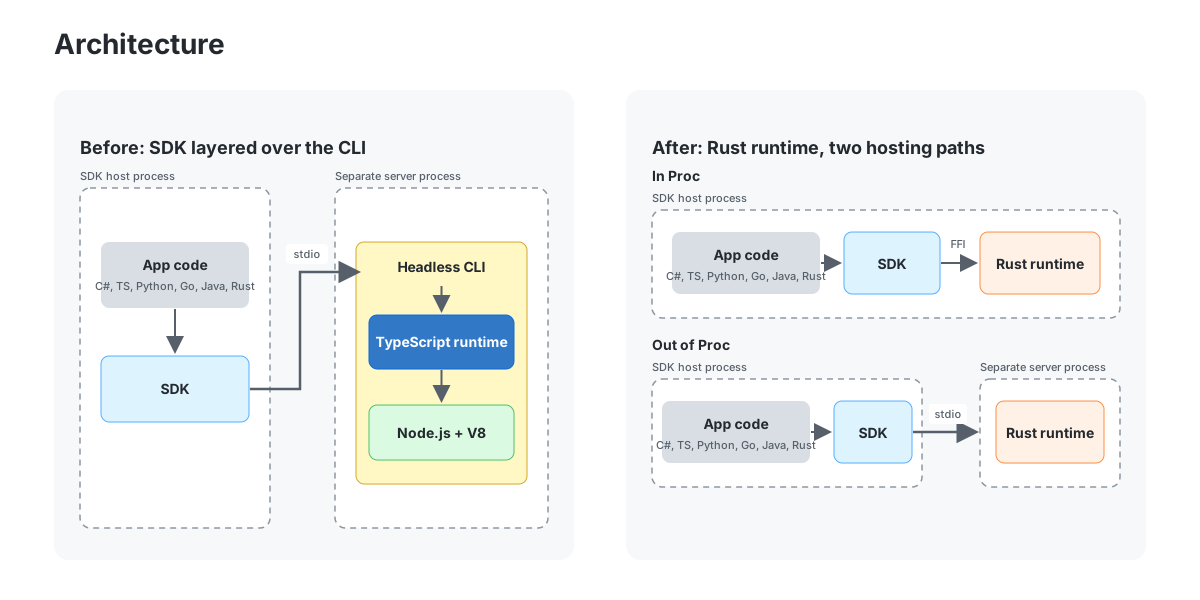
Before the advent of autonomous coding agents, rewriting a system of this magnitude was a luxury few companies could afford. It required armies of senior engineers, months of dedicated sprint time, and a level of risk tolerance that would have sent most CTOs to the exit. Porting the GitHub Copilot runtime, which now spans over 800,000 lines of production Rust, was not just a task; it was a logistical marathon that would have stalled under the weight of its own complexity. The sheer volume of code meant that every function, every type definition, and every edge case had to be audited, migrated, and verified, creating a bottleneck that traditional human-only workflows simply could not clear.
The decision to attempt this migration was driven by the need for safety and performance, but the method of execution turned the project into a meta-narrative about the very technology it sought to improve. By using Copilot itself to write the Rust code, we created a unique feedback loop where the agent was tasked with rewriting its own underlying infrastructure. This wasn't just about speed; it was about consistency. Rust's strict borrow checker and memory safety guarantees demanded a level of precision that manual refactoring often struggled to maintain across such a vast codebase, making the AI's ability to synthesize complex logic patterns not just helpful, but essential.
There were moments of genuine friction where the generated code hit walls that even the most advanced models couldn't immediately resolve. We didn't encounter magic where the agent instantly solved every problem; instead, we faced a messy reality of half-baked implementations, type mismatches, and logic errors that required human intervention to course-correct. The collaboration between the developer and the agent evolved from a simple prompt-response interaction into a true partnership, where the human provided the architectural guardrails and the machine filled in the intricate details at a pace no human team could match.
What emerged from this rewrite was a system that was not only safer but also more resilient, proving that the integration of AI into the core development lifecycle is inevitable rather than experimental. The migration demonstrated that when given the right constraints and context, agents can handle the grueling work of maintaining massive codebases with a level of endurance that would exhaust a team of engineers. It shifted the paradigm from viewing AI as a mere assistant to recognizing it as a force multiplier capable of tackling the "unaffordable" tasks that have long held back industry-scale software evolution.
This journey into Rust with Copilot was less about the language itself and more about the realization that the tools we build today will define how we build tomorrow. As we look forward, the lessons learned here suggest that the next generation of software infrastructure will be forged in this exact crucible: a blend of human intuition and machine scale. The 800,000 lines of Rust are now running smoother than ever, but the true victory lies in the new workflow that made it possible, a workflow that is already beginning to reshape the landscape of software engineering.
On Bluesky? Meet HomeSky.
Follower analytics, a growth toolkit, scheduling and AI posting — built for Bluesky. Connect your account and use everything free for 60 days.
Try HomeSky free →