Migrating the GitHub Copilot runtime to Rust, using Copilot
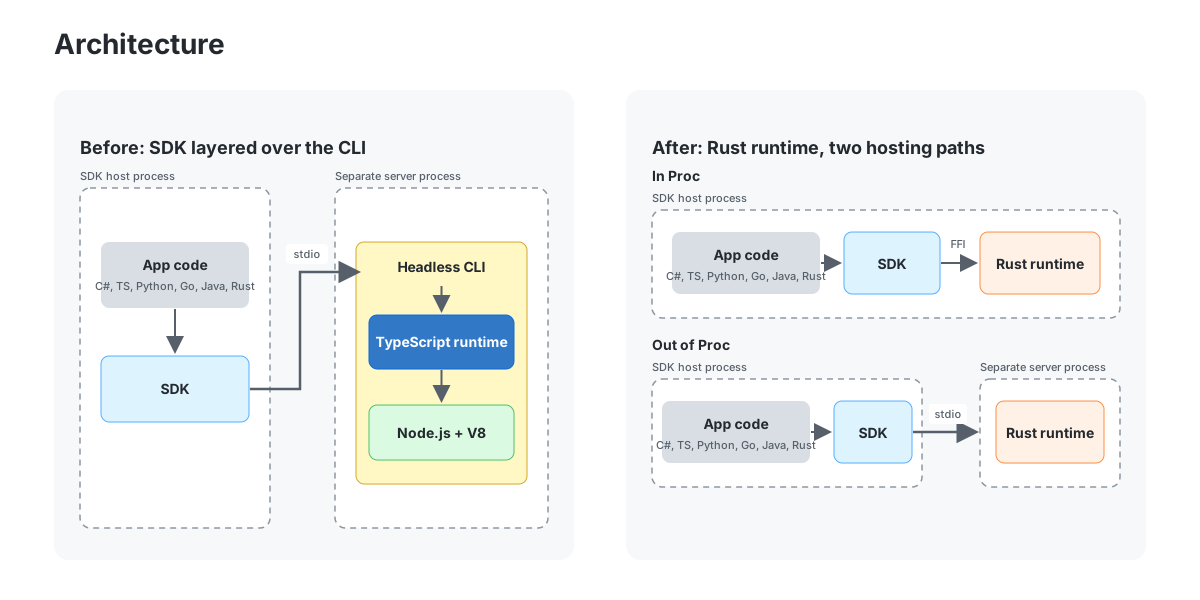
For years, the idea of rewriting the GitHub Copilot runtime in Rust felt like a fantasy reserved for whiteboard sessions, not production reality. The sheer scale of the codebase—nearly 800,000 lines of logic that powers millions of developers globally—seemed to define the boundary of what was feasible. Traditional refactoring was a slow, painstaking exercise in manual translation, where the risk of introducing subtle bugs far outweighed the performance gains. We were stuck in a cycle where the complexity of the legacy code acted as a hard ceiling, preventing us from adopting the safety and efficiency that Rust offers. The cost wasn't just in time; it was in the opportunity to innovate while maintaining stability.
That changed when we stopped treating the port as a standard engineering task and started treating it as a problem for Copilot itself to solve. It sounds circular, almost recursive, but the logic is sound: if we are building an agent to help developers write better code, that same agent should be capable of migrating its own runtime. By leveraging Copilot's ability to understand context across massive codebases, we could generate the initial scaffolding for the Rust ports. We weren't just writing code; we were writing a blueprint for the future, allowing the tool we built to rewrite itself in a more robust language.
The results were far more impressive than we anticipated, defying the skepticism that often surrounds AI-assisted enterprise refactoring. What initially seemed like a monumental undertaking was broken down into manageable chunks where Copilot could generate high-quality Rust implementations directly from the existing Python logic. We didn't just copy-paste; we engaged in a continuous loop of generation, review, and refinement. The AI understood the intricate dependencies and the specific architectural patterns of the Copilot runtime, translating them into idiomatic Rust that was both performant and maintainable. This wasn't magic; it was the power of context-aware intelligence applied to a problem that had previously been deemed too large for any single human to tackle alone.
Porting this volume of code revealed that the biggest challenge wasn't the syntax or the language features, but the fidelity of the intent. Every function had to behave exactly as it did before, and the stakes were incredibly high since this is the engine driving the world's most popular code completion tool. We implemented a rigorous verification process where the generated Rust code was tested against the original behavior in real-time. It was a tense process, requiring a delicate balance between trusting the suggestions generated by the agent and applying the human oversight necessary to ensure correctness. Yet, the sheer speed at which we moved forward would have been impossible without this new approach.
Looking back, this migration stands as a testament to how quickly the landscape of software development is shifting. The days of manual, line-by-line refactoring for projects of this magnitude are ending, replaced by a paradigm where agents can handle the bulk of the heavy lifting. We didn't just move lines of code from one language to another; we moved a massive piece of infrastructure into a future-proof state with significantly lower latency and stronger memory safety guarantees. The journey from "not affordable" to a fully operational Rust runtime in record time proves that the tools we build today will fundamentally transform how we build them tomorrow.
On Bluesky? Meet HomeSky.
Follower analytics, a growth toolkit, scheduling and AI posting — built for Bluesky. Connect your account and use everything free for 60 days.
Try HomeSky free →