Migrating the GitHub Copilot runtime to Rust, using Copilot
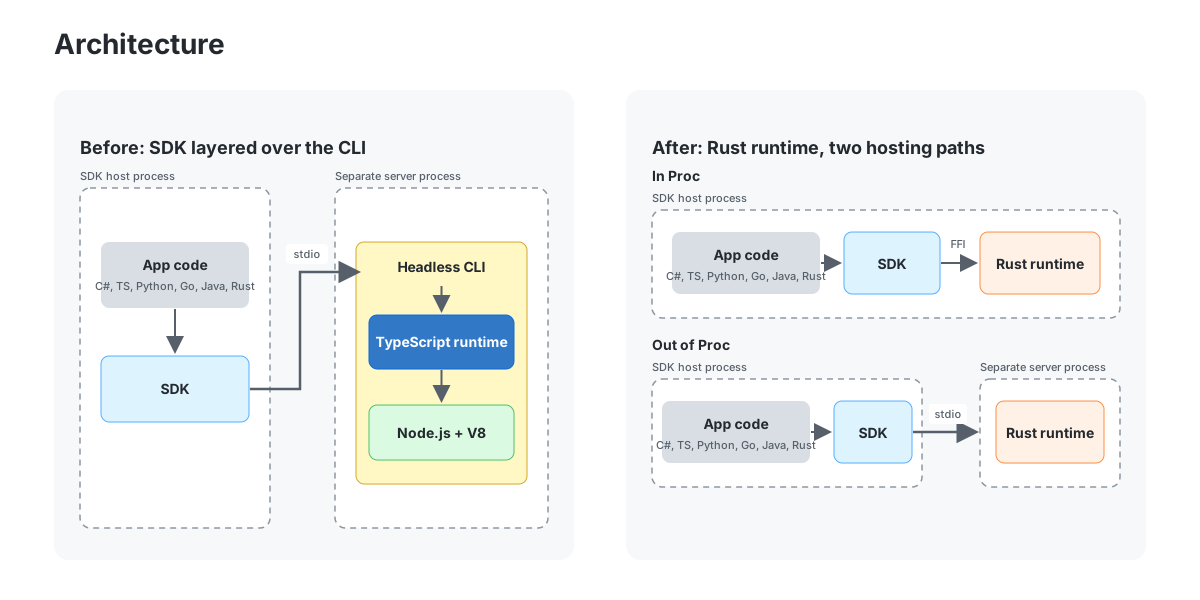
For years, the decision to rewrite massive systems in Rust felt like an impossible dream, a luxury reserved for startups with infinite runway or theoretical toy projects. The sheer scale of the GitHub Copilot agent runtime—nearly 800,000 lines of production code—was a fortress of C++ that seemed untouchable by the promise of modern systems programming. Before the rise of autonomous coding agents, the cost of such a migration was simply too high; the human effort required to manually refactor, test, and validate every single line would have bankrupted a dedicated team before the first compile succeeded.
Then, the paradigm shifted. We stood on the precipice of a new era where AI agents could not just assist but actually execute complex engineering tasks. The question was no longer if it was possible, but what it would take to leverage these new capabilities to bridge the gap between ambition and execution. We needed a tool that could understand the intricate logic of our existing C++ architecture and translate it into the strict, memory-safe world of Rust without losing a shred of functionality.
The result was a process that felt less like a traditional software rewrite and more like a guided exploration. By feeding the Copilot agent the existing codebase and asking it to generate the Rust equivalents, we discovered a startling level of proficiency in its architectural reasoning. It didn't just perform mechanical translation; it understood context, idiomatic usage, and the subtle interplay between components, often proposing optimizations that a human reviewer might have missed in the heat of a deadline.
However, trusting an agent with the core of our product was never a blind leap of faith. The "using Copilot" in this context meant building a rigorous, iterative feedback loop where the AI generated candidates, but human engineers acted as the final gatekeepers. We didn't just accept the output; we scrutinized it, challenged its assumptions, and refined its logic. This hybrid approach allowed us to move at a pace previously unimaginable, turning what would have been a multi-year project into a sprint of intense, focused iteration.
The implications of this migration extend far beyond the mere lines of code saved or the performance gains from Rust's ownership model. It represents a fundamental shift in how we approach large-scale system maintenance and evolution. We have demonstrated that with the right tools, the barrier to entry for adopting safer, more efficient languages is lower than ever, democratizing the ability for established organizations to modernize their tech stacks without sacrificing stability or speed.
Looking forward, this rewrite is just the beginning of a new workflow where human ingenuity and AI scalability work in tandem. The 800,000 lines of Rust code now running behind our product are a testament to what happens when we stop fighting the future of development and start building with it. We are no longer limited by the speed of our typing or the endurance of our teams; we are limited only by the complexity of the problems we dare to solve.
On Bluesky? Meet HomeSky.
Follower analytics, a growth toolkit, scheduling and AI posting — built for Bluesky. Connect your account and use everything free for 60 days.
Try HomeSky free →