Migrating the GitHub Copilot runtime to Rust, using Copilot
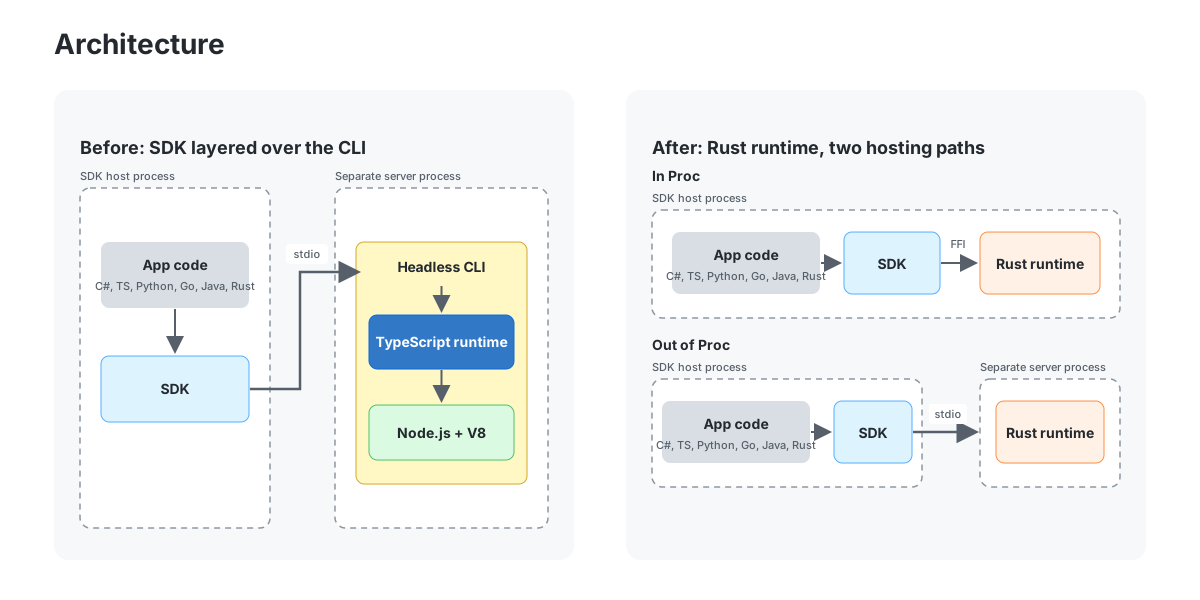
For years, the idea of rewriting the GitHub Copilot agent runtime in Rust felt like a fantasy reserved for a mythical team of hero developers. The project spans roughly 800,000 lines of production-grade code, a scale that historically demanded a multi-year budget and a dedicated army of engineers. Before the advent of sophisticated AI agents, such a massive undertaking would have been financially prohibitive and operationally chaotic, likely resulting in months of downtime and a steep learning curve for the entire engineering organization. The sheer volume of legacy logic, intertwined with complex networking layers and security protocols, created a barrier that seemed impossible to cross without a sledgehammer approach that would inevitably break the system.
However, the emergence of Copilot as an agent fundamentally shifted the equation, turning an unaffordable dream into a manageable reality. Instead of human engineers manually tracing thousands of dependencies and rewriting logic line-by-line, the AI acted as a force multiplier, capable of understanding the architectural intent behind the code. It didn't just translate syntax; it grasped the semantic relationships between modules, allowing for a surgical migration that preserved the integrity of the system while drastically reducing the timeline. This wasn't just about changing languages; it was about leveraging intelligence to handle the cognitive load that had previously paralyzed any attempt at such a rewrite.
The decision to move to Rust was driven by a need for reliability and performance that the previous technology stack could not guarantee. In the world of an AI-powered coding assistant, latency is not just an annoyance; it is a dealbreaker. Users expect instant suggestions, and any bottleneck in the runtime directly translates to a degraded user experience. Rust's memory safety guarantees and superior concurrency model provided the necessary foundation to handle the massive throughput of code analysis requests without the fear of null pointer exceptions or data races that plague other languages. The transition required a deep understanding of ownership and borrowing, concepts that felt abstract until they were applied to the concrete reality of the Copilot runtime.
The process itself was a fascinating dance between human oversight and machine execution. The team didn't simply let the AI rewrite everything blindly; they established a rigorous feedback loop where the agent proposed changes, humans validated the logic against test suites, and the results were fed back to refine the AI's behavior. This iterative cycle allowed the system to learn the specific quirks of the Copilot codebase, ensuring that the migration wasn't just a syntactic transformation but a functional evolution. The result was a runtime that was not only faster and safer but also more maintainable, setting a new standard for what large-scale code migrations could achieve.
Ultimately, this project serves as a proof of concept for the future of software engineering. It demonstrates that the constraints of scale are not fixed laws of nature but rather limitations imposed by our current tools and methodologies. By harnessing the power of AI agents, we are unlocking the ability to tackle problems that were once deemed insurmountable, potentially opening the door to other ambitious projects that require massive refactoring or modernization. The migration to Rust was a bold gamble, but it paid off by proving that with the right intelligence, even the most daunting technical debt can be cleared efficiently.
This shift represents more than just a technical upgrade; it is a paradigm change in how we approach software longevity. As organizations face increasing pressure to modernize their infrastructure, the ability to automate the heavy lifting of migration becomes a competitive advantage. The 800,000 lines of Rust code standing today are a testament to what can be achieved when human ingenuity is augmented by artificial intelligence. It is a reminder that the limits of what we can build are expanding, one line of code at a time, and that the future of development is collaborative, efficient, and limitless.
On Bluesky? Meet HomeSky.
Follower analytics, a growth toolkit, scheduling and AI posting — built for Bluesky. Connect your account and use everything free for 60 days.
Try HomeSky free →