Migrating the GitHub Copilot runtime to Rust, using Copilot
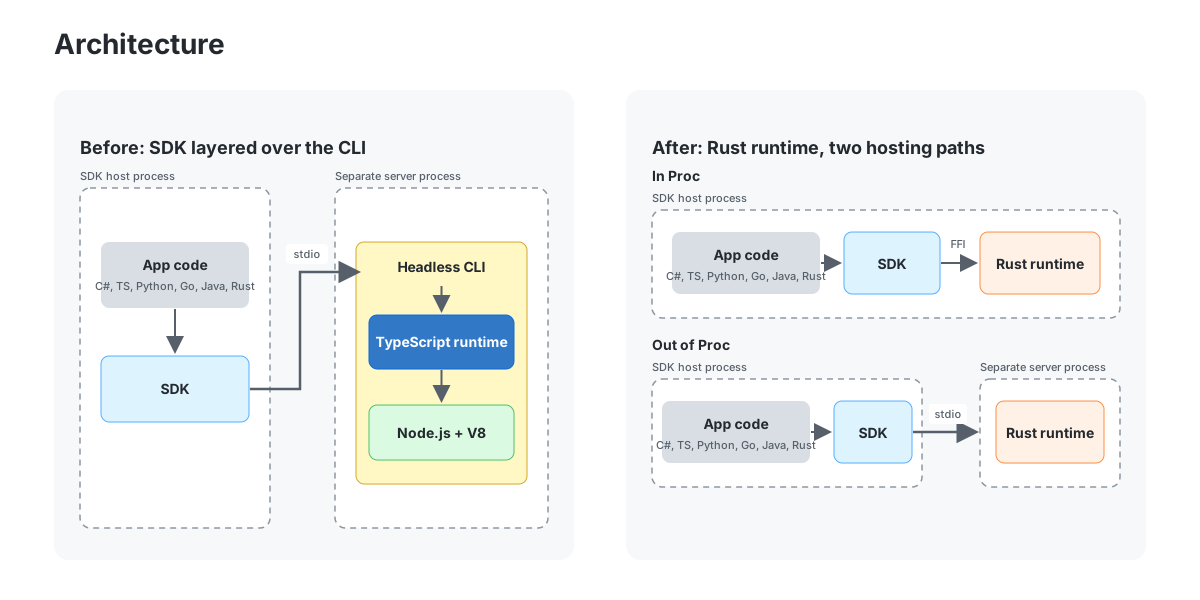
Before the advent of intelligent agents, a rewrite of this magnitude would have been a prohibitive expense, requiring months of dedicated effort and a massive investment of engineering time. The decision to migrate the GitHub Copilot runtime to Rust, a project spanning roughly 800,000 lines of production code, initially seemed like a monumental undertaking that defied economic sense. However, the emergence of autonomous agents fundamentally altered the cost-benefit analysis, turning what was once a multi-year slog into a manageable, albeit complex, sprint. This shift highlights a paradigm where tools that were once merely accelerators have become the primary architects of their own evolution.
The sheer volume of code involved in this migration presents a unique challenge that traditional refactoring simply could not address efficiently. Porting a critical component of the development ecosystem requires not just syntactic translation, but a deep understanding of the underlying logic, security implications, and performance constraints that Rust enforces. The language's strict ownership model and borrow checker force a level of explicitness in memory management that is absent in many higher-level languages, demanding a rigorous rethinking of data structures and interaction patterns. Yet, it is precisely this discipline that makes the resulting system more robust and secure, essential for a tool that runs directly within millions of developer environments.
What made this endeavor feasible was the ability to deploy agents that could read, understand, and generate the necessary code with unprecedented accuracy. Rather than manually dissecting every function and module, specialized agents were able to navigate the complex web of dependencies, identify potential pitfalls, and propose solutions that adhered to Rust's safety guarantees. This approach allowed the engineering team to focus on high-level architectural decisions and validation, rather than getting lost in the minutiae of boilerplate conversion. It effectively democratized the heavy lifting of large-scale system migration, allowing human expertise to direct the process while the machines handled the execution.
The implications of this migration extend far beyond a simple language swap; it represents a significant hardening of one of the most widely used development tools in existence. Rust offers memory safety without garbage collection, which is a crucial feature for a runtime that must operate reliably under load and interact seamlessly with native systems. By rewriting the core infrastructure in Rust, GitHub ensures that the Copilot service remains resilient against the kinds of memory vulnerabilities that plague less strict languages, thereby protecting the integrity of the code written by its users. This move underscores a broader trend in the industry where performance and safety are no longer optional features but foundational requirements.
Ultimately, this project serves as a testament to the transformative power of intelligent automation in software engineering. It demonstrates that when the right tools are applied to the right problems, even the most daunting technical challenges can be overcome with speed and precision. The successful porting of the Copilot runtime validates the hypothesis that agents can handle tasks previously reserved for armies of engineers, setting a new precedent for future infrastructure projects. As the technology continues to evolve, we can expect to see more such feats, where the boundary between human and machine collaboration becomes increasingly blurred, paving the way for a future where software development is defined by intent rather than syntax.
On Bluesky? Meet HomeSky.
Follower analytics, a growth toolkit, scheduling and AI posting — built for Bluesky. Connect your account and use everything free for 60 days.
Try HomeSky free →