Migrating the GitHub Copilot runtime to Rust, using Copilot
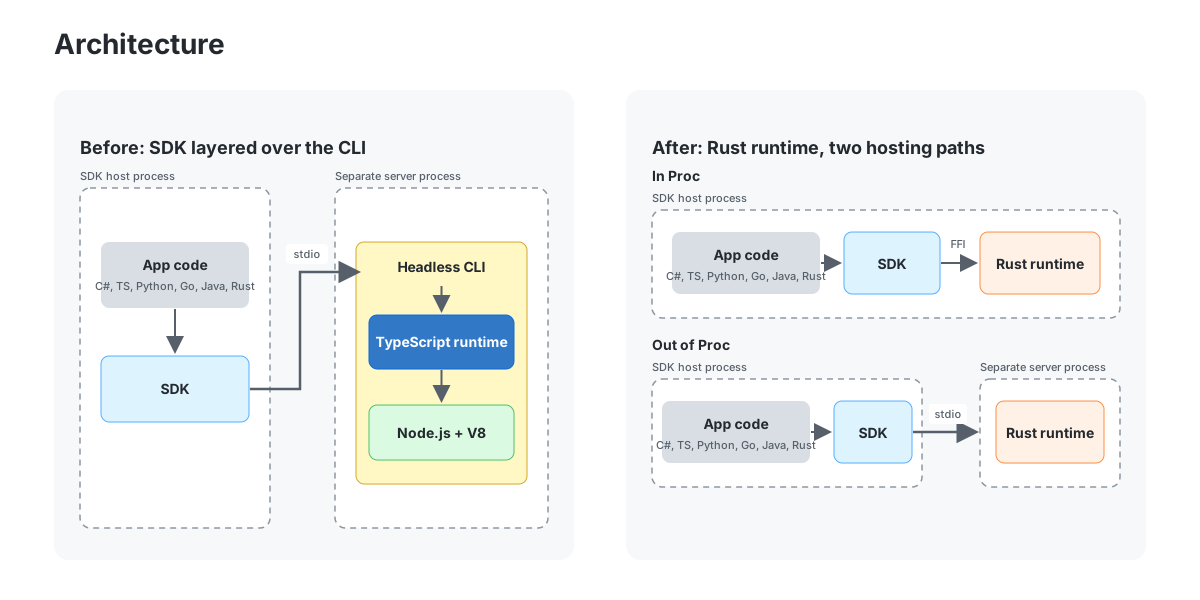
For years, the idea of rewriting a critical piece of infrastructure using the very tool designed to assist with that infrastructure seemed like a paradox rather than a plan. The GitHub Copilot agent runtime, a massive codebase spanning roughly eight hundred thousand lines, was previously built in Python and JavaScript. In the traditional development lifecycle, such a migration would have been a multi-year endeavor, fraught with the risk of introducing regressions and requiring a massive, dedicated team of engineers to manually refactor every line. Before the emergence of autonomous agents, this scale of rewriting was simply not affordable in terms of time, risk, or resources.
The decision to attempt this port wasn't just a technical exercise; it was a test of whether modern AI agents could handle the nuance of enterprise-grade software architecture. The goal was to move the runtime to Rust, a language chosen for its memory safety and performance guarantees, but the path was anything but straightforward. It required the agents to not only understand the existing logic but to translate idioms, refactor complex dependencies, and ensure that the new implementation behaved identically to the old one under every conceivable scenario. It was a high-stakes gamble on the maturity of AI coding assistants in production environments.
The process revealed both the immense potential and the lingering gaps in current AI capabilities. While the agents excelled at generating boilerplate, handling data structures, and applying Rust's strict type system, they frequently struggled with the deep, contextual understanding required for legacy codebases. Human engineers remained essential not to write the code, but to act as the conductors of the orchestra, reviewing agent-generated diffs, resolving ambiguities in complex state machines, and making architectural decisions that required a broader view than the local context window allowed. The collaboration became a feedback loop where the AI proposed solutions and the human validated intent.
Once the migration hit a critical mass, the results were undeniable. The new Rust implementation delivered significant performance improvements, reducing latency and resource consumption in ways that Python simply could not match. More importantly, the migration itself validated a new paradigm for software development: using AI agents to automate the most tedious and risky parts of large-scale refactoring. What was once a bottleneck is now a scalable capability, allowing teams to modernize their stacks with a fraction of the historical effort.
This shift marks a turning point in how we approach software evolution. We are moving away from the era where every line of code had to be meticulously hand-crafted by human experts to the era where humans guide intelligent agents to build robust systems. The eight hundred thousand lines of Rust code sitting in production today are not just a technical achievement; they are a declaration that the future of development is a partnership between human intent and machine execution, making the impossible merely a matter of patience and the right tools.
On Bluesky? Meet HomeSky.
Follower analytics, a growth toolkit, scheduling and AI posting — built for Bluesky. Connect your account and use everything free for 60 days.
Try HomeSky free →