Migrating the GitHub Copilot runtime to Rust, using Copilot
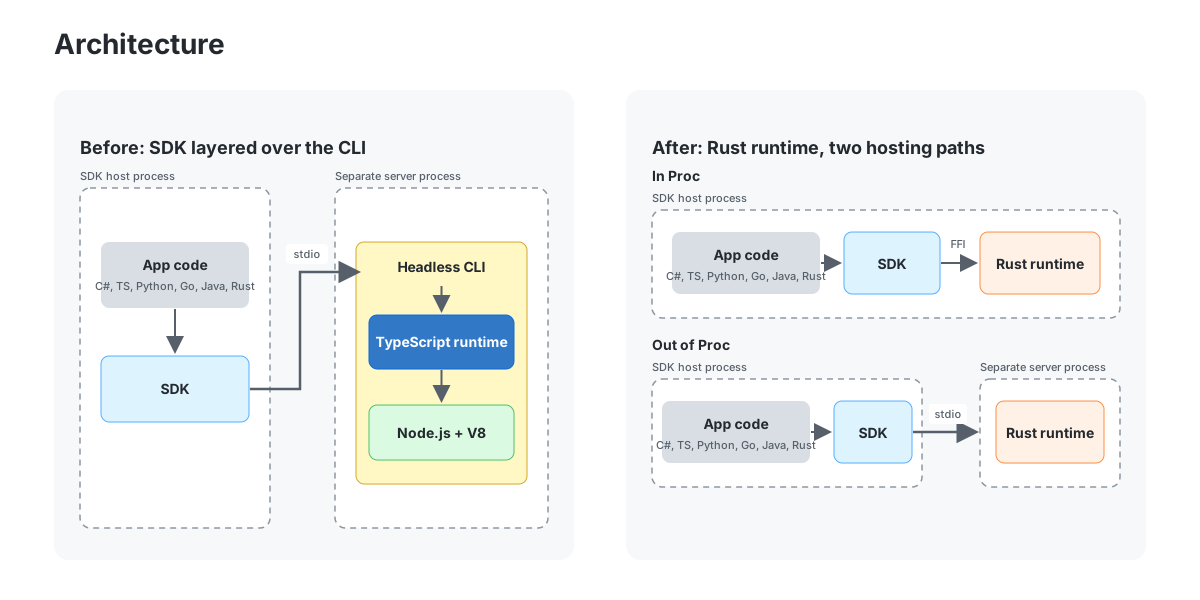
There was a time when rewriting a core service was a high-stakes gamble, reserved only for companies with infinite runway and armies of engineers. For the GitHub Copilot runtime, a system underpinned by 800,000 lines of production code, the decision to migrate from a legacy stack to Rust wasn't just a technical preference; it was a strategic necessity to improve performance and reliability. Yet, in the world of software engineering, this massive undertaking remained economically unfeasible until the arrival of AI agents. The sheer volume of boilerplate, the intricate dependencies, and the subtle bugs hidden in decades of code created a wall that traditional manual refactoring could not easily breach.
Before the current generation of coding assistants, the cost of such a rewrite was prohibitive. It would have required a dedicated team for years, navigating the labyrinth of existing logic with the constant fear of introducing regressions. The risk of breaking the delicate balance between the agent's reasoning and the underlying execution engine was too high. However, the integration of Copilot itself into the migration process changed the economics of the operation entirely. What was once a multi-year project became a manageable sprint, as the very tool being rebuilt could help build itself. This created a recursive loop where the new codebase was not just being written from scratch, but was being iteratively improved and verified by the intelligence it was designed to run.
The transition was not without its unique challenges, primarily the tension between the expressive power of Rust and the sometimes opaque nature of the original logic. Porting such a large codebase requires a deep understanding of the "why" behind every function, not just the "how." The team had to translate not only syntax but also architectural intent, ensuring that the safety guarantees of Rust were applied without sacrificing the fluidity of the agent's workflow. There were moments where the compiler refused to accept a translation that made semantic sense in the old language, forcing a redesign of data structures to fit Rust's strict ownership model. These friction points were where the real engineering value was extracted, turning potential debt into robust, type-safe foundations.
What makes this migration particularly fascinating is the meta-narrative of using an AI agent to rewrite itself. It is a glimpse into a future where software evolution is accelerated by the very intelligence it generates. The process validated the hypothesis that AI agents can handle complex, large-scale system rewrites with a level of context and consistency that human teams struggle to maintain alone. It demonstrated that the barrier to entry for massive refactoring is not just intellectual capacity, but the efficiency of the tools available to execute that capacity.
Ultimately, rewriting the Copilot runtime in Rust was about more than just swapping languages; it was about securing the future of a platform that relies on speed and precision. By leveraging Copilot to navigate the 800,000 lines of code, the team proved that the dream of self-improving software is not science fiction, but an attainable engineering reality. The result is a system that is faster, safer, and built on a foundation that can evolve alongside the demands of developers worldwide. This migration stands as a testament to the changing landscape of software development, where the tools we use are as powerful as the problems they solve.
On Bluesky? Meet HomeSky.
Follower analytics, a growth toolkit, scheduling and AI posting — built for Bluesky. Connect your account and use everything free for 60 days.
Try HomeSky free →