Migrating the GitHub Copilot runtime to Rust, using Copilot
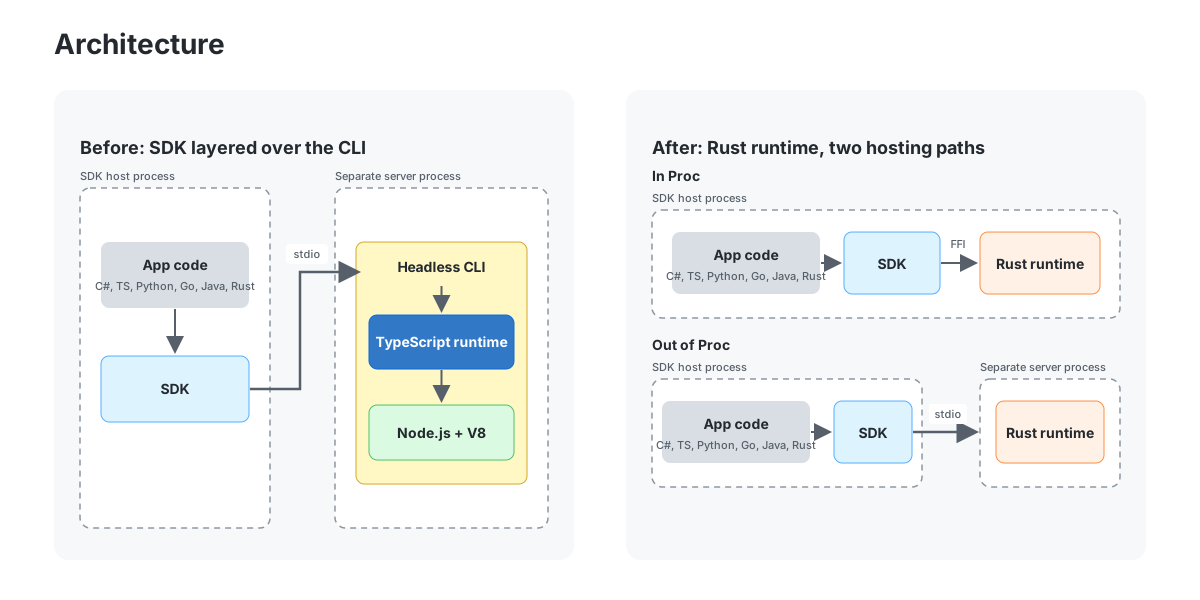
Porting the GitHub Copilot runtime to Rust was never just an exercise in language translation; it was a fundamental restructuring of how we approach the reliability of AI agents. For years, the idea of rewriting a system as massive as the Copilot backend—spanning roughly 800,000 lines of production code—seemed like a logistical impossibility. The sheer volume of logic, the intricate state machines governing code generation, and the delicate dance between LLM inference and editor feedback created a technical debt that felt too heavy to lift without a complete platform overhaul. Before the advent of sophisticated AI agents, this rewrite would have been prohibitively expensive, requiring armies of engineers and years of iterative refactoring that threatened to break the very product it was meant to improve.
The catalyst for this monumental shift was the realization that the original architecture, built on a different runtime, was becoming a bottleneck for the very agents it sought to empower. As Copilot evolved from a simple code-completion tool into a sophisticated agent capable of understanding context, editing files, and executing complex workflows, the underlying infrastructure needed to match that ambition. Rust offered the solution not merely because of its performance characteristics or memory safety guarantees, but because it provided a deterministic environment where the agent's logic could be reasoned about with mathematical precision. In a world of probabilistic AI, having a rock-solid, crash-proof runtime became the most critical feature of the system.
The process of actually executing this migration was a study in modern engineering efficiency, made possible only by leveraging Copilot itself to build Copilot. It is a recursive paradox that highlights the maturity of the current generation of developer tools: the AI agent was used to generate the code required to migrate the AI runtime. By feeding the existing Python implementation into the new Rust-based Copilot environment, the system could autonomously generate the equivalent Rust logic, translate complex data structures, and even draft the migration scripts needed to swap out the old runtime. What once would have taken a team of senior engineers months of manual refactoring was accelerated by having the agent perform the heavy lifting, effectively using the solution to solve itself.
However, automation alone could not carry a project of this scale. The transition demanded a rigorous validation strategy where human oversight was woven into the automated pipeline. Every generated function, every state transition, and every integration point had to be scrutinized to ensure that the semantic meaning of the original logic was preserved. The challenge was not just getting the code to compile, but ensuring that the agent's behavior remained consistent, safe, and compliant with the strict standards required for a production environment serving millions of developers. This required a deep understanding of both the source and target languages, as well as the unique nuances of the Copilot ecosystem.
The result is a system that is faster, safer, and more maintainable than its predecessor, proving that the convergence of AI and high-performance computing is not just a theoretical ideal but a practical reality. By rewriting the runtime in Rust, the team has removed the fragility that often plagues complex AI systems, allowing the agent to focus entirely on its primary job: helping developers write better code. The success of this migration stands as a testament to the power of using advanced tools to solve the problems inherent in those same tools, setting a new precedent for how large-scale infrastructure should be modernized in the age of AI.
On Bluesky? Meet HomeSky.
Follower analytics, a growth toolkit, scheduling and AI posting — built for Bluesky. Connect your account and use everything free for 60 days.
Try HomeSky free →