Migrating the GitHub Copilot runtime to Rust, using Copilot
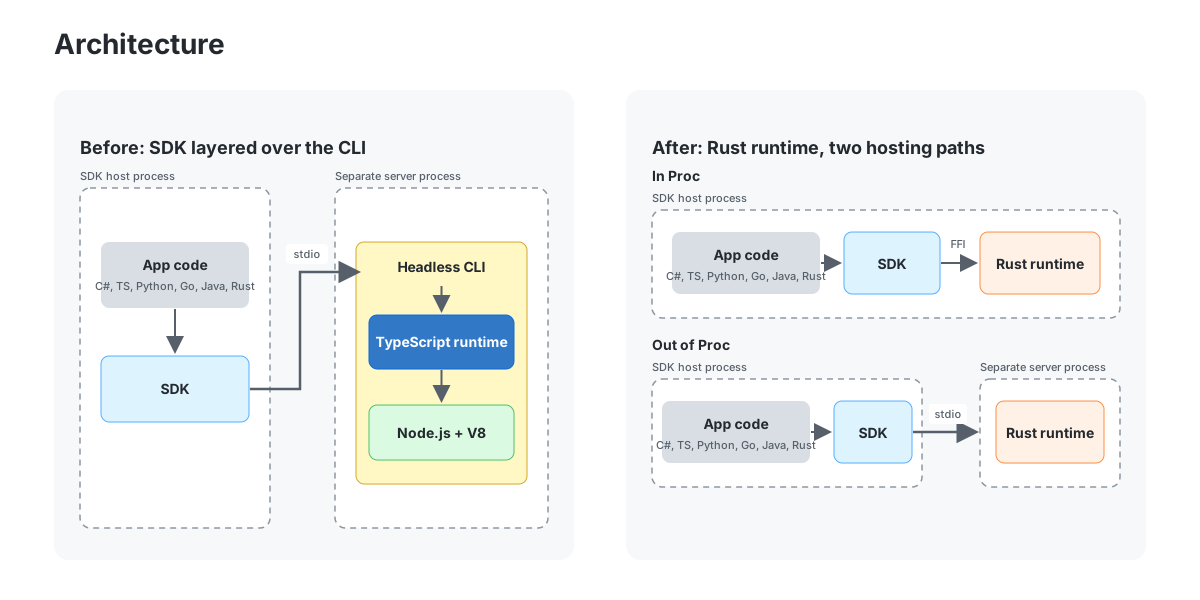
For decades, the act of rewriting a massive codebase was a logistical nightmare reserved for teams with armies of engineers and months of downtime. Before the arrival of AI agents, porting a critical system like the GitHub Copilot runtime from a legacy language to modern Rust would have required a manual, line-by-line translation that was both prohibitively expensive and fraught with human error. The sheer volume of code, sitting somewhere around 800,000 lines of production-grade logic, made the old way simply unaffordable. We were stuck in a cycle where maintaining the old stack was a burden, but touching it was a risk too high to calculate.
The shift to Rust was not just a change in syntax; it was a fundamental restructuring of how the runtime handles memory, safety, and performance. Rust demands a different mindset, one where the compiler acts as a strict guardian against the kinds of runtime errors that once plagued the system. Yet, attempting to map millions of lines of human-written code into a language that enforces such rigorous ownership rules manually was an exercise in futility. The cognitive load required to ensure every borrow checker constraint was met by hand would have stalled progress before it even began. We needed a way to leverage the very intelligence we were building to build itself.
This is where the irony and the brilliance of the migration converge: we used Copilot to help migrate Copilot. By feeding the AI agent the existing codebase and asking it to generate the Rust equivalents, we turned an impossible manual task into a collaborative engineering sprint. The agent didn't just write boilerplate; it understood the context, the data structures, and the specific architectural patterns required for the Copilot runtime. It generated thousands of functions and complex logic flows that adhered to Rust's strict typing and safety guarantees, effectively acting as a force multiplier that allowed a smaller team to execute a rewrite that would have taken a large team years.
However, generating the code was only the first hurdle. The real work lay in the rigorous verification that followed. The AI could propose solutions, but humans had to validate them. We established a rigorous feedback loop where the agent generated code, we reviewed it against our internal standards, and then fed the corrections back to refine its future outputs. It was a dance between machine generation and human oversight, ensuring that the resulting 800,000 lines were not just syntactically correct but also semantically identical to the original functionality. This hybrid approach allowed us to move at a speed that defies traditional software engineering timelines while maintaining the quality bar that users of GitHub Copilot expect.
The outcome is a runtime that is faster, safer, and more reliable than ever before. By embracing the capabilities of AI agents to tackle the very systems they power, we have broken the bottleneck that had held us back for years. This migration proves that the future of large-scale software development isn't about replacing engineers with tools, but about empowering them with tools that can handle the sheer scale of complexity that modern computing demands. The rewrite is complete, the code is running in Rust, and the cycle of continuous improvement has just accelerated into a new gear.
On Bluesky? Meet HomeSky.
Follower analytics, a growth toolkit, scheduling and AI posting — built for Bluesky. Connect your account and use everything free for 60 days.
Try HomeSky free →