Migrating the GitHub Copilot runtime to Rust, using Copilot
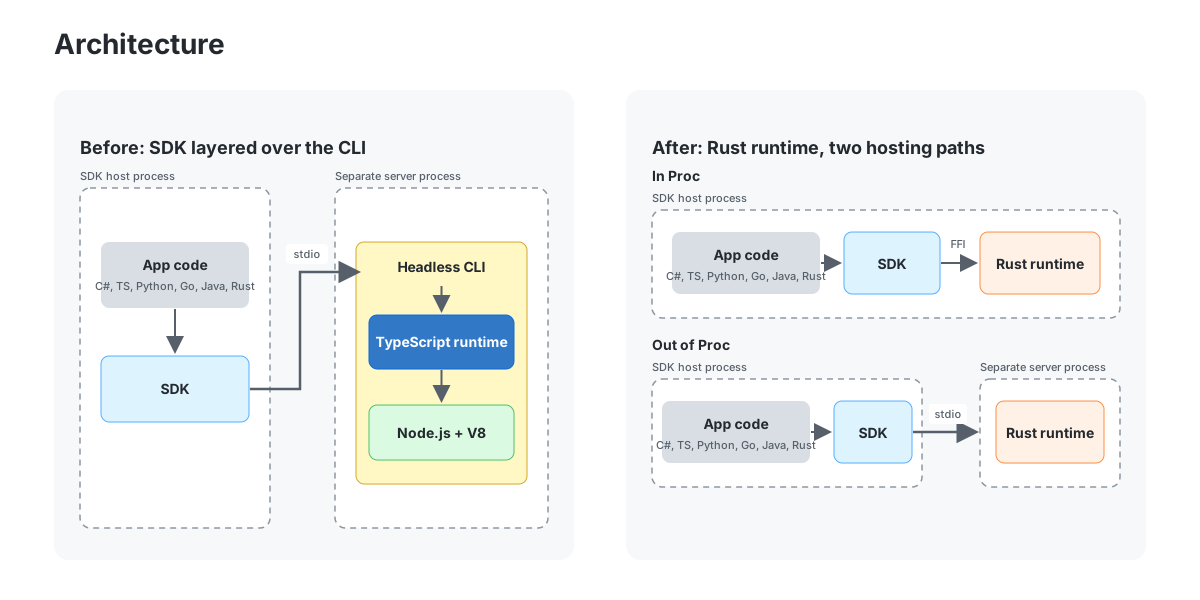
For years, the idea of rewriting the GitHub Copilot runtime in Rust was dismissed as a pipe dream, a vanity project born of hype rather than necessity. The sheer scale of the codebase, stretching across hundreds of thousands of lines, combined with the intricate dependencies of the agent logic, made the cost-benefit analysis seem overwhelmingly negative. It wasn't until the advent of AI agents fundamentally shifted the paradigm that the math finally balanced. We needed a system that was not just fast, but resilient enough to handle the unpredictable, high-frequency demands of an intelligent coding assistant, and Rust offered the memory safety and concurrency model that dynamic languages simply could not provide without significant overhead.
The challenge wasn't merely about swapping syntax; it was about reconstructing a complex cognitive engine from the ground up. Porting this massive undertaking required a level of precision and architectural foresight that traditional refactoring could never achieve. The team had to disentangle the legacy logic, ensuring that every decision tree and inference path remained intact while translating them into a type-safe environment. It was a monumental task of translation, where the nuances of natural language processing had to be preserved in a language that demands strict adherence to data structures and ownership rules, turning what was once a fluid, mutable state into a rigid, verifiable system.
What made this migration truly unique was the tool we used to build the new version: Copilot itself. It feels almost paradoxical to have an AI agent assist in the creation of its own infrastructure, yet that circular dependency was the key to our efficiency. By leveraging the very runtime we were building, the developers were able to generate boilerplate, debug complex interactions, and prototype new features in real-time. This created a feedback loop where the agent learned from its own execution, refining its suggestions and the underlying Rust code simultaneously, effectively bootstrapping the modernization effort in a way that manual coding could never have accomplished.
The result is a system that feels lighter, faster, and more secure than ever before. The transition to Rust eliminated entire classes of runtime errors that had plagued the previous implementation, providing a safety net that allows the agent to operate with greater confidence and speed. For users, this means fewer interruptions, more reliable suggestions, and a seamless experience that underpins the trust users place in their AI pair programmer. Behind the scenes, the architecture has been hardened, capable of scaling to handle the increasing complexity of codebases without the fear of memory leaks or race conditions that once threatened stability.
Looking back, the journey highlights a broader truth about the evolution of software engineering: the tools we build today often shape the way we build tomorrow. The migration wasn't just a technical upgrade; it was a necessary evolution to keep pace with the growing expectations of developer productivity and system reliability. By tackling this rewrite, we demonstrated that even the most entrenched systems can be modernized with the right strategy and the right tools, proving that the future of software is both incredibly fast and remarkably safe.
On Bluesky? Meet HomeSky.
Follower analytics, a growth toolkit, scheduling and AI posting — built for Bluesky. Connect your account and use everything free for 60 days.
Try HomeSky free →