Migrating the GitHub Copilot runtime to Rust, using Copilot
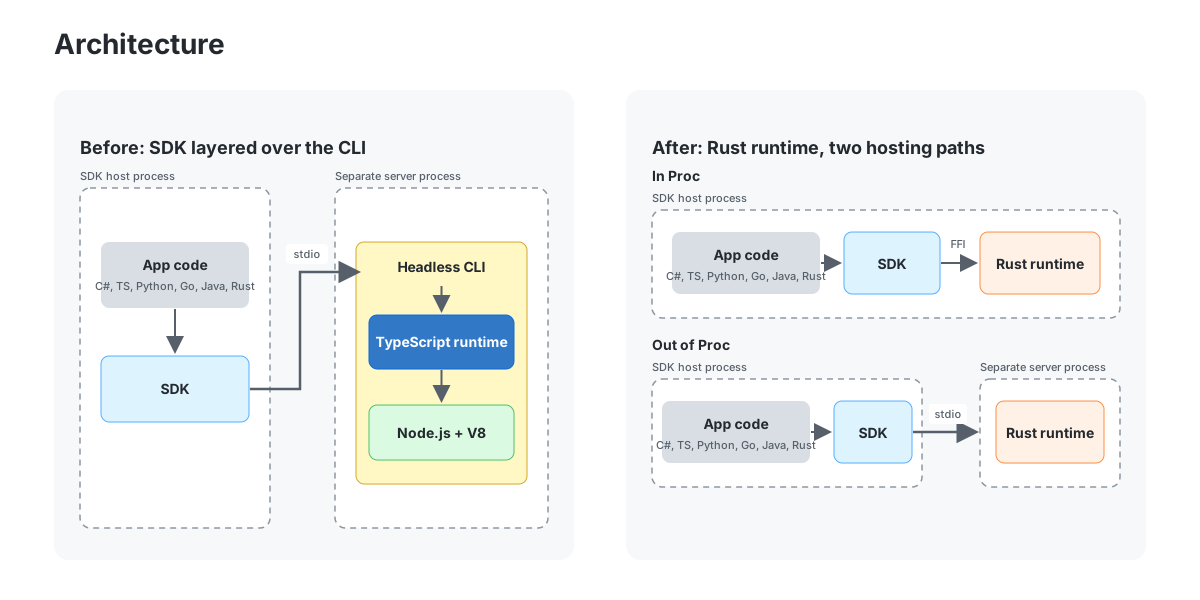
Before the rise of autonomous agents, rewriting a system of this magnitude was not just a logistical nightmare; it was a financial impossibility. The GitHub Copilot runtime, a complex beast powering code suggestions for millions of developers, stood as a monolithic structure that simply could not be refactored by hand. It wasn't merely about updating code libraries; it was about surviving the inevitable performance cliffs and security vulnerabilities that come with maintaining a legacy codebase built on outdated paradigms. We faced a choice: accept the technical debt or find a way to rebuild the foundation while the engine was still running.
The decision to port the runtime to Rust was driven by a need for memory safety and concurrency that previous languages simply could not guarantee at that scale. However, the sheer volume of code—nearly 800,000 lines of production logic—made the task daunting. It was a scenario where traditional human effort would have taken years, potentially costing more than the system was worth. We needed a new approach, one that could leverage the very AI technology we were building to execute the migration itself. This created a recursive problem: using the agent to write the code that would allow the agent to function better.
We decided to treat the migration not as a manual task, but as a problem to be solved by the system itself. By feeding the Rust agent into the existing logic, we created a feedback loop where the AI analyzed the current implementation, generated Rust equivalents, and validated the output against the original behavior. It was a high-stakes gamble where the cost of failure was a broken build for every developer on the platform. Yet, the potential reward was a runtime that was faster, safer, and fundamentally more reliable than what came before.
The process was far from linear, filled with moments where the generated code broke in ways that no human could have predicted in a single pass. The AI would occasionally hallucinate correct-looking syntax that failed under edge-case loads, requiring human intervention to prune the logic and guide the next iteration. This wasn't a "set it and forget it" deployment; it was a dance between the machine's speed and the engineer's intuition, constantly refining the output until the logic held up under scrutiny. Each successful refactor was a small victory in a marathon of rewrites.
Ultimately, the migration demonstrated that the barrier to large-scale system rewrites had shifted. What was once an insurmountable wall of code became a manageable stream of data when the right tools were applied. The result is a Rust-based runtime that powers Copilot with greater efficiency and resilience, proving that the future of software engineering lies in collaboration between human intent and machine execution. We didn't just rewrite the code; we redefined the limits of what a single development team could achieve in a single sprint.
On Bluesky? Meet HomeSky.
Follower analytics, a growth toolkit, scheduling and AI posting — built for Bluesky. Connect your account and use everything free for 60 days.
Try HomeSky free →