Migrating the GitHub Copilot runtime to Rust, using Copilot
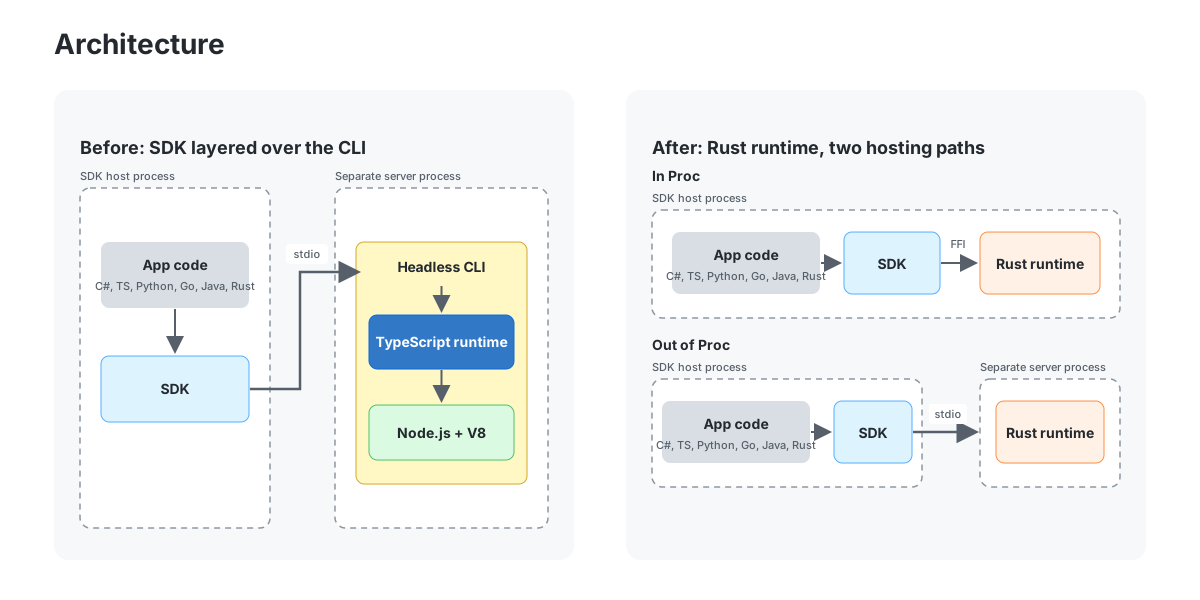
There was a time when rewriting a system of 800,000 lines of code was a multi-year endeavor requiring a dedicated team of senior engineers and a budget that could break a mid-sized department. Before the rise of AI agents, such a massive migration was considered an unaffordable risk, a project where the cost of failure often outweighed the benefits of modernization. The prevailing wisdom was that legacy code should be left to rot until it became so fragile that a rewrite was inevitable, rather than attempted with such a high bar for perfection.
That era of caution has shifted dramatically, largely because we finally possess the tools to inspect, understand, and refactor codebases at a scale previously thought impossible. The migration of the GitHub Copilot runtime to Rust serves as the definitive proof point for this new reality. By leveraging AI agents to handle the heavy lifting of translation and verification, a team was able to tackle a monolithic codebase with confidence, turning what would have been a decade-long struggle into a focused, manageable engineering campaign.
The technical challenge was not merely about swapping syntax; Rust demands a level of memory safety and concurrency discipline that is radically different from the dynamic languages previously used. The runtime had to be rebuilt from the ground up, ensuring that every interaction with the underlying models remained robust, type-safe, and performant. Porting this specific agent architecture required a deep understanding of both the existing logic and the strictures of the Rust ecosystem, demanding a precision that human effort alone could rarely sustain across such a vast surface area.
What makes this migration truly significant is the feedback loop it created during development. Rather than guessing at how to translate complex business logic, the AI agents acted as real-time co-pilots, suggesting implementations and immediately highlighting potential edge cases. This allowed the engineering team to focus on architectural decisions and correctness rather than getting bogged down in the minutiae of boilerplate, effectively accelerating the velocity of a project that was once the definition of slow and difficult.
The result is a system that is not only faster and safer but also easier to maintain in the long run. Rust's strict ownership model has eliminated entire classes of runtime errors that plagued the previous implementation, leading to a more reliable foundation for Copilot's daily operations. This success story validates the notion that AI agents are not just for generating snippets of code, but are essential tools for orchestrating massive, systemic changes that define the future of software infrastructure.
As we look toward the next generation of software development, the boundary between what is humanly feasible and what is technically possible continues to blur. The ability to rewrite hundreds of thousands of lines of code with the assistance of intelligent agents suggests that the next great leap forward will not be in writing new code, but in the audacity to rewrite the old. The Copilot runtime migration stands as a testament to that shift, proving that the future of large-scale engineering is already here.
On Bluesky? Meet HomeSky.
Follower analytics, a growth toolkit, scheduling and AI posting — built for Bluesky. Connect your account and use everything free for 60 days.
Try HomeSky free →