Migrating the GitHub Copilot runtime to Rust, using Copilot
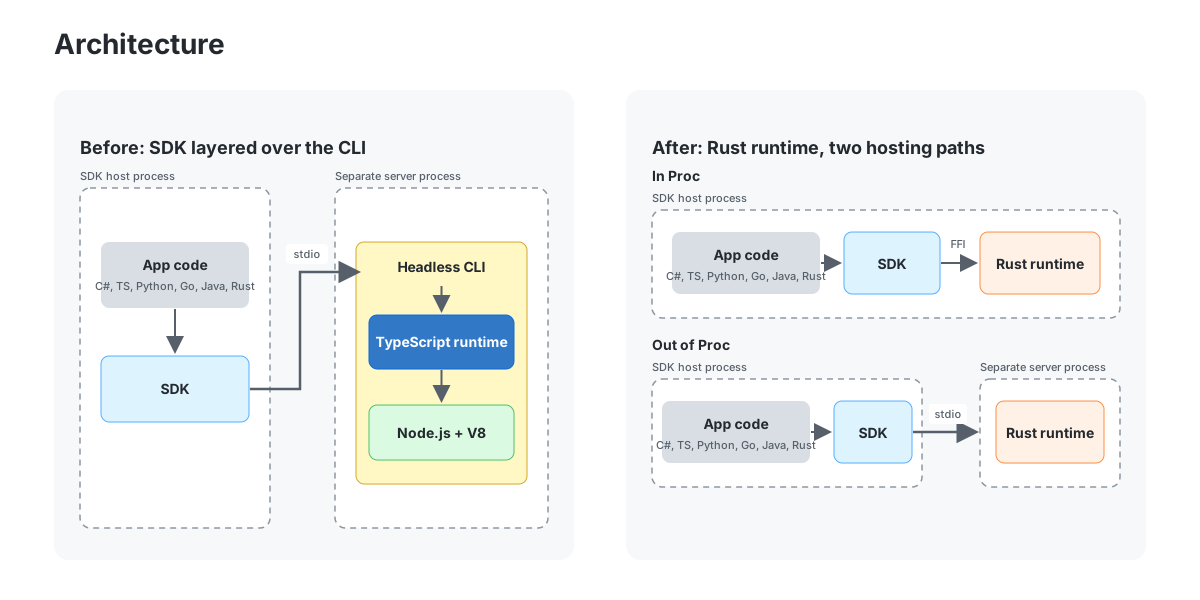
A rewrite of this magnitude was never economically viable until the advent of intelligent agents. For years, the idea of porting the GitHub Copilot agent runtime to Rust, a language spanning roughly 800,000 lines of production code, sounded like a fool's errand. The sheer volume of legacy C++ and Go code represented a debt of engineering hours that no team could justify paying off with manual labor. We were staring down a wall of technical debt so high that the only logical move seemed to be maintaining the status quo, accepting the bloat and the performance penalties as the cost of doing business.
That calculus changed completely when we turned the very tool we were building against the problem of building itself. By leveraging Copilot's agent capabilities, we shifted the paradigm from human-driven refactoring to a collaborative, automated evolution. It wasn't magic; it was a highly orchestrated feedback loop where the agent understood the architectural intent and executed the translation with a precision that would have taken a dozen senior engineers months to replicate. We watched as lines of complex memory management logic in C++ were systematically dismantled and rebuilt in Rust's strict type system, all guided by an intelligence that could contextualize the entire codebase rather than just isolated functions.
The journey revealed that the barrier wasn't just syntax; it was the deep, implicit knowledge required to make the new runtime safe and efficient. Rust demands a level of foresight regarding concurrency and memory safety that C++ often leaves to runtime checks. Our agent had to learn not just how to write Rust, but how to write safe Rust within the specific constraints of the Copilot architecture. This required a level of semantic understanding that goes beyond simple pattern matching, forcing the agent to reason about data flow and potential race conditions before a single line of code was committed.
What emerged from this process was a system that is leaner, faster, and significantly more reliable than its predecessor. The migration wasn't just a translation of code; it was an opportunity to refactor decades of accumulated technical debt into a modern, expressive foundation. The result is a runtime that boots faster, consumes less memory, and offers a more robust foundation for the future of AI-assisted development. It stands as a testament to what can be achieved when human strategy and machine execution align perfectly, turning an impossible timeline into a matter of weeks.
This experiment fundamentally alters how we approach large-scale software evolution. It proves that for massive, monolithic rewrites, the human role is shifting from the primary coder to the architect and the editor. We provide the vision, the constraints, and the final sign-off, while the agent handles the heavy lifting of the transformation. As we look ahead, this capability opens the door to reimagining other critical infrastructure projects, suggesting that the next generation of software will be written not by individuals typing at keyboards, but by teams orchestrating intelligent agents to build the systems of tomorrow.
On Bluesky? Meet HomeSky.
Follower analytics, a growth toolkit, scheduling and AI posting — built for Bluesky. Connect your account and use everything free for 60 days.
Try HomeSky free →