Migrating the GitHub Copilot runtime to Rust, using Copilot
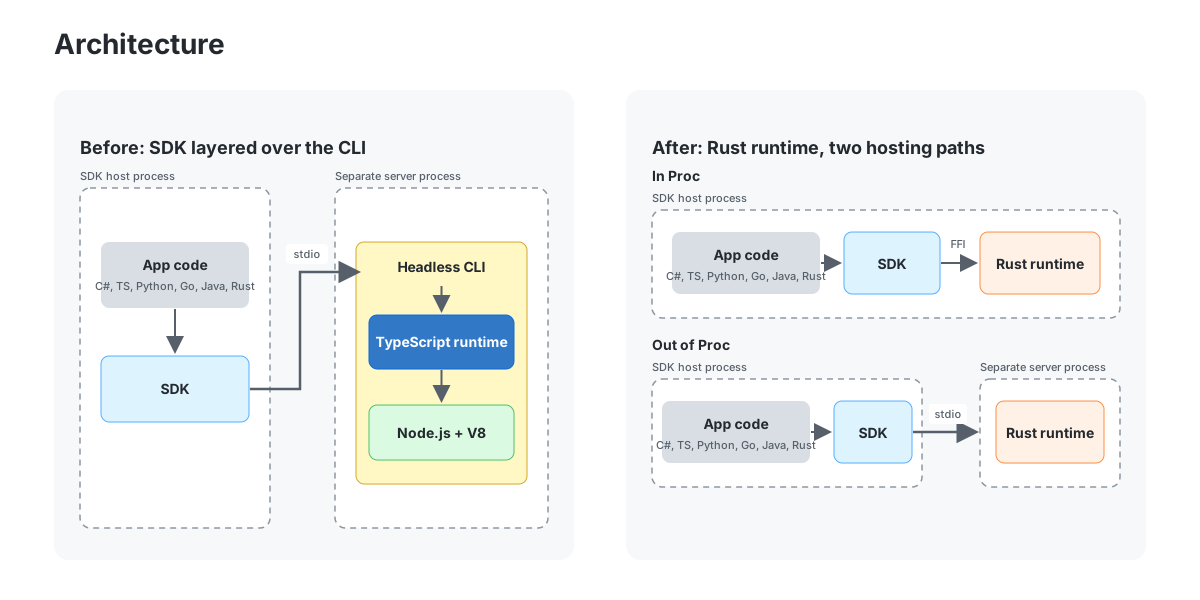
A rewrite of this magnitude was simply not affordable until the arrival of agent-driven development. For years, the engineering team behind GitHub Copilot lived in the shadow of legacy code, a sprawling ecosystem of 800,000 lines of Python that governed the very intelligence we were trying to build. Maintaining this monolith required a relentless cycle of patching and refactoring, where every new feature demanded a careful extraction of logic from the fragile, interconnected tangle of existing scripts. The cost of change was too high; the risk of breaking the core inference loop made any attempt at a full-scale migration feel like a suicide mission for the product.
Then came the shift in how we approached software construction, moving from a model of static compilation to one of autonomous collaboration. We realized that the tool we had built to help developers write code could also be the primary instrument for rewriting the tool itself. By deploying Copilot agents within the development environment, we were able to orchestrate a complex, multi-step migration strategy that no human team could have executed alone. These agents didn't just suggest lines of text; they understood the architectural implications of moving logic from Python to Rust, analyzing dependencies, and mapping out the intricate data flows required to preserve the model's behavior.
The transition to Rust was not merely a language swap; it was a fundamental restructuring of the runtime's memory management and concurrency models. Python's dynamic typing and interpreted nature provided speed of development but introduced latency and memory overhead that were unacceptable for a high-performance inference engine. Rust's strict ownership system and zero-cost abstractions offered a pathway to a leaner, more efficient binary, but the cost of porting was immense. The agents had to navigate the treacherous waters of unsafe blocks, ensuring that every pointer arithmetic operation was verified against the original Python logic, effectively acting as a real-time safety net during the most dangerous phases of compilation.
What emerged from this process was a runtime that was not only faster but also more resilient. The Rust version eliminated garbage collection pauses that had previously caused micro-stutters in the user experience, resulting in a smoother, more responsive interaction for developers relying on Copilot. The performance gains were measurable and immediate, reducing inference times significantly while lowering the resource footprint on the server side. This efficiency allowed us to scale the service to handle millions of concurrent requests without the infrastructure overhead that had previously constrained our growth.
The broader implication of this migration extends beyond the immediate performance metrics; it represents a new paradigm in software engineering where the boundary between developer and tool blurs completely. We are no longer waiting for the next language or framework to solve our problems; we are using the tools we have built to evolve the very foundation of our platform. This successful port demonstrates that the future of large-scale software maintenance lies in leveraging AI not just as an assistant, but as a primary architect capable of understanding and transforming complex, legacy systems with precision and foresight.
On Bluesky? Meet HomeSky.
Follower analytics, a growth toolkit, scheduling and AI posting — built for Bluesky. Connect your account and use everything free for 60 days.
Try HomeSky free →