Migrating the GitHub Copilot runtime to Rust, using Copilot
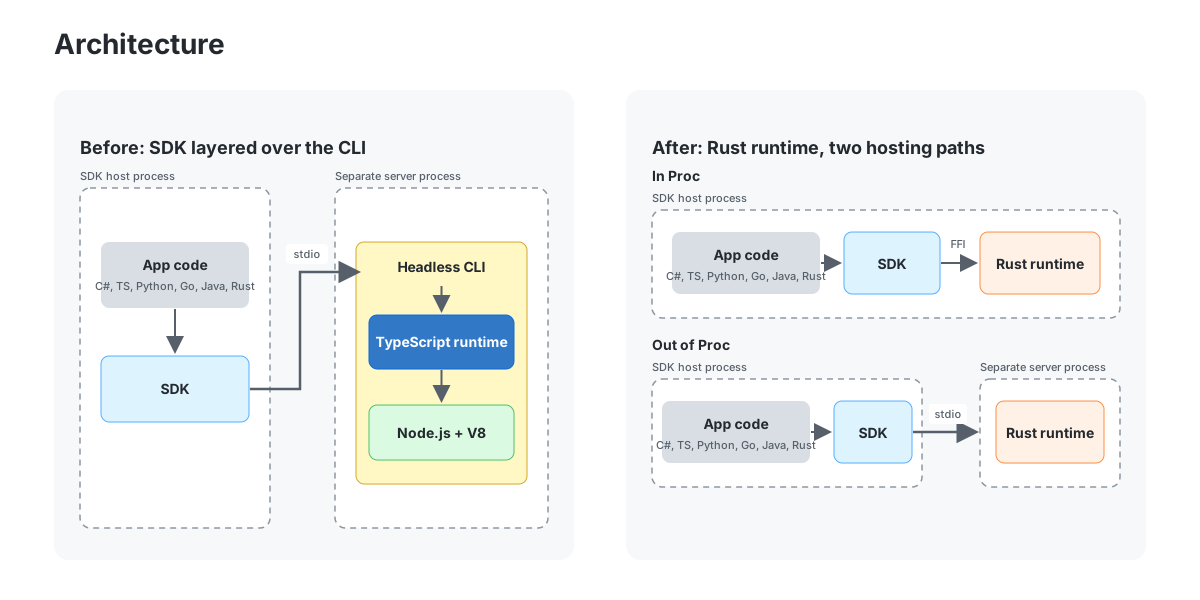
Before the rise of autonomous agents, the idea of rewriting a massive codebase while simultaneously generating the new code was a logistical impossibility. We were stuck with the ancient, painful ritual of reading every line of legacy documentation, manually tracing dependencies, and praying the compiler wouldn't bite us at the 14th iteration. The GitHub Copilot runtime, a sprawling beast of 800,000 lines of Python logic, represented the pinnacle of that old world. It was fragile, slow, and deeply entangled, yet it powered the future of software development for millions.
The decision to migrate this system to Rust wasn't just about performance or memory safety; it was a strategic necessity to survive the scaling challenges of modern AI. Python, while rapid to prototype, chokes under the weight of high-concurrency inference required by a global AI assistant. We needed a runtime that could handle millions of requests per second without leaking memory or crashing under load. Rust offered that stability, but the cost was a daunting mountain of manual labor that simply didn't exist in our budget or timeline.
Enter Copilot. The irony of using an AI to rewrite the codebase that powers itself is almost cinematic, but the execution was far messier. We didn't just ask Copilot to "translate this file"; we had to orchestrate a complex feedback loop where the agent analyzed the Python semantics, generated Rust equivalents, verified them against our internal test suites, and then iterated on failures. It required a custom scaffolding of prompts and validation scripts to ensure the agent understood not just syntax, but the specific architectural patterns of the Copilot engine.
The results were staggering, yet the process revealed the limitations of current AI reasoning. There were moments where Copilot confidently generated perfect-looking Rust code that failed to compile because it misunderstood a subtle context variable. We found ourselves in a constant dance of correcting the agent's hallucinations, teaching it our specific style guides, and manually merging conflicts that the AI couldn't resolve on its own. It wasn't a one-button magic wand; it was a rigorous, multi-week engineering sprint where human oversight remained critical even as the machine did the heavy lifting.
Ultimately, this migration proves that while AI agents can accelerate the most arduous tasks in software history, they cannot fully replace the need for deep architectural understanding. The rewrite succeeded because we treated Copilot as a highly skilled junior engineer who needs constant mentorship, rather than a god-like oracle. The resulting Rust runtime is faster, leaner, and more robust, but the journey to get there required a blend of human intuition and machine speed that defines the next era of development.
On Bluesky? Meet HomeSky.
Follower analytics, a growth toolkit, scheduling and AI posting — built for Bluesky. Connect your account and use everything free for 60 days.
Try HomeSky free →