Migrating the GitHub Copilot runtime to Rust, using Copilot
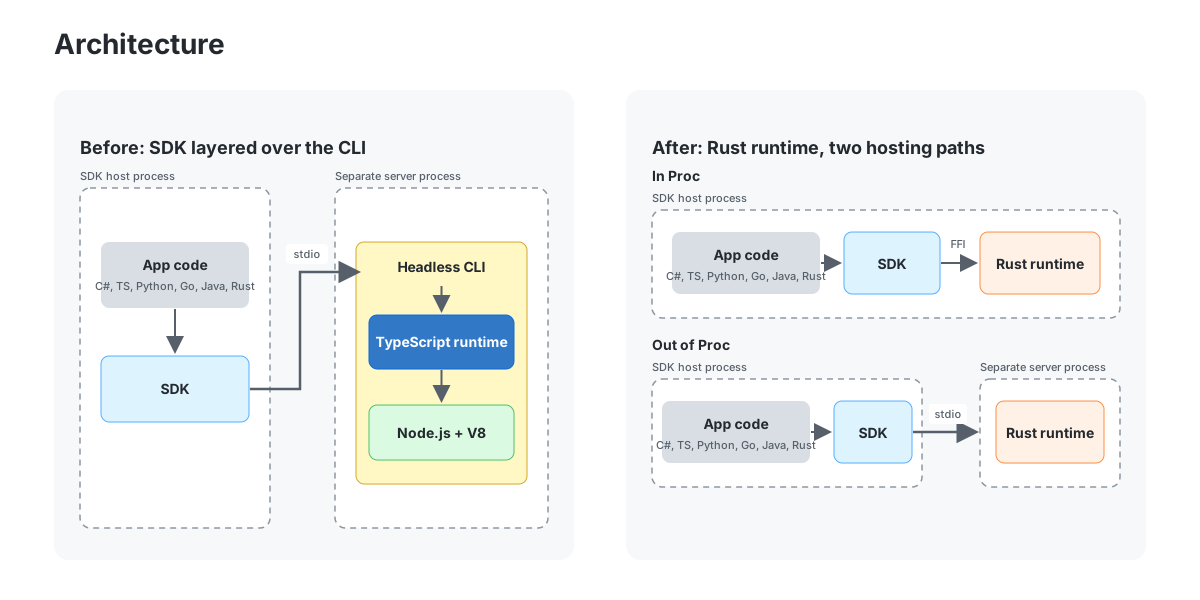
For years, the prospect of rewriting the GitHub Copilot agent runtime in Rust felt like a logistical impossibility. The sheer volume of logic, spanning 800,000 lines of production code, represented a mountain that seemed to grow higher with every attempt at a manual refactor. Before the arrival of autonomous agents, this migration was simply not affordable; the human cost in terms of engineering hours and opportunity loss far outweighed the theoretical benefits of memory efficiency and execution speed.
The turning point came when we asked the very tool we were building to help us build itself. By leveraging the Copilot agent to guide the porting process, we transformed a project that would have taken a team years into a disciplined, iterative journey. It wasn't magic, exactly, but it was the application of immense computational leverage to a problem that had long resisted human-only solutions, allowing the agent to handle the drudgery of syntax translation while we focused on architectural integrity.
The challenge of moving from a higher-level language to Rust is unique because it demands a rigorous attention to ownership and memory safety that simply does not exist in the previous implementation. Every data structure had to be reimagined to fit the borrow checker's strict rules, and the fear of introducing undefined behavior was a constant shadow. However, the agent's ability to generate candidate code variations meant we could validate safety invariants across the entire codebase without manually inspecting every single pointer dereference, a task that would have been insurmountable for a human team.
Performance metrics tell the story of the payoff. The resulting Rust runtime offers significantly lower latency in inference loops and a more predictable memory footprint, which is critical for the real-time nature of code completion. Yet, the true victory isn't found just in the benchmarks. It is in the confidence that the system can scale to support the next generation of AI features without the constant threat of a memory leak silently corrupting user sessions, a stability that Rust enforces by design.
This migration also serves as a case study in how the tools we build can evolve to become their own architects. It challenges the traditional notion that major infrastructure overhauls require a complete stoppage of development and a mobilization of massive human resources. Instead, we demonstrated that intelligent automation can act as a force multiplier, enabling a single focused effort to achieve what previously required a full department's attention.
Ultimately, porting the Copilot runtime to Rust was less about writing better code and more about writing code that allows us to do better things. It proved that the boundary between human ingenuity and machine efficiency is porous, provided we have the right frameworks to bridge them. As we continue to push the limits of what AI can do for developers, the foundation of our own tools must be as robust and efficient as the work we are trying to assist.
On Bluesky? Meet HomeSky.
Follower analytics, a growth toolkit, scheduling and AI posting — built for Bluesky. Connect your account and use everything free for 60 days.
Try HomeSky free →