Migrating the GitHub Copilot runtime to Rust, using Copilot
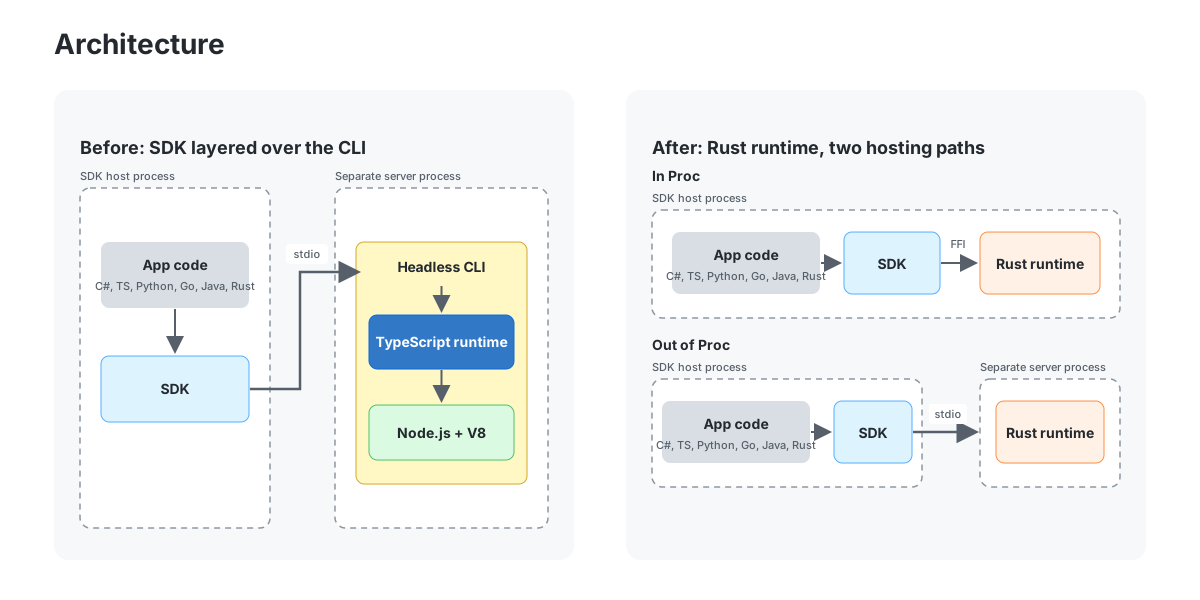
For years, the idea of rewriting a complex software system in a new language felt like a monumental, perhaps even impossible, undertaking. It was a task reserved for teams with infinite resources and a luxury of time that few startups could afford. The GitHub Copilot runtime, a critical piece of infrastructure powering millions of developers, stood as a testament to this old-school reality. However, the arrival of AI agents fundamentally shifted the cost-benefit analysis of such a migration. Before agents, the cognitive load required to understand, refactor, and verify a massive codebase was a human bottleneck. With the ability to leverage AI to read, write, and reason about 800,000 lines of production Rust code, the barrier to entry collapsed overnight, turning a multi-year dream into a feasible project.
The decision to port the runtime to Rust was driven by the need for reliability and performance in an environment where latency and correctness are non-negotiable. Rust's memory safety guarantees without a garbage collector offered a significant upgrade over the previous implementation, but the sheer scale of the rewrite presented a unique challenge. How does one guide a compiler and a runtime through a labyrinth of existing logic without breaking the very thing you are trying to fix? The answer lay in the very tool being built: Copilot itself. By creating a feedback loop where the agent could generate code, the team could immediately test its own output against the production requirements, effectively using the AI to bootstrap the migration rather than just automating the grunt work.
This process was far from a linear translation of syntax. It was an iterative dance between human intent and machine generation. The AI would propose a chunk of Rust code, the team would review it for architectural coherence and edge cases, and then prompt the agent to refine or expand. This approach allowed the team to tackle the codebase in manageable slices, ensuring that each component was robust before moving to the next. The result was a deep understanding of the system that wasn't possible through manual refactoring alone, as the AI forced a constant dialogue about design patterns, error handling, and performance implications that might have been glossed over in a traditional rewrite.
The outcome was a system that not only met the technical requirements of a Rust port but also evolved into something better than the original. The migration revealed hidden complexities and opportunities for optimization that were obscured by the original language's limitations. By treating the rewrite as a collaborative session between human architects and AI agents, the team demonstrated a new paradigm for software development. It proved that the future of large-scale system maintenance isn't just about writing more code, but about orchestrating intelligent agents to do the heavy lifting while humans focus on high-level strategy and validation.
In the end, the migration of the Copilot runtime to Rust serves as a microcosm for the broader shift in the industry. It illustrates that the constraints of the past—time, cognitive load, and the sheer volume of code—are no longer absolute barriers. When we empower AI agents with the context of our own systems, we unlock a productivity multiplier that allows us to reimagine and rebuild our foundations with unprecedented speed and confidence. The 800,000 lines of Rust code are just the beginning; the real innovation lies in the methodology that made such a massive undertaking not just possible, but efficient.
On Bluesky? Meet HomeSky.
Follower analytics, a growth toolkit, scheduling and AI posting — built for Bluesky. Connect your account and use everything free for 60 days.
Try HomeSky free →