Migrating the GitHub Copilot runtime to Rust, using Copilot
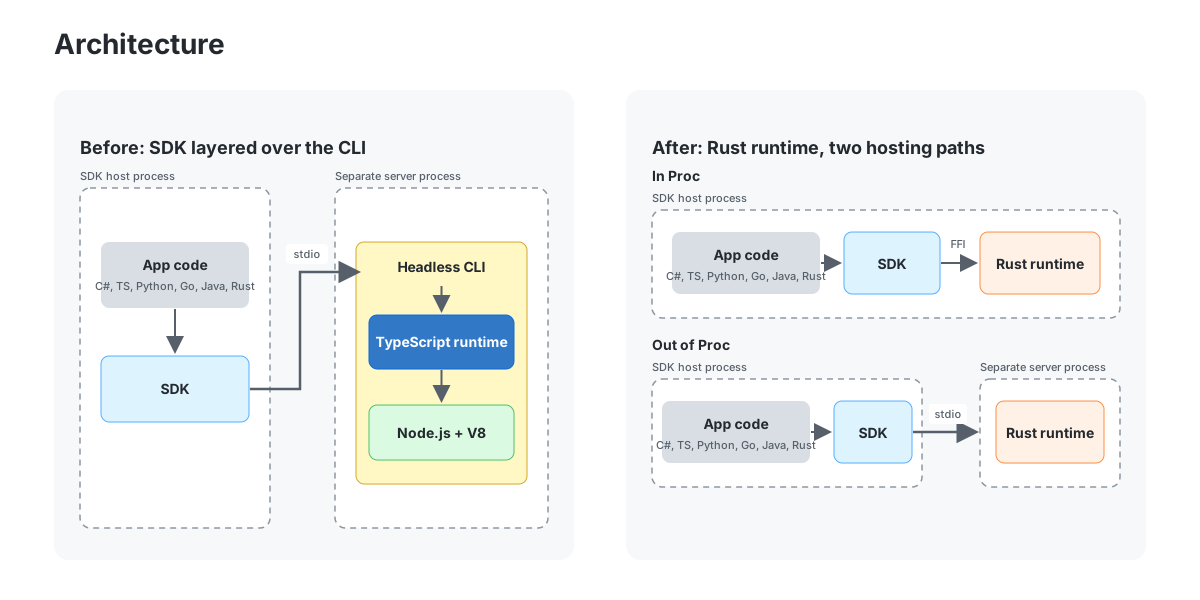
For years, the decision to port a critical piece of infrastructure to Rust was a monumental gamble, often requiring weeks of manual code review, extensive test rewriting, and a team entirely dedicated to the migration. Before the arrival of modern AI agents, the sheer scale of moving a system as complex as the Copilot runtime would have been prohibitively expensive in terms of both time and human capital. The prospect of tackling eight hundred thousand lines of production code felt less like an engineering challenge and more like an insurmountable mountain, one that likely required a dedicated sprint just to map out the terrain.
The narrative of this migration, however, took a sharp turn when we realized that the very tool we were trying to build could also be the architect of its own foundation. By leveraging the Copilot agent itself, we were able to automate the heavy lifting of translation, effectively turning a six-month manual estimate into a matter of weeks. It is a meta-narrative that fits the spirit of the product: using the intelligence of the code to generate the code that drives that intelligence. This wasn't just about swapping syntax or optimizing memory usage; it was about fundamentally changing the velocity at which we could evolve our own infrastructure.
The technical reality of this port was not without its hurdles. Rust's strict ownership model and lack of garbage collection demand a level of precision that differs vastly from the dynamic nature of the original implementation. We encountered scenarios where the agent's suggestions needed human-in-the-loop validation to ensure that the generated Rust code adhered to our specific safety constraints and architectural patterns. Yet, the feedback loop was incredibly tight; errors were caught at the type level before they could become runtime bugs, and the resulting codebase was significantly more robust, with compile-time guarantees that simply weren't possible in the previous environment.
What makes this migration particularly fascinating is the psychological shift it represents for the engineering team. Instead of feeling burdened by the scale of the rewrite, the team felt empowered, almost dancing with the machine. The agent didn't just write boilerplate; it understood context, inferred intent, and refactored logic in ways that would have taken human engineers days to achieve. It highlighted a new paradigm where human engineers act as directors and critics rather than manual typists, guiding the AI through the nuances of the domain while the AI handles the repetitive and laborious aspects of the syntax.
Looking at the broader implications, this experiment proves that the infrastructure supporting AI agents can be just as reliant on those agents for its own survival and optimization. It sets a precedent for how future large-scale migrations might be approached, suggesting that the barrier to entry for rewriting legacy systems in modern, safer languages is rapidly collapsing. The result is a runtime that is not only faster and more secure but also a testament to the symbiotic relationship between human ingenuity and artificial intelligence, proving that the best tool for the job might just be the one you are building.
On Bluesky? Meet HomeSky.
Follower analytics, a growth toolkit, scheduling and AI posting — built for Bluesky. Connect your account and use everything free for 60 days.
Try HomeSky free →