Migrating the GitHub Copilot runtime to Rust, using Copilot
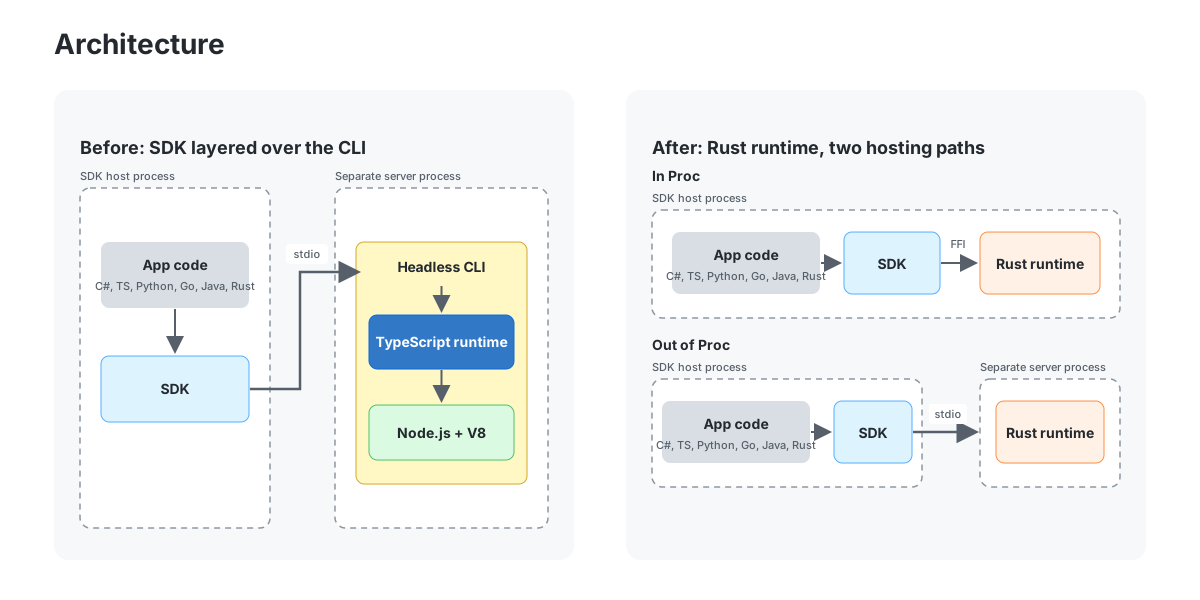
For years, the idea of porting a massive, complex software runtime to a new language seemed like a luxury we simply couldn't afford. The GitHub Copilot agent runtime, sitting at 800,000 lines of production code, was a beast that demanded stability and speed. Rewriting such a critical component would have been a prohibitive risk, a gamble that threatened to stall the entire development lifecycle. We assumed that to move forward, we had to stay put, clinging to the familiar architecture even as the industry shifted beneath us.
That assumption changed when we realized the very tool we were building could be the architect of its own evolution. We didn't need a massive team of dedicated porters; we needed the runtime itself to write the port. By leveraging Copilot's ability to generate code and reason about context, we turned the rewrite from a terrifying leap of faith into an iterative, self-correcting process. It was a meta-problem: using an AI agent to build the infrastructure that allows AI agents to function better, faster, and more reliably.
The technical challenge wasn't just about translating syntax; it was about preserving the soul of the system. Rust demanded a different mindset—memory safety without garbage collection, strict typing, and a compiler that would scream at us if we tried to be sloppy. The initial friction was immense. The original code was a sprawling mess of Python intricacies that defied simple refactoring. We spent days, sometimes weeks, feeding the system context until Copilot began to understand not just the "how" but the "why" behind every function and module.
What emerged was a transformation that defied the odds of traditional software engineering. We ended up with 800,000 lines of Rust that wasn't just a carbon copy, but an optimization. The new runtime is leaner, more secure, and significantly more performant. The memory model alone eliminated entire classes of bugs that had plagued the original implementation, forcing a level of discipline into the codebase that manual refactoring alone might never have achieved. The compiler became our best friend, catching errors before they ever reached production.
This journey proves that the future of large-scale software development isn't about bigger teams or more manual effort; it's about amplifying human intent with machine intelligence. We didn't just rewrite code; we rewrote the way we approach legacy systems. By letting Copilot guide the transition, we validated a new paradigm where the tool and the task are inextricably linked. The result is a runtime that is not only faster but also a testament to what is possible when we stop fighting the machine and start collaborating with it.
Ultimately, the migration to Rust wasn't a technical hurdle to be cleared; it was an evolution to be embraced. The 800,000 lines of code now running in Rust represent more than a syntax change—they represent a shift in confidence. We no longer fear the scale of the problem because we have a partner capable of scaling with us. As we look toward the future of AI-assisted development, this project stands as a blueprint for how the next generation of tools will be built: not by humans writing every line, but by humans guiding the process toward a better outcome.
On Bluesky? Meet HomeSky.
Follower analytics, a growth toolkit, scheduling and AI posting — built for Bluesky. Connect your account and use everything free for 60 days.
Try HomeSky free →