Migrating the GitHub Copilot runtime to Rust, using Copilot
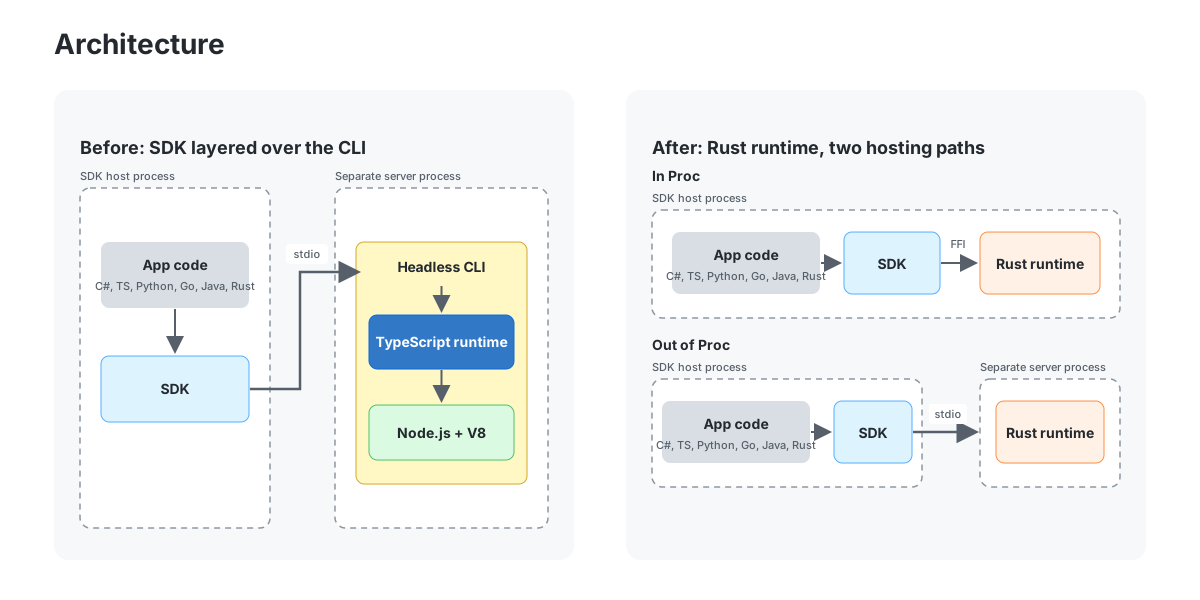
Before the era of autonomous coding agents, a rewrite of this magnitude was simply not economically feasible. The decision to port the GitHub Copilot runtime to Rust represented a pivot that would have required years of manual labor and a massive team just to handle the translation of 800,000 lines of production code. It was a project where the cost of execution far outweighed the perceived benefit, until the realization that the very agents we built could now be used to build the agents themselves.
The challenge was not merely syntactic; it was architectural and philosophical. Rust demands a level of explicitness about memory safety and concurrency that is often implicit in higher-level languages. Moving a complex, high-throughput AI runtime into a system that forbids garbage collection and requires careful borrowing rules was akin to conducting an orchestra with instruments that must never be out of tune. The initial attempts revealed gaps in our understanding of how the runtime interacted with the underlying infrastructure, forcing a deep dive into the micro-architecture that had been opaque for years.
What emerged from this migration was a system that was not just faster, but fundamentally more predictable. By eliminating the runtime overhead associated with interpreted languages and unsafe pointer management, the latency between a developer's prompt and the generation of code dropped significantly. This wasn't a marginal improvement; it was a transformation that made real-time, multi-agent collaboration viable. The Rust codebase provided a foundation where the agent could reason about its own execution environment with a precision that was previously impossible.
The irony, of course, lies in the tooling. We did not manually refactor millions of lines of code or painstakingly map every dependency. Instead, we leveraged the very Copilot agents we were trying to optimize to perform the migration. The agents analyzed the legacy codebase, proposed idiomatic Rust alternatives, and even generated the complex tests necessary to verify that the new implementation behaved exactly as the old one had. It was a bootstrapping process where the solution helped build the path to the solution.
This shift represents a broader evolution in how we approach software engineering. It suggests that the barrier between human developers and machine intelligence is shrinking, allowing us to tackle problems that were once considered too large for a single team. The 800,000 lines of Rust are not just a refactored codebase; they are a testament to a new workflow where humans define the boundaries of possibility, and agents fill in the details with speed and accuracy that defies traditional project management models.
Ultimately, the migration proved that the most significant leap forward wasn't just in the language or the performance metrics, but in the methodology of development itself. We are moving toward an era where the act of rewriting core infrastructure becomes a collaborative dialogue between human intent and machine capability, turning what was once a monumental, prohibitive task into a routine, iterative process.
On Bluesky? Meet HomeSky.
Follower analytics, a growth toolkit, scheduling and AI posting — built for Bluesky. Connect your account and use everything free for 60 days.
Try HomeSky free →