Migrating the GitHub Copilot runtime to Rust, using Copilot
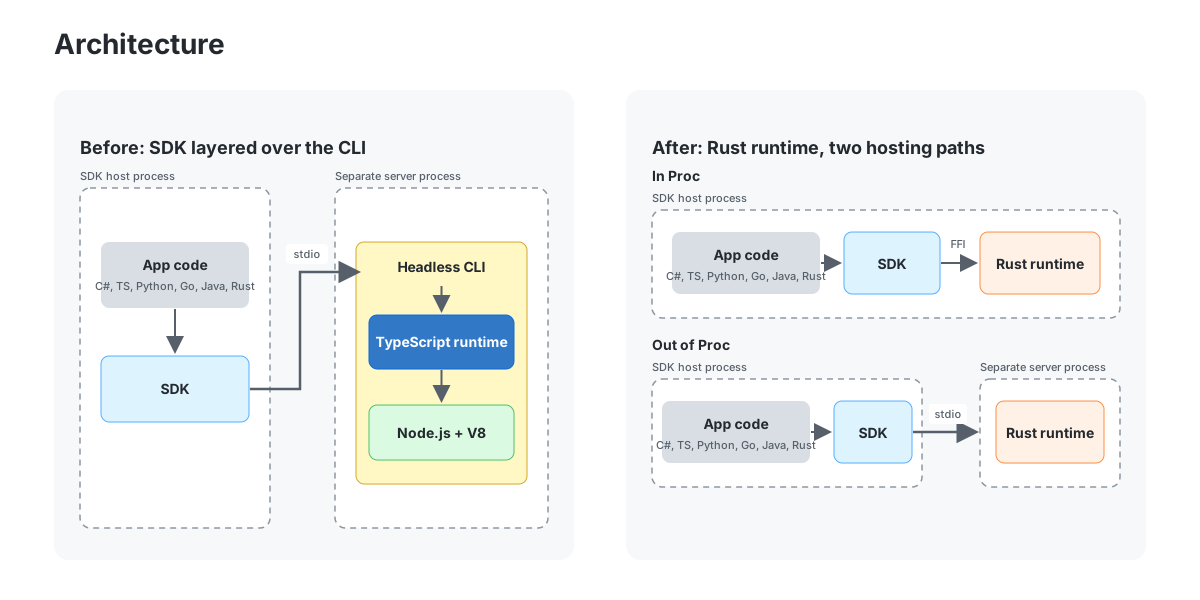
Porting the GitHub Copilot runtime to Rust wasn't just a matter of translating syntax; it was an exercise in fundamentally rethinking how we build the infrastructure that powers modern software development. Before the rise of autonomous agents, such a migration would have been a monumental financial and temporal sinkhole, requiring months of manual refactoring and countless hours of debugging. The sheer volume of code—nearly 800,000 lines in production Rust—demanded a paradigm shift where the tools of development itself had to become the architects of the migration. This was not a simple rewrite; it was a complete reconstruction of the agent's runtime, leveraging the very capabilities of Copilot to guide the transformation from the inside out.
The decision to use Rust was driven by the need for performance, safety, and memory efficiency, qualities that are non-negotiable when building the backbone of an AI service that must remain responsive under heavy load. Traditional languages often hit bottlenecks here, leaking memory or introducing latency that degrades the user experience for developers waiting for code completions. By rewriting the core components in Rust, we eliminated these inefficiencies, creating a system that is both faster and more resilient. The challenge lay in the complexity of the existing architecture, which was deeply intertwined with business logic and data handling routines that could not be simply copied and pasted into a new language without rigorous validation.
What made this undertaking unique was the strategy of using Copilot to write the Rust code that would eventually run Copilot's agent logic. It created a recursive loop of innovation where the agent wrote its own agent infrastructure, guided by human oversight but driven by the AI's ability to understand context, idioms, and architectural patterns. This approach allowed us to tackle the massive scale of the rewrite without burning out the engineering team, effectively scaling our own productivity through the very technology we were building. The result was a system that felt less like a port and more like an evolution, where every line of Rust was generated with an intimate understanding of the original intent.
The implications of this migration extend far beyond the technical metrics of speed and safety. It represents a significant step forward in how we can leverage AI not just to assist with individual tasks, but to orchestrate large-scale infrastructure changes. By proving that an autonomous agent could successfully refactor millions of lines of code into a safer, faster language, we have opened the door to a future where complex system modernizations are no longer prohibitive barriers. The 800,000 lines of Rust now standing ready in production are a testament to what is possible when human creativity and artificial intelligence align toward a singular, ambitious goal.
This journey has reshaped the way we approach legacy system modernization, turning a potential bottleneck into a catalyst for growth. The team that undertook this rewrite found themselves at the forefront of a new capability, one that blurs the line between developer and machine in the most productive way possible. As we continue to refine the runtime and explore new frontiers with this Rust-based architecture, the lessons learned here will inform how we build the next generation of developer tools. The path forward is clear: the future of software engineering lies in symbiotic relationships where AI and human ingenuity work in tandem to build systems that are not just functional, but magnificent.
On Bluesky? Meet HomeSky.
Follower analytics, a growth toolkit, scheduling and AI posting — built for Bluesky. Connect your account and use everything free for 60 days.
Try HomeSky free →