Migrating the GitHub Copilot runtime to Rust, using Copilot
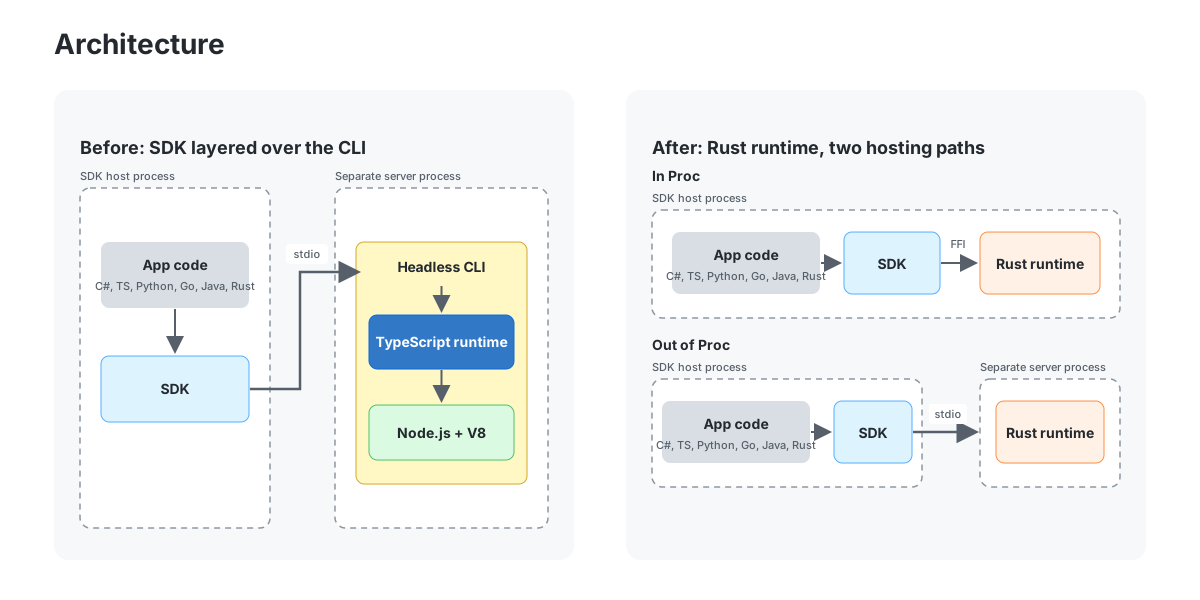
There was a time when rewriting a massive codebase was a monumental, terrifying prospect, reserved for teams of engineers working in silos for months on end. Before the arrival of modern AI agents, the idea of porting a complex, mission-critical system to a new language felt like attempting to cross an ocean without a map. That ship, however, is the GitHub Copilot runtime, a sprawling 800,000-line monolith that has now been successfully migrated to Rust. The premise wasn't just a technical exercise; it was a fundamental challenge to the industry's assumption that such a rewrite was economically unviable without an army of developers. We didn't just move lines of code; we moved an entire architecture, proving that the cost of rewriting can be decimated when the right tool is applied.
The journey began with a realization that the old way of doing things—manual refactoring, line-by-line translation, and constant debugging—was not only too slow but also prone to introducing subtle, catastrophic bugs. The team needed a safety net, a way to ensure that the logic of the original Python implementation was preserved while gaining the performance and safety guarantees of Rust. This is where the irony became the engine of the project: we used Copilot, the very system we were building, to build the system that would power it. It was a recursive loop, a chicken-and-egg problem solved by leveraging the AI's ability to understand context on a scale no human could manage alone.
The numbers tell a story that defies conventional wisdom. In previous eras, a project of this magnitude would have required hundreds of engineers and years of development. Here, the rewrite was accomplished with a fraction of the manpower and a significantly shorter timeline. The AI didn't just write code; it acted as a senior architect, analyzing patterns, suggesting refactors, and generating boilerplate that allowed human engineers to focus on the hard problems. It wasn't magic, but it felt like it, bridging the gap between the abstract complexity of the original design and the rigorous demands of the new language.
However, the process wasn't without its perils. Porting to Rust demands a strict adherence to memory safety and type theory concepts that are foreign to many dynamic language developers. There were moments where the AI's suggestions were overly creative, introducing Rust idioms that, while technically correct, were impractical for the specific domain. The human engineers had to act as gatekeepers, refining the AI's output, stripping away unnecessary complexity, and ensuring that the final product was not just safe, but efficient. It was a dance between machine speed and human judgment, where the AI provided the velocity and the team provided the steering.
The result is a system that is faster, safer, and more maintainable than ever before. The migration has unlocked new levels of performance, allowing the Copilot runtime to handle even greater loads and respond with the latency required by modern development workflows. But beyond the metrics, the real victory is in the methodology. It proves that the future of large-scale software engineering isn't about hiring more people; it's about empowering existing teams with intelligent tools that can handle the grunt work, leaving them to solve the puzzles that truly matter.
We are standing at a precipice where the boundaries of what is affordable to build are shifting rapidly. The successful migration of the Copilot runtime to Rust is not just a technical win for GitHub; it is a signal to the entire industry that the era of prohibitive rewrite costs is over. With AI agents acting as force multipliers, we can now reimagine our infrastructure with the confidence of a rewrite we could actually afford to execute. The code is written, the runtime is running, and the future is compiled.
On Bluesky? Meet HomeSky.
Follower analytics, a growth toolkit, scheduling and AI posting — built for Bluesky. Connect your account and use everything free for 60 days.
Try HomeSky free →