Rendering huge pull requests in the GitHub Copilot app
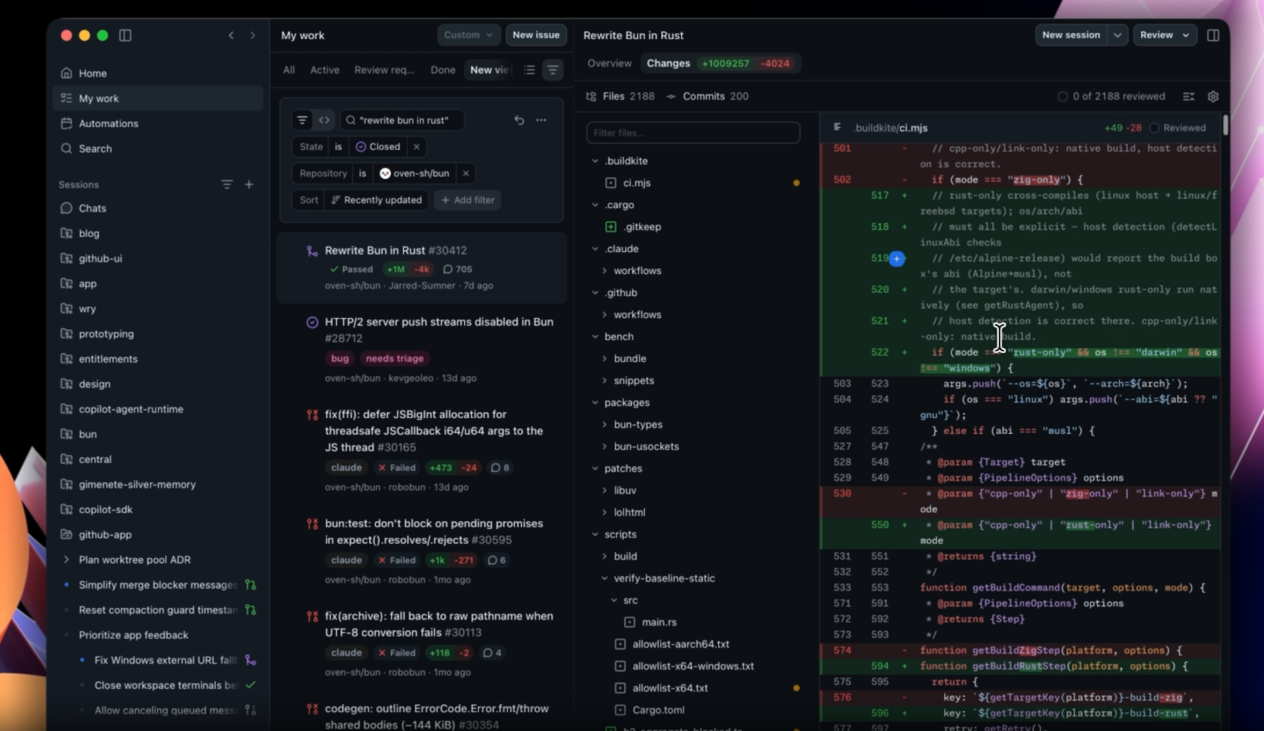
Imagine sitting down to review a pull request that spans a million lines of code, populated by hundreds of inline comments from reviewers. In the world of software development, this is not merely a rare occurrence; it is a logistical nightmare that often forces teams to abandon the review process entirely. The sheer volume of text creates a cognitive wall so high that meaningful feedback becomes impossible, leading to stale branches and stalled innovation. We knew that if we wanted to keep the conversation going, we had to tear down the walls of the diff surface in the GitHub Copilot app.
The challenge wasn't just about displaying more lines; it was about managing the complexity of rendering them without sacrificing performance or usability. Traditional diff viewers rely on algorithms that break text into chunks, which works beautifully for small files but collapses under the weight of massive monolithic changes. We realized that the existing infrastructure could not handle the granularity required for hundreds of specific review comments scattered across a million lines. The latency would be unacceptable, and the user experience would degrade into a blur of scrolling and waiting.
Our solution required a fundamental rethinking of how we approached the rendering engine. We rebuilt the diff surface from the ground up, introducing a system capable of streaming and rendering vast datasets on demand rather than loading them all into memory at once. This involved a deep dive into virtualization techniques, optimizing the DOM structure, and ensuring that the browser could handle the sheer scale of the data while maintaining a silky-smooth scroll. It was a battle against the limits of client-side computation, pushing the boundaries of what a web application could do in real time.
The impact of this rebuild extends far beyond the technical metrics. By successfully opening a million-line pull request, we validated that complex, large-scale codebases can be reviewed with the same intimacy as small, focused changes. Reviewers can now zoom in on specific logical blocks, leave targeted comments, and understand the context of changes without getting lost in the noise. This shifts the paradigm from "can we merge this?" to "how do we improve this?", fostering a culture where even the largest refactors are treated with the care they deserve.
Looking ahead, this architectural shift opens the door to future possibilities we could only dream of a few years ago. We are now exploring features like automated summary generation for specific sections of the file, intelligent navigation to the most commented areas, and enhanced collaboration tools that leverage the density of the new surface. The ability to visualize and interact with millions of lines of change is just the beginning of a new era in how teams approach software maintenance and evolution.
This journey proved that the constraints we often accept as immutable are frequently just artifacts of outdated tooling. By tackling the problem head-on and rewriting the rules of engagement for the diff surface, we didn't just fix a bug; we removed a barrier to collective intelligence. Now, when a developer opens a massive pull request, they aren't facing a mountain of text they can't climb; they are entering a workspace designed to help them reach the summit.
On Bluesky? Meet HomeSky.
Follower analytics, a growth toolkit, scheduling and AI posting — built for Bluesky. Connect your account and use everything free for 60 days.
Try HomeSky free →