Webb Searches for Brown Dwarfs in a Stunning Star-Forming Region
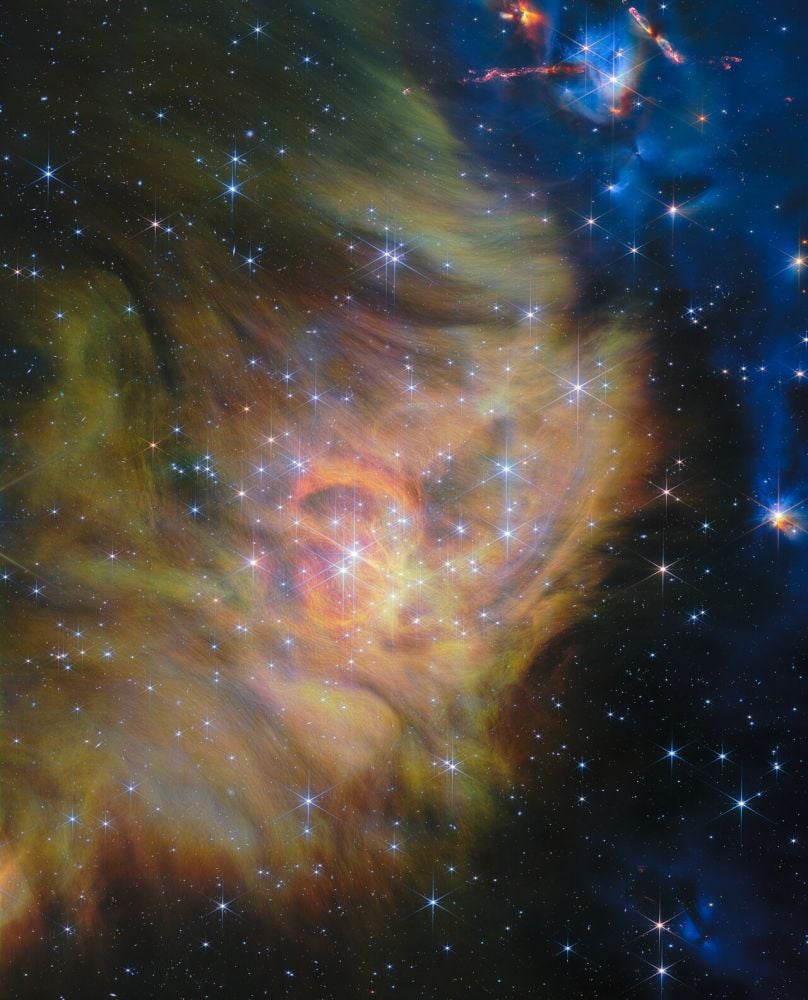
For decades, the boundary between a star and a brown dwarf has been a fuzzy line drawn in the sand of astrophysics, defined by the inability of these failed stars to sustain the nuclear fusion of hydrogen. But what happens when an object slips so far below the traditional mass limit that it challenges our very definitions? Recent observations from the James Webb Space Telescope have pushed this frontier further than ever before, revealing a new class of these sub-stellar objects in a vibrant star-forming region that defies easy categorization. These are not merely slightly dimmer versions of their stellar cousins; they represent a distinct population that hints at a more complex formation history than we previously imagined.
The discovery centers on a peculiar spectral signature: a hydrocarbon feature that has long been associated with cooler, massive brown dwarfs, yet here it appears on objects with surprisingly low masses. In the past, astronomers believed that as brown dwarfs cooled, their atmospheres would eventually lose these molecular markers, transitioning into a featureless haze. The presence of hydrocarbons in such low-mass entities suggests that these worlds possess unique atmospheric dynamics, perhaps retaining heat or circulating gases in ways that preserve these chemical fingerprints against the cooling backdrop of interstellar space. It is a reminder that the universe does not always adhere to the clean, linear progression we expect from our models.
What makes this finding particularly striking is the context of the environment itself. These brown dwarfs were found nestled within a dense, active star-forming region where the interstellar medium is churning with the raw materials of new worlds. In such a chaotic nursery, one might expect only the most robust objects to survive or be clearly distinguished. Instead, Webb's infrared vision has pierced the dust and gas to uncover these faint, elusive bodies, proving that even in the most energetic cosmic nurseries, the smallest, coldest, and most enigmatic objects can hide in plain sight. The telescope's sensitivity allows us to see not just what is there, but what we might have missed for years.
This research forces us to reconsider the formation mechanisms of brown dwarfs. If these low-mass objects can exist with such distinct atmospheric properties, it implies that the process of their creation is more varied than the simple fragmentation of collapsing gas clouds. They may be the result of accretion from the circumstellar disks of young stars, or perhaps they formed through a mechanism entirely different from the binary star formation process that typically produces them. Each new data point adds a layer of complexity to the puzzle, suggesting that the population of brown dwarfs is far more diverse and dynamic than our current taxonomies allow.
Ultimately, the journey to define these objects is not just about refining a mass limit; it is about understanding the full spectrum of stellar evolution. As we continue to feed Webb's instruments with more light from these distant regions, we may yet find that the dividing line between a star and a brown dwarf is less a wall and more a spectrum of possibilities. The hydrocarbon feature serves as a beacon, guiding us toward a deeper comprehension of the physical laws governing the smallest of these celestial bodies. In the end, it is a humbling reminder that the cosmos is full of surprises, waiting patiently for us to look closer.
On Bluesky? Meet HomeSky.
Follower analytics, a growth toolkit, scheduling and AI posting — built for Bluesky. Connect your account and use everything free for 60 days.
Try HomeSky free →