A New Mission Could Rendezvous With Halley's Comet In 2061
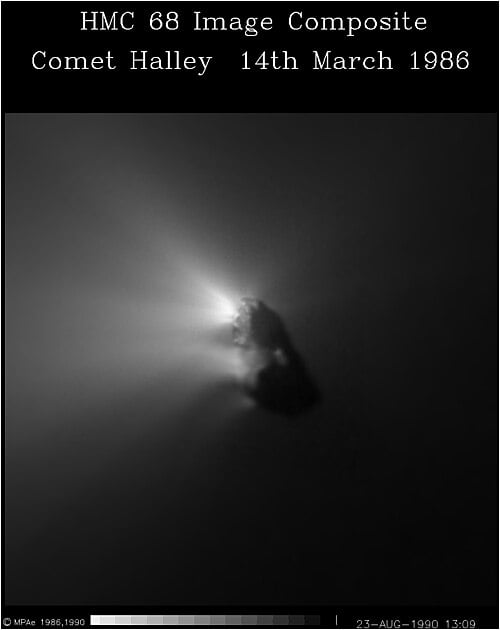
There is a peculiar nostalgia attached to the sight of a comet, an ancient wanderer that bridges the gap between the mythological and the mechanical. When Halley's comet last graced our skies in 1986, I was merely a toddler, but for the scientists of that era, it was a moment of intense, almost frantic activity. We unleashed what became known as the "Halley Armada," a fleet of spacecraft from different nations racing to capture a glimpse of the icy giant before it vanished into the glare of the sun. Yet, as we now know with regret, our technology in those days was limited by the very nature of the comet's path. The spacecraft could only skim its surface for a fleeting few hours, unable to linger in the shadow of its nucleus or observe the changes that occur over weeks and months.
The desire to revisit this celestial traveler is not merely about capturing better photographs; it is about understanding the dynamic process of comet evolution. Halley is unique in our solar system because it is the only long-period comet with a period shorter than a human lifetime, meaning it returns frequently enough to be observed by multiple generations. However, its trajectory is a narrow ribbon of opportunity. Any spacecraft attempting to rendezvous must match its speed and direction with incredible precision, a feat that leaves little room for error. For decades, planetary scientists have yearned for a mission that could slow down, hang around, and study the comet's coma and tail in real-time, observing how it sheds its dust and ice as it approaches perihelion.
Now, a new proposal from researchers at Khalifa University offers a potential solution to this decades-old dilemma. Available currently as a pre-print on arXiv, this paper outlines a mission architecture designed specifically to achieve a sustained rendezvous rather than a fleeting flyby. The core of their proposal lies in a clever use of orbital mechanics that allows a spacecraft to wait for the comet to catch up to it, or to slow its own descent relative to the comet's high velocity. This approach transforms the mission from a race against time into a patient observation, allowing instruments to remain in position for weeks or even months, collecting data that was simply impossible to gather in 1986.
The implications of such a mission extend far beyond the immediate scientific curiosity of watching a comet. By studying Halley with sustained observation, we can better understand the volatile processes occurring on the surface of these bodies, potentially revealing clues about the early solar system and the delivery of water and organic molecules to Earth. The "Halley Armada" provided us with snapshots, a collection of high-resolution images taken in quick succession. A new mission could provide the video footage that scientists have been begging for, tracking the erosion of the nucleus and the chemical composition of the outgassing in a continuous, evolving narrative. It represents a shift from capturing a moment to witnessing a story.
While the technology to execute such a maneuver exists, the path forward requires careful planning and international cooperation. The mission would need to wait in a stable orbit until the comet returns in 2061, a long gestation period that demands robust funding and political will. However, the payoff promises to be significant, offering insights that could reshape our understanding of comet behavior and their role in planetary development. As we look toward the middle of this century, the dream of a sustained visit to Halley's comet is no longer science fiction but a feasible engineering challenge, waiting for the next generation of explorers to answer the questions that the Armada only began to ask.