APOD: 2026 September 8 – Hubble: Decagon Around Saturn’s South Pole
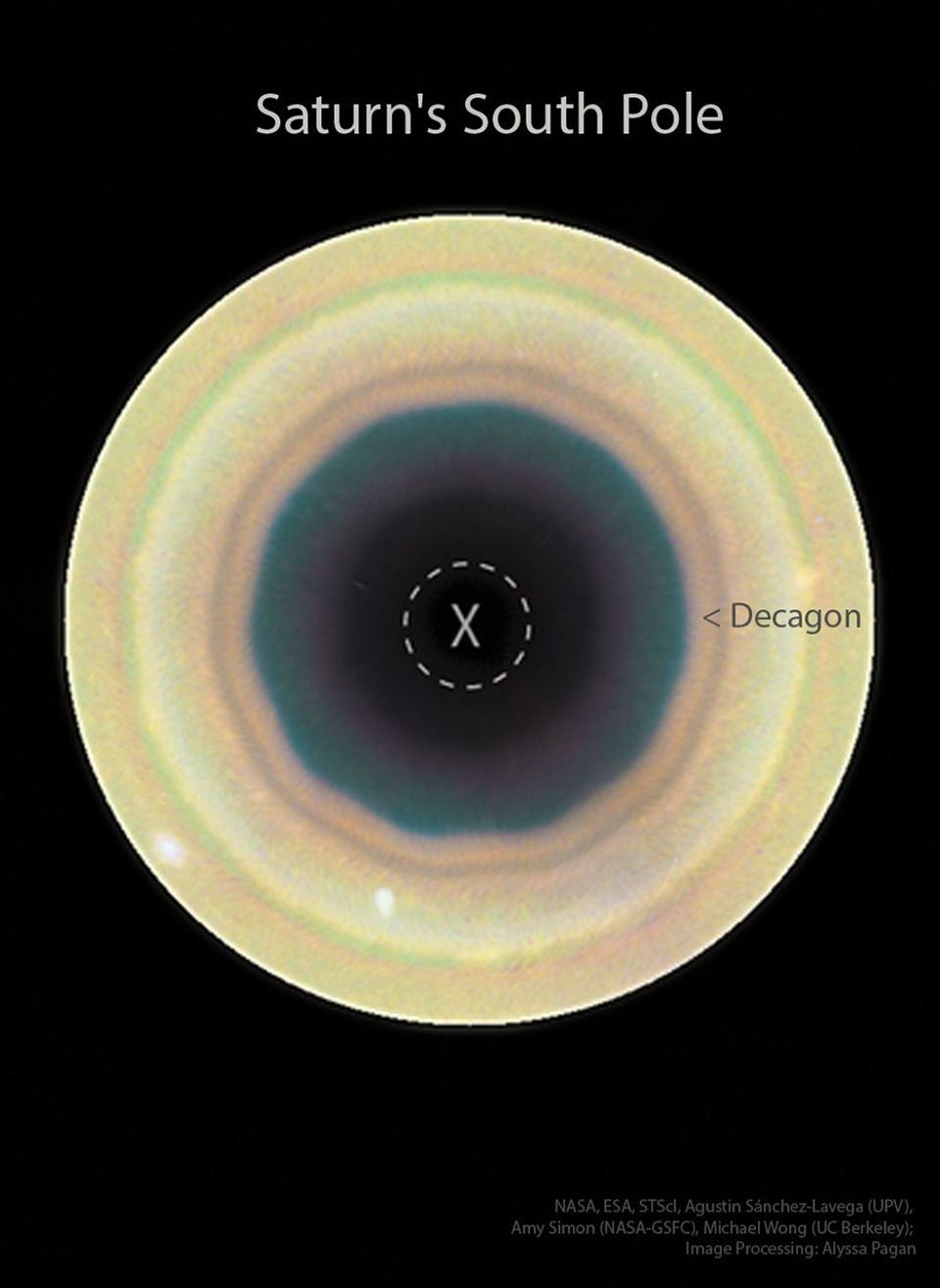
Look closely at the geometric precision of Saturn's southern hemisphere, and you will find a celestial anomaly that defies the chaotic turbulence expected in planetary atmospheres. Instead of a random swirl of storms or a uniform band of winds, the Hubble Space Telescope has revealed a striking decagon—a ten-sided polygon—hugging the planet's south pole. It is a shape so sharp and regular that it looks less like a natural meteorological phenomenon and more like a blueprint drawn by an alien architect.
This geometric marvel is not a solid structure but a pressure belt where the winds behave with an almost mathematical rigidity. At this latitude, the jet stream does not simply flow; it organizes itself into a stable, counter-clockwise circulation. The sheer improbability of nature generating such a specific symmetry without human intervention is what captivates astronomers. It suggests that under the right conditions of temperature, rotation, and atmospheric density, fluids can spontaneously organize into complex, high-order symmetries, challenging our intuition about how gases should behave in a turbulent system.
The history of this discovery is as fascinating as the image itself. While early observations hinted at unusual patterns near Saturn's poles, it was only with the sustained, high-resolution monitoring of Hubble that the full extent of this decagonal arrangement became clear. Scientists have debated for years whether this is a fleeting storm system or a permanent feature of the planet's atmospheric dynamics. The consensus is leaning toward the latter, suggesting that the south pole of Saturn hosts a unique atmospheric regime that stabilizes these wind patterns in a way that the north pole does not, creating a distinct duality in the planet's weather.
What makes this phenomenon particularly compelling is the comparison we can draw with Earth. On our own world, hurricanes and typhoons are often circular or irregular, rarely exhibiting such high degrees of geometric order. Yet, here in the frigid dark of Saturn's south pole, the atmosphere has found a way to impose strict geometric discipline upon itself. It serves as a powerful reminder that the laws of physics governing our sky are the same as those governing the distant giants, yet the outcomes can be profoundly different, sometimes leading to forms of beauty we are ill-equipped to anticipate.
As we continue to send more probes to the outer solar system and refine our models of fluid dynamics, this decagon stands as a testament to the mystery that still lingers at the edge of our understanding. It forces us to admit that there are still patterns in the universe waiting to be named and understood, patterns that may one day lead us to new insights about the nature of turbulence, stability, and the hidden order within the apparent chaos of the cosmos.