COSI Telescope Comes Together
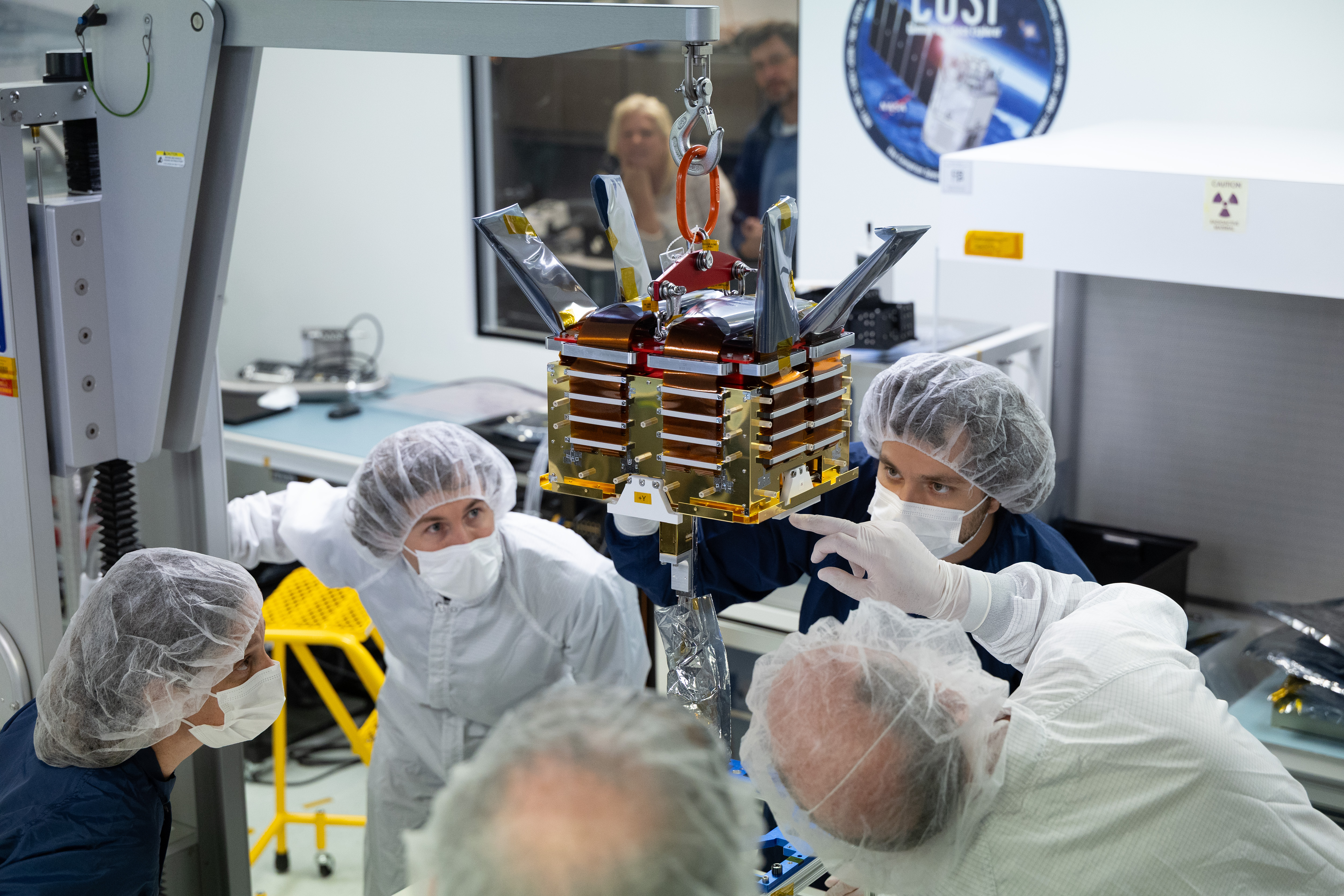
On July 8, 2026, a moment that could have been a blur of motion for a camera lens was captured instead with the slow, deliberate grace of a religious ceremony. The Compton Spectrometer and Imager, affectionately known as COSI, was lifted inches off the workbench, a maneuver watched with bated breath by engineers and managers from UC Berkeley. In the high-stakes world of particle physics, where a single microsecond of misalignment can ruin months of calibration, this slow raise was not merely logistical; it was the first true test of a machine designed to catch the ghosts of the universe.
What lies within this detector is nothing less than a window into the violent architecture of the cosmos. We are not merely looking at stars; we are attempting to reconstruct the debris of supernovae and the echoes of black hole collisions by measuring how gamma rays scatter off electrons. The Compton Effect, which gives the detector its name, is the fundamental interaction we are exploiting here, turning a quantum mechanical collision into a readable map of high-energy events. To build a device that can perform this dance in the chaotic environment of space requires a level of precision that borders on the magical, yet it is grounded entirely in the hard, unyielding laws of physics.
The journey to this moment was paved with years of iterative failure and triumph. The team at UC Berkeley did not simply bolt together aluminum plates and silicon sensors; they engineered a complex ecosystem of cooling systems, radiation-hardened electronics, and magnetic shielding that must function in the harsh vacuum of orbit without maintenance. Watching the assembly rise from the table in 2026 was the culmination of solving problems that often seemed insoluble, from managing the thermal expansion of materials to ensuring that the delicate scintillator crystals would not degrade under decades of cosmic bombardment.
This is why the image matters. It represents the transition from theoretical possibility to physical reality. For too long, our understanding of gamma-ray sources has been limited by the sensitivity of our instruments. COSI aims to push that boundary, offering a clarity that allows us to see the inner workings of gamma-ray bursts with unprecedented detail. When this detector finally looks up at the sky, it will not just count photons; it will tell a story of the most energetic processes in the known universe, a narrative written in the language of scattering angles and energy deposition.
There is a profound humility in this endeavor, a recognition that human ingenuity is small compared to the forces we seek to measure. The engineers who watched that lift in 2026 were not just technicians; they were storytellers attempting to decipher a cosmic text that has been obscured for eons. Their work bridges the gap between the abstract mathematics of quantum field theory and the tangible, cold reality of the instruments we build to explore it.
As the assembly rises higher, the stakes increase. The next few years will be dedicated to rigorous testing, simulating the environment of space on the ground and refining the algorithms that will translate raw data into celestial maps. But for now, the image stands as a testament to the human capacity to build bridges to the unknown, one carefully raised component at a time. The universe waits for no one, but thanks to this slow, deliberate lift, we are finally ready to listen.
On Bluesky? Meet HomeSky.
Follower analytics, a growth toolkit, scheduling and AI posting — built for Bluesky. Connect your account and use everything free for 60 days.
Try HomeSky free →