Migrating the GitHub Copilot runtime to Rust, using Copilot
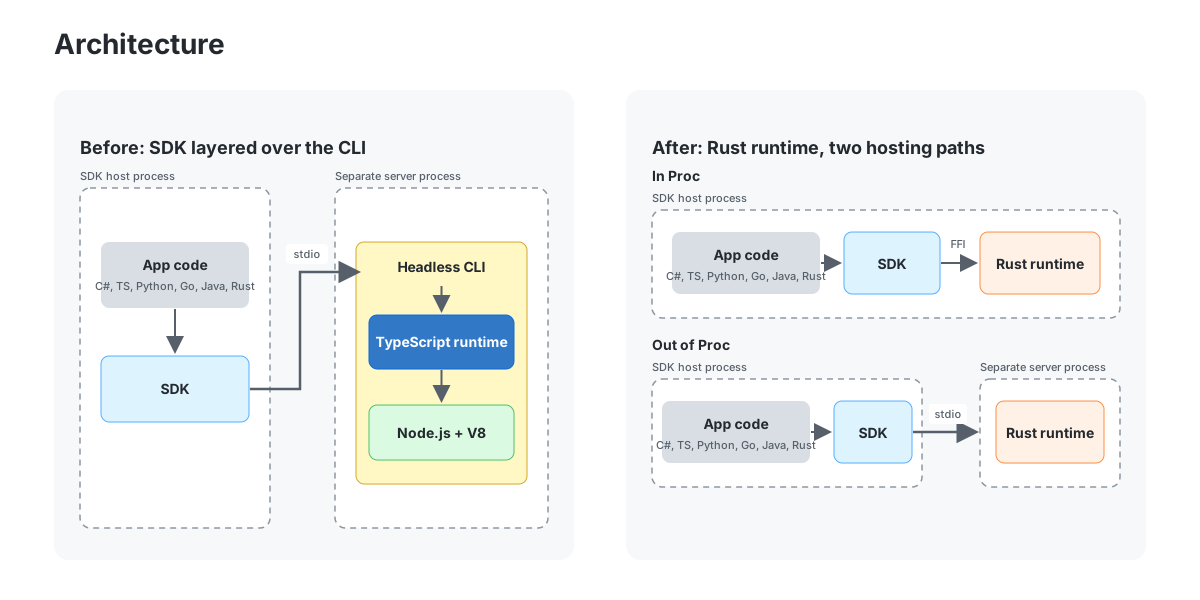
For years, the idea of rewriting a massive codebase using AI felt like science fiction, a notion dismissed by engineers who knew the cost of context limits and the fragility of translation. But the landscape shifted when Copilot itself became the tool for its own evolution. The challenge was monumental: porting the Copilot agent runtime, a sprawling system of roughly 800,000 lines of production code, from its previous implementation to Rust. Before the emergence of powerful agent workflows, such a rewrite would have required a legion of senior engineers operating over several years, a timeline that made the project financially unviable. The new reality allowed us to tackle a decade's worth of debt in a fraction of the time.
The decision to choose Rust was not merely a stylistic preference but a strategic necessity for performance and memory safety at scale. The original runtime demanded extreme efficiency, processing thousands of requests simultaneously while maintaining the state of complex agent interactions. Rust's ownership model provided the guarantees we needed to prevent race conditions and memory leaks without sacrificing the speed required for real-time inference. However, translating idiomatic features from the source language into Rust's strict type system presented unique hurdles that standard AI suggestions often failed to resolve, requiring a human-in-the-loop approach to navigate the most critical architectural decisions.
The narrative of this migration is defined by a symbiotic relationship between human intuition and machine capability. We did not simply ask the agent to "rewrite the code"; we guided it through a series of constrained, iterative prompts that respected the existing architectural patterns and error handling strategies. This was a dance of refinement, where the AI generated boilerplate and standard library integrations rapidly, allowing our team to focus on the intricate logic of the agent's decision trees and the subtle nuances of its interaction with the LLM. It proved that agents could act as force multipliers, handling the volume of repetitive refactoring while humans directed the flow.
Perhaps the most surprising aspect of this undertaking was how the process itself improved the final product. The constraints of Rust forced a level of clarity and modularity that was absent in the legacy code, leading to a system that was not only faster but significantly easier to maintain and extend. The porting process uncovered latent bugs and design inconsistencies that had been tolerated in the original implementation, effectively performing a deep audit of the system while it was being rebuilt. We ended up with a runtime that was leaner, safer, and more responsive than ever before, all achieved through a methodology that was only possible because of the tools we were building.
This migration stands as a testament to a changing paradigm in software development, where the boundaries between builder and tool are blurring. It challenges the traditional metrics of engineering effort, suggesting that the value of an engineer may increasingly lie in their ability to orchestrate these advanced agents rather than write every line of code manually. As we look toward the future, the path forward for large-scale systems will likely involve even tighter integration between human oversight and AI execution, making projects of this magnitude not just affordable, but routine. The 800,000 lines of Rust now running in production are not just code; they are proof that the future of software is being written in collaboration with the very intelligence it seeks to serve.
On Bluesky? Meet HomeSky.
Follower analytics, a growth toolkit, scheduling and AI posting — built for Bluesky. Connect your account and use everything free for 60 days.
Try HomeSky free →