Migrating the GitHub Copilot runtime to Rust, using Copilot
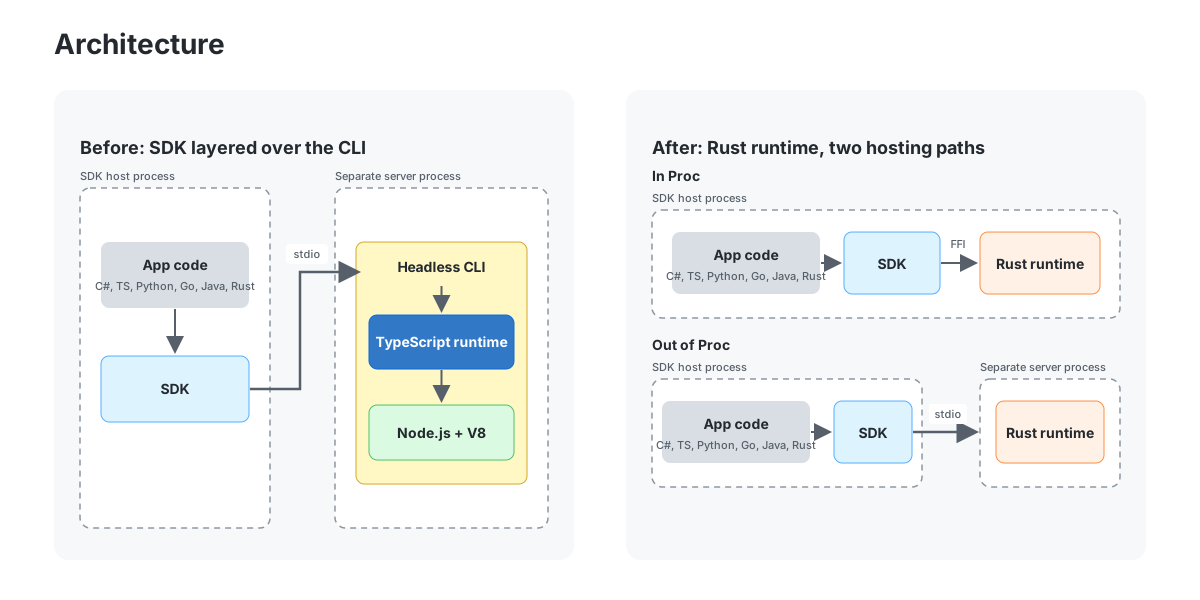
For a long time, the idea of rewriting the GitHub Copilot runtime in Rust felt like a pipe dream, a theoretical exercise for a future where artificial intelligence could handle the tedium of boilerplate conversion. Before the era of agent-driven development, such a massive migration—touching 800,000 lines of code—was simply not affordable. The cost in engineering hours, the risk of introducing subtle bugs, and the sheer scale of the undertaking made the decision to port from a higher-level language to a systems language like Rust a financial impossibility for most teams, let alone one trying to maintain a global AI service.
The breakthrough came not from a team of engineers sitting down for months to manually refactor the codebase, but from an agent itself. By leveraging Copilot to understand the existing architecture, the system was able to generate the equivalent of a year's worth of manual labor in a fraction of the time. This wasn't just about swapping syntax; it was about translating the intent of millions of developers into a safer, more memory-efficient runtime that could handle the rigorous demands of a production environment without the usual garbage collection overheads.
Porting to Rust forced a fundamental rethinking of how the system interacts with memory and concurrency. The old code, comfortable with the safety net of reference counting and managed runtimes, had to be stripped down to its bare essentials to fit the strict borrowing rules of the new language. Every function signature was scrutinized, every pointer replaced with a strict ownership model, and the entire logic flow was rewritten to ensure that data races were impossible by design rather than by testing. It was a painful but necessary evolution to ensure the Copilot runtime could remain robust even as the volume of requests scaled exponentially.
The result is a system that is significantly faster and more reliable, proving that the friction of legacy code doesn't have to be a permanent barrier to architectural improvement. By using Copilot to write the code that migrates Copilot, the team created a positive feedback loop where the AI tool became the engine of its own optimization. This approach demonstrates a new paradigm in software engineering: instead of fighting against the complexity of large codebases, we can use intelligent agents to navigate and reshape them, turning what was once a multi-year project into a manageable sprint.
Ultimately, this migration serves as a testament to the shifting landscape of software development. It shows that the tools we build today can be the architects of the systems of tomorrow, capable of handling tasks that would have been unthinkable just a few years ago. The 800,000 lines of Rust now powering the Copilot runtime stand as a monument to the power of combining human strategy with AI execution, proving that even the most massive infrastructure overhauls can be accomplished with the right tools and a willingness to let machines learn from machines.
On Bluesky? Meet HomeSky.
Follower analytics, a growth toolkit, scheduling and AI posting — built for Bluesky. Connect your account and use everything free for 60 days.
Try HomeSky free →