Migrating the GitHub Copilot runtime to Rust, using Copilot
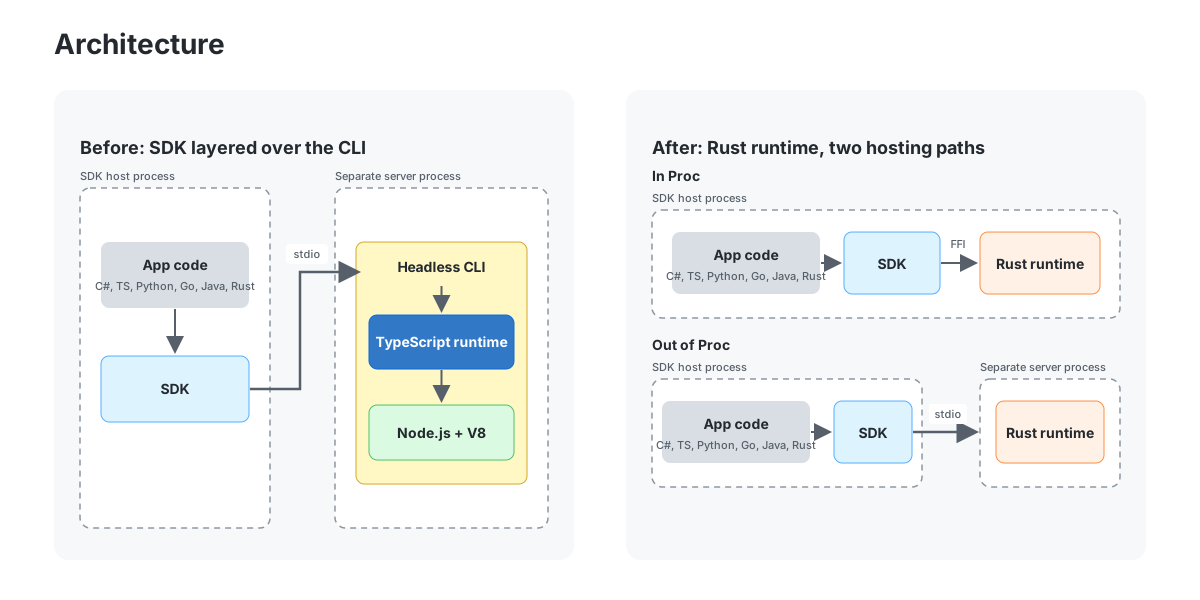
Porting a massive software system is rarely about lines of code; it is about the invisible architecture of assumptions that hold the whole thing together. When we decided to migrate the GitHub Copilot agent runtime to Rust, the goal wasn't just a language switch. It was an attempt to strip away decades of accumulated complexity and build a foundation as solid as the metal beneath our feet. We aren't talking about a toy project here. We are discussing an 800,000-line production system that powers one of the most ubiquitous developer tools in the world. Before we even opened the compiler, the question wasn't if it could be done, but if the cost of doing it was worth the risk of disruption.
In the old world of enterprise development, a rewrite of this magnitude was an economic impossibility. The budget required to maintain a dual codebase, the engineering hours needed to verify parity, and the opportunity cost of freezing feature development meant that legacy systems were often allowed to rot slowly rather than being rebuilt. The prevailing wisdom suggested that you live with the technical debt until the day the system inevitably crashes. That day has arrived, but instead of a collapse, we had a transformation. The catalyst wasn't just financial desperation; it was the realization that our existing tooling was holding us back from achieving the performance and reliability that modern AI demands.
The irony of using an AI agent to write the code that powers an AI agent is a narrative trope we often joke about, but it is the crux of this entire endeavor. We leveraged Copilot to generate the initial scaffolding for the Rust implementation, effectively using the very system we were building to help build itself. It was a feedback loop that felt almost magical at times, yet required a level of human oversight that was more intense than any previous migration. We weren't just copy-pasting; we were guiding a sophisticated engine through a labyrinth of our own making, correcting its hallucinations, and ensuring that every generated function adhered to the rigorous safety standards that define our production environment.
The journey from the first `cargo init` to a fully deployed runtime was not a linear sprint. There were nights where the compiler errors seemed to form a pattern that defied logic, and moments when we questioned whether the language itself was the bottleneck. Rust forced us to confront our architectural flaws head-on. Memory safety, borrowing rules, and concurrency models didn't just add constraints; they exposed weaknesses in our data models that had been hidden for years by the forgiving nature of interpreted languages. The friction was real, but it was the friction of progress, grinding away the soft underbelly of our legacy system to reveal something far more resilient.
Today, the runtime stands as a testament to what is possible when you align the right tools with a clear vision. The migration didn't just improve performance metrics or reduce memory footprints; it fundamentally changed how we approach problem-solving. We are now writing code that is provably safe, where the compiler acts as a co-pilot that never sleeps and never makes a mistake. The 800,000 lines of Rust are no longer a burden; they are a fortress. We have proven that even the most entrenched systems can be reinvented, and that the future of software development lies not in avoiding change, but in mastering the art of evolution.
On Bluesky? Meet HomeSky.
Follower analytics, a growth toolkit, scheduling and AI posting — built for Bluesky. Connect your account and use everything free for 60 days.
Try HomeSky free →