Migrating the GitHub Copilot runtime to Rust, using Copilot
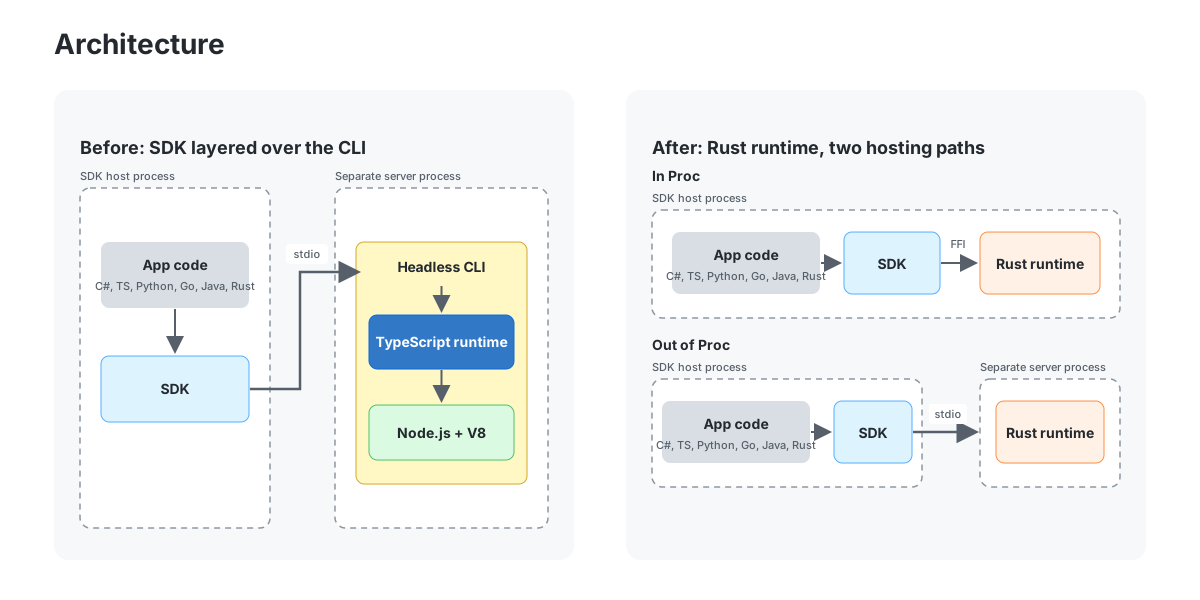
Before the rise of autonomous agents, a rewrite of this magnitude was simply not affordable. The original Copilot runtime was a sprawling ecosystem of Go, JavaScript, and Python, stitched together by a team of brilliant engineers who spent years maintaining a delicate patchwork of services. When the decision was made to migrate the entire agent runtime to Rust, the sheer volume of code—approximately 800,000 lines of production-ready Rust—seemed daunting. It wasn't just about porting syntax; it was about rethinking the architecture, memory safety, and concurrency models that underpinned a service serving millions of developers daily.
The irony that defined this project was that we used Copilot itself to write the code that would replace Copilot's own runtime. This created a recursive loop of unprecedented complexity: an AI agent attempting to refactor the very infrastructure that enables its own existence. The challenge wasn't merely technical; it was existential. If the agent hallucinated a critical dependency or introduced a logic error in a core service, the entire ecosystem could stall. We were essentially asking an AI to build the airplane while flying it, a scenario that usually ends in disaster, but here, the stakes were measured in lost developer productivity and broken build pipelines.
The process was a masterclass in iterative refinement and rigorous verification. We didn't just dump the old code and let the agent generate new code blindly. Instead, we established a strict feedback loop where the agent proposed changes, a specialized evaluation harness tested them against a massive suite of golden tests, and human engineers reviewed the most critical path modifications. This hybrid approach allowed us to leverage the speed of generative AI without sacrificing the safety guarantees that Rust provides. The language's borrow checker became our safety net, catching potential memory leaks and race conditions that might have slipped through the cracks in our previous dynamic languages.
What emerged from this migration was a system that was not only faster but fundamentally more reliable. The shift to Rust eliminated the garbage collection pauses that occasionally jittered latency-sensitive requests and removed the dynamic typing ambiguities that often led to runtime crashes. The result was a runtime that felt snappier, more predictable, and easier to reason about, even as it grew in complexity. This wasn't just an optimization; it was a foundational upgrade that aligned the performance characteristics of the infrastructure with the high-performance expectations of the developers who rely on it every day.
This journey proved that the future of large-scale software development lies in a symbiotic relationship between human oversight and machine augmentation. We didn't replace our engineers; we amplified their capabilities, allowing them to focus on architectural decisions while the agent handled the repetitive, error-prone tasks of boilerplate generation and pattern matching. The migration of 800,000 lines of code to Rust using Copilot wasn't a magical shortcut, but rather a disciplined engineering effort that redefined what is possible when you combine the precision of compiled languages with the creativity of artificial intelligence.
On Bluesky? Meet HomeSky.
Follower analytics, a growth toolkit, scheduling and AI posting — built for Bluesky. Connect your account and use everything free for 60 days.
Try HomeSky free →