Migrating the GitHub Copilot runtime to Rust, using Copilot
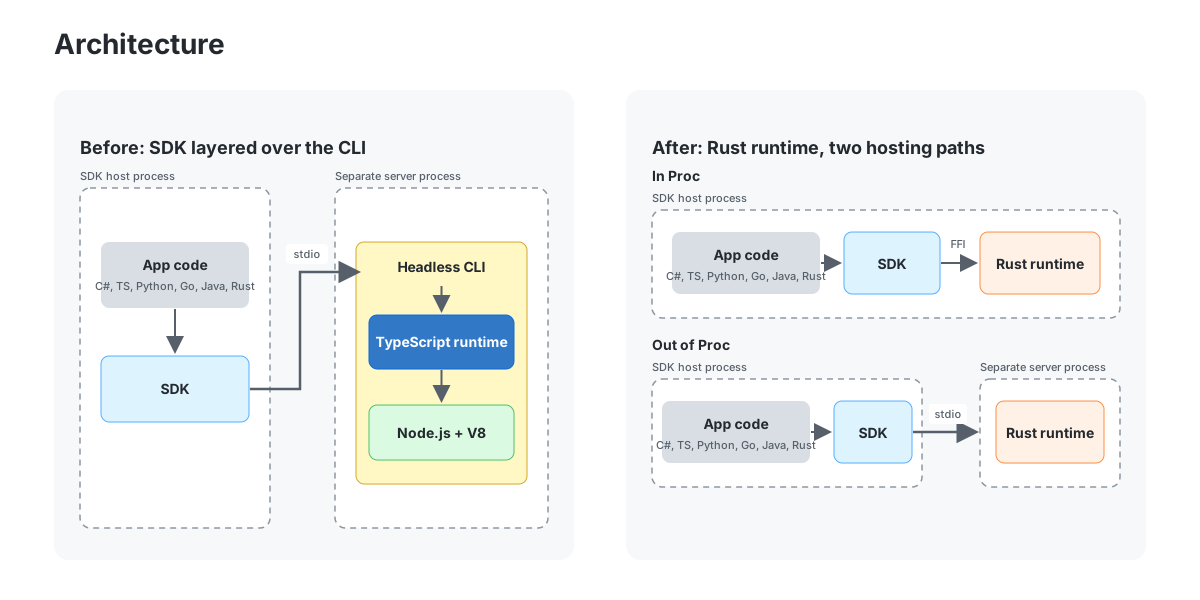
For a long time, rewriting a piece of software was a high-stakes gamble of human endurance. We would stare at mountains of legacy code, knowing that a single misstep could introduce a subtle bug that haunted us for months. But the landscape of software engineering has shifted dramatically, not because we've built faster compilers, but because we've given our machines the ability to reason alongside us. When we decided to migrate the core runtime of GitHub Copilot to Rust, we weren't just looking for a language swap; we were aiming to reclaim a significant portion of our engineering bandwidth, reducing a massive undertaking to something manageable, safe, and surprisingly rapid.
The scope of the challenge was daunting. We are talking about a system architecture involving roughly 800,000 lines of production-grade Rust code. In a traditional waterfall model, this would require a team of senior engineers working for years, constantly terrified of regressions. Yet, by leveraging the very tool we were building—the Copilot agent itself—we turned the impossible into a routine workflow. It wasn't magic; it was a feedback loop where the AI generated the port, and we acted as the rigorous gatekeepers, verifying logic, handling edge cases, and refining the implementation until it was robust enough for production.
This approach dismantled the old myth that AI coding assistants are merely autocomplete on steroids. We found that when given a clear architectural goal and the context of the existing ecosystem, the Copilot agent could understand the nuances of concurrency, memory management, and the specific idioms required for a high-performance language like Rust. It didn't just write syntax; it reasoned about the implications of that syntax within the broader system, suggesting refactors that human engineers might have missed in the heat of the moment.
The result was a profound shift in velocity and confidence. What once would have been a multi-year project with a high probability of failure became a series of iterative sprints. We could attempt the rewrite, see the results immediately, and iterate without the crippling fear of breaking the build. The Rust port brought us not only the safety guarantees and performance optimizations we sought but also a significant reduction in the cognitive load required to maintain the runtime. We stopped fighting the machine and started collaborating with it.
Ultimately, this migration proves that the future of large-scale software engineering isn't about replacing human intellect with algorithms, but about amplifying it. By using Copilot to rewrite Copilot, we demonstrated a new paradigm where agents handle the brute force of translation and boilerplate, freeing human developers to focus on the high-level architecture and the creative problem-solving that defines great software. The 800,000 lines of Rust now standing between the user and the model are no longer a burden; they are a testament to what happens when we finally stop viewing our tools as obstacles and start viewing them as partners.
On Bluesky? Meet HomeSky.
Follower analytics, a growth toolkit, scheduling and AI posting — built for Bluesky. Connect your account and use everything free for 60 days.
Try HomeSky free →