Migrating the GitHub Copilot runtime to Rust, using Copilot
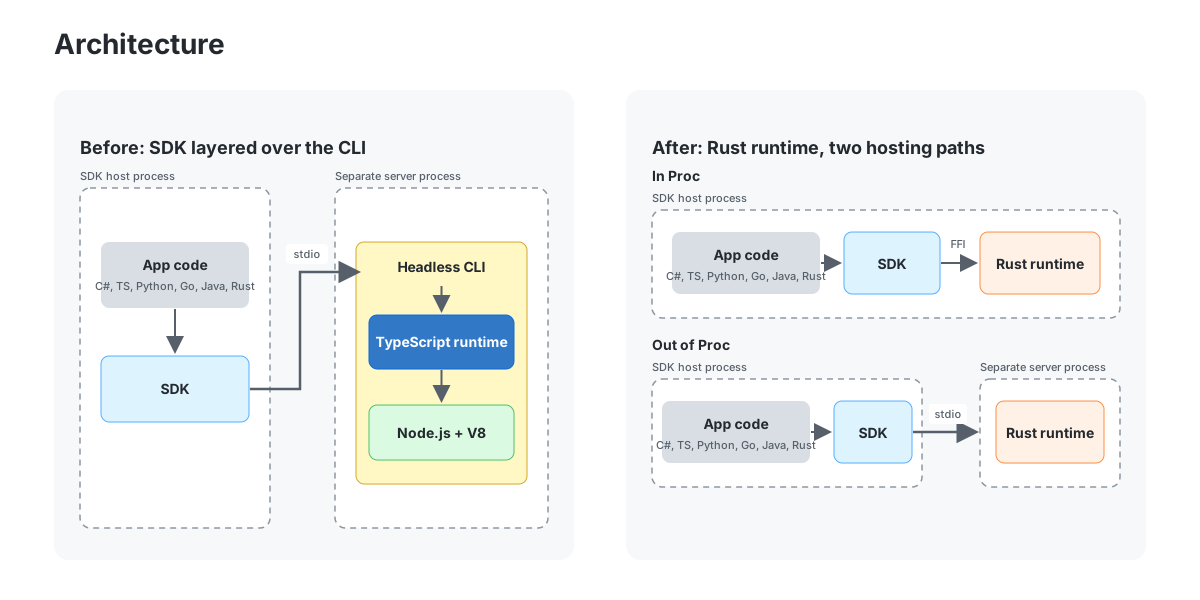
Before the arrival of modern AI agents, the idea of rewriting a massive codebase while simultaneously using the new technology to write the code itself was a fantasy, bordering on science fiction. The GitHub Copilot runtime, a critical piece of infrastructure sitting somewhere between 600,000 and 800,000 lines of code, presented exactly this paradox: how do you migrate such a colossal system to Rust when the migration itself requires writing thousands of complex files? In the past, this would have demanded a massive army of engineers working for years, but the emergence of Copilot shifted the paradigm, turning an impossible logistical hurdle into a manageable, albeit chaotic, engineering sprint.
The decision to port the runtime to Rust wasn't just about performance; it was about fundamental safety and reliability. As the system grew, the fragility of the existing architecture became a liability, with every new feature introducing potential points of failure. Rust offers memory safety without the garbage collector, a non-negotiable requirement for a system that must operate continuously with minimal latency. However, the challenge wasn't merely translating syntax; it was translating mental models. The team had to convince a language that hates undefined behavior to understand the nuances of a legacy system built over many years, all while trying to prove that the new code was as correct as the old.
The irony of the project was palpable: using an AI agent to migrate the AI system's own brain. It felt like asking a child to help build the ladder they are standing on, yet the AI proved surprisingly adept at the heavy lifting. The agents didn't just write boilerplate; they generated the intricate glue code required to connect the new Rust logic with the underlying infrastructure, often suggesting optimizations that human engineers might have overlooked in the rush to get the first version working. The human role shifted from line-by-line coder to architect and editor, guiding the agents through the labyrinth of dependencies and ensuring the resulting code adhered to the rigorous standards of a production environment.
Naturally, the process was not a straight line of success. There were moments where the AI generated code that looked perfect but failed in the most subtle ways, or where the sheer volume of changes triggered cascading failures that took days to isolate. The team had to develop new workflows to vet the output, creating a feedback loop where human intuition corrected the AI's hallucinations, which in turn refined the AI's understanding of the codebase. This symbiotic relationship revealed that the best results came from a tight loop of human oversight and machine generation, rather than relying on either in isolation.
Looking back at the journey of porting 800,000 lines of code, the experience redefines what is possible in software engineering. It demonstrates that the barrier to high-assurance systems is no longer just technical expertise, but the ability to orchestrate intelligent tools effectively. The migration to Rust was not just a change of language; it was an evolution in how teams approach complexity, proving that with the right tools, even the most daunting infrastructure challenges can be dismantled one logical step at a time.
On Bluesky? Meet HomeSky.
Follower analytics, a growth toolkit, scheduling and AI posting — built for Bluesky. Connect your account and use everything free for 60 days.
Try HomeSky free →