Migrating the GitHub Copilot runtime to Rust, using Copilot
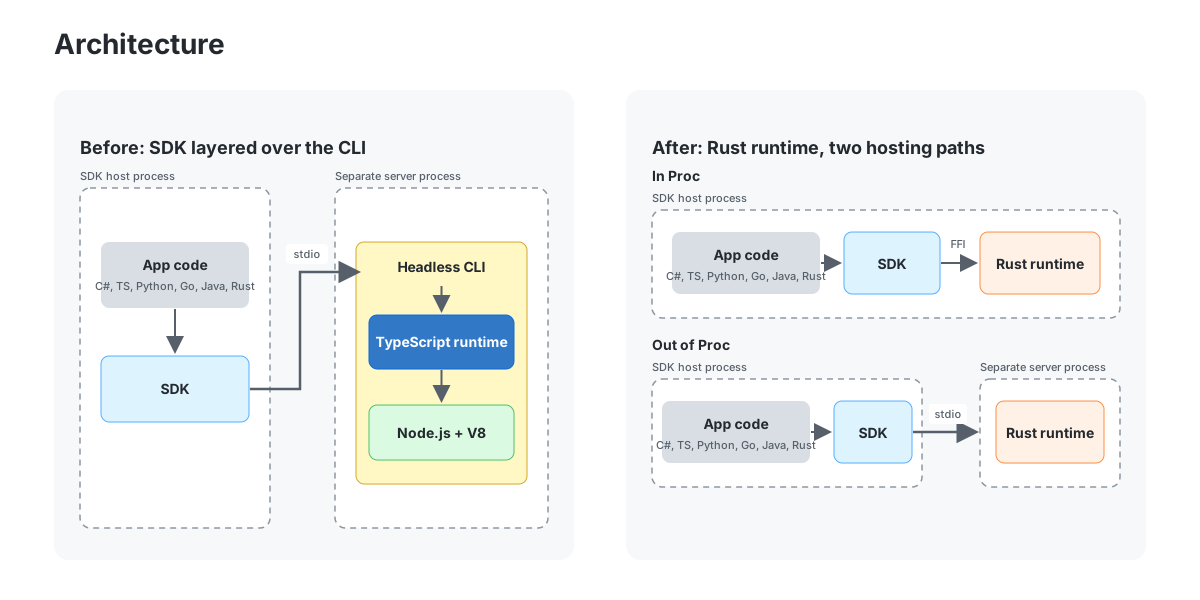
For years, the idea of rewriting a massive software component using the very tools that component was built to use felt like a paradox, a recursive loop that promised efficiency but threatened chaos. Before the rise of autonomous agents, undertaking a port of this magnitude was not just a technical challenge; it was an economic impossibility. The sheer volume of cognitive load required to translate 800,000 lines of production code from one language to another, while simultaneously understanding the semantic intent behind every function, exceeded the capacity of any single engineering team. We were stuck in a cycle where the complexity of the codebase acted as a brake on the very innovation needed to move it forward.
The Copilot runtime was built with a specific philosophy: speed and reliability were paramount, originally relying on a dynamic language that offered rapid iteration but struggled with the overhead of massive enterprise-scale systems. The decision to migrate to Rust was driven by a need for memory safety and performance that could not be compromised, yet the fear of introducing regressions or breaking existing integrations kept the team paralyzed. It wasn't until the integration of Copilot itself as a co-pilot in the development process that the equation balanced. The runtime, which previously could only assist individual developers, became the engine driving its own evolution, creating a feedback loop where the system learned the architecture of its own future.
Porting a codebase of this size is rarely about line-by-line translation; it is about architectural discovery. As the agents worked through the legacy code, they didn't just rewrite syntax; they identified patterns of redundancy and refactored logic that human reviewers had overlooked over years of incremental changes. The process revealed that a significant portion of the original implementation was defensive over-engineering that Rust's strict type system and ownership model naturally corrected. This wasn't a blind port; it was a guided excavation where the AI suggested modern idioms that human engineers then validated, ensuring that the new Rust implementation wasn't just functionally equivalent but structurally superior.
The human element in this story is often underestimated. It required a shift in how the engineering culture viewed its own tools. Developers stopped seeing the agent as a utility for generating snippets and started viewing it as a structural partner capable of handling the bulk of the migration burden. There were moments of friction where the agent proposed solutions that were technically correct but culturally misaligned with the team's established patterns, leading to a collaborative dance of refinement. The result was a codebase that felt less like a translation and more like a reinvention, shedding the baggage of the past while retaining the core functionality that millions of users relied upon daily.
Ultimately, this migration stands as a proof of concept for a new era of software engineering where the boundary between tool and builder begins to blur. It demonstrates that with the right alignment of technology and process, the barriers to large-scale modernization can be dismantled. The journey from a dynamic runtime to a robust Rust ecosystem was not just about improving performance metrics; it was about proving that the future of software development is not a choice between human intuition and artificial precision, but a synergy where both amplify each other to achieve what was once thought impossible.
On Bluesky? Meet HomeSky.
Follower analytics, a growth toolkit, scheduling and AI posting — built for Bluesky. Connect your account and use everything free for 60 days.
Try HomeSky free →