Migrating the GitHub Copilot runtime to Rust, using Copilot
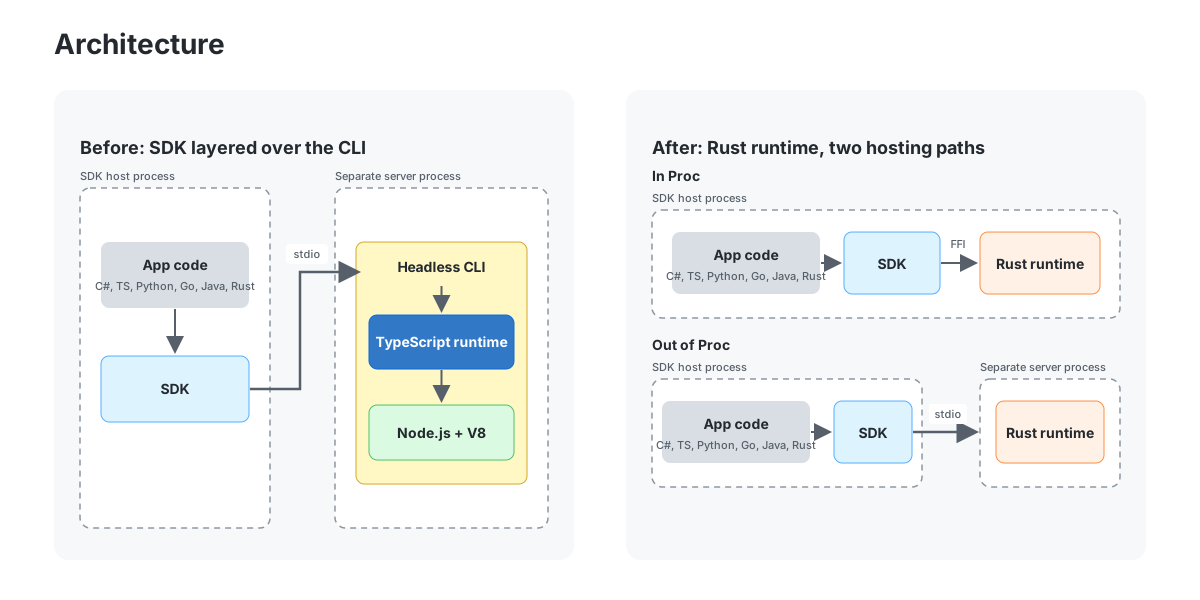
For decades, the cost of engineering excellence was measured in dollars and hours, but the equation has shifted. Before the era of autonomous agents, rewriting a complex system was a luxury we couldn't afford; it was a gamble where the downtime alone could bankrupt a product team. Today, we are proving that porting a massive, production-grade runtime to a new language isn't just a technical exercise—it is an act of accelerated evolution. The decision to migrate the GitHub Copilot runtime to Rust wasn't made lightly, but the catalyst for change was the very tool we built: Copilot.
The legacy runtime was written in a language known for its speed and safety, yet as the system grew, so did the friction. It had reached a tipping point where the complexity of the codebase itself became a liability. We weren't just moving lines of code; we were transferring the burden of millions of users who rely on instant, reliable suggestions. The goal was clear: leverage Rust's memory safety guarantees and performance to build a foundation that could scale indefinitely without the baggage of historical technical debt. In the past, this would have required years of manual refactoring, sleepless nights, and a high risk of regression. With agents, we turned a multi-year project into a manageable sprint.
The scale of this undertaking is staggering, yet it feels almost surreal when viewed through the lens of modern development. We are talking about roughly 800,000 lines of production Rust code, a mountain of logic that powers one of the most sophisticated AI assistants in the world. The challenge wasn't just writing the new code; it was making the machine write the new code. By using Copilot to architect and generate the Rust implementation, we created a recursive loop where the tool we built was the primary instrument of its own resurrection. This isn't science fiction; it is the new normal of software engineering, where the barrier to entry for massive system rewrites has been effectively erased.
However, this isn't just a victory lap for automation. The migration revealed something profound about the relationship between humans and machines in high-stakes environments. The agent didn't replace the engineers; it amplified their intent, allowing them to focus on the architectural vision while handling the gritty details of porting. It proved that we can tackle problems of unprecedented scale by trusting our tools to handle the heavy lifting. The result is a system that is faster, safer, and more resilient, all built in a fraction of the time it would have taken a team of senior engineers working in isolation.
As we stand on this new foundation, the implications stretch far beyond a single language migration. We are witnessing the dawn of an era where legacy systems are no longer anchors dragging down innovation. The ability to rewrite, refactor, and reimagine at this velocity means we can iterate on safety, performance, and features at a pace that was previously impossible. The 800,000 lines of Rust are not just code; they are a testament to a new paradigm where the most complex challenges are met not with hesitation, but with the confidence that our tools are ready to lead the way.
On Bluesky? Meet HomeSky.
Follower analytics, a growth toolkit, scheduling and AI posting — built for Bluesky. Connect your account and use everything free for 60 days.
Try HomeSky free →