Migrating the GitHub Copilot runtime to Rust, using Copilot
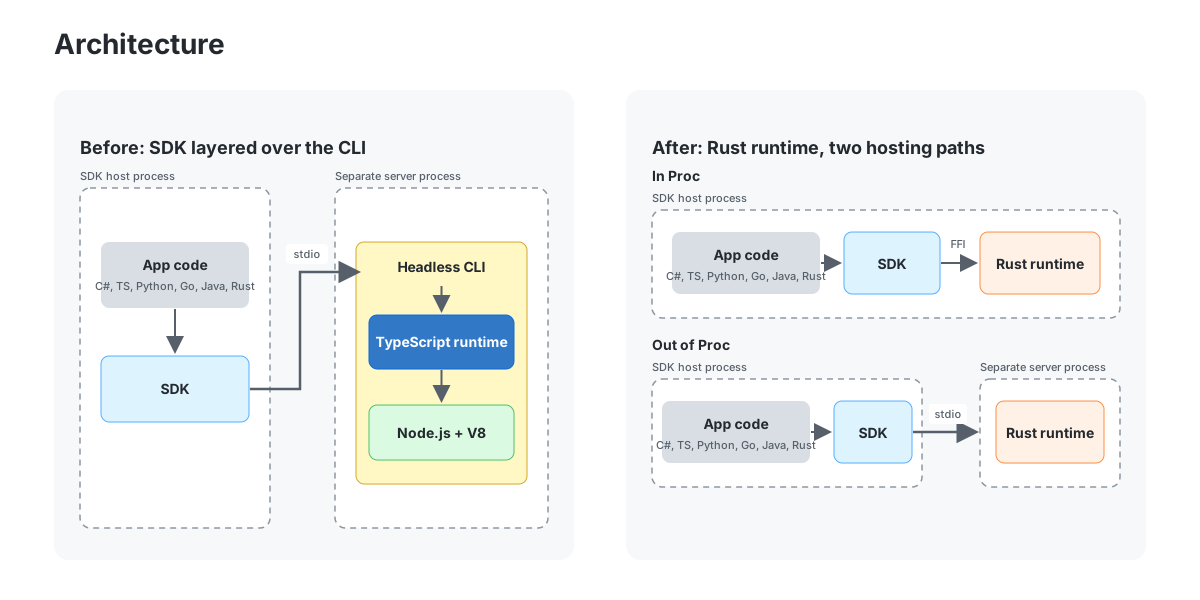
Before the dawn of modern AI agents, the economic model of software engineering was brutally simple: if a task required significant human effort, it could not be afforded at scale. Rewriting a massive codebase was a luxury reserved for greenfield projects or situations where safety demanded a complete rebuild, not a migration. The decision to port the GitHub Copilot runtime, a complex system managing hundreds of millions of user interactions, to Rust represented a shift in that calculus. It was an attempt to solve a problem that, under old constraints, would have simply been deemed too expensive to attempt.
The scale of this undertaking was nothing short of daunting. We were looking at a migration involving approximately 800,000 lines of production-grade Rust code. To put that number in perspective, this was not a weekend hackathon project or a library rewrite; it was a full-scale operational rewrite of a critical infrastructure layer. In previous decades, the sheer volume of manual refactoring required would have introduced an unmanageable window of risk, where bugs could slip through and compromise the reliability of the service for millions of users. The margin for error in the old world was nonexistent.
The arrival of Copilot fundamentally altered the risk profile. By leveraging these agents to handle the heavy lifting of translation, verification, and integration, we turned a theoretical impossibility into a practical engineering exercise. The agents didn't just write the code; they acted as a continuous audit trail, cross-referencing the new Rust implementation against the logic of the legacy system. This symbiotic relationship allowed the team to move forward with a level of confidence that was previously unattainable, effectively outsourcing the most tedious and error-prone aspects of the migration to the very technology built on top of the runtime.
However, the transition was far from a magic button press. It required a deep, architectural understanding of both the Rust ecosystem and the specific nuances of the Copilot runtime. The process involved dissecting the existing logic, mapping dependencies, and ensuring that performance characteristics—such as latency in generating code suggestions—were preserved or even improved upon in the new architecture. It was a dance between human oversight and automated execution, where the engineers had to guide the agents through edge cases that no amount of training data could fully anticipate on its own.
The outcome validates a profound truth about the current state of software development: the tools we build today are evolving faster than the processes we use to build them. Migrating the Copilot runtime to Rust demonstrated that with the right combination of agent capabilities and rigorous engineering standards, we can tackle monolithic rewrites with agility. The result is a faster, more secure, and more maintainable system, but more importantly, it is a testament to the idea that the future of large-scale software evolution depends on our ability to partner effectively with our own creations.
On Bluesky? Meet HomeSky.
Follower analytics, a growth toolkit, scheduling and AI posting — built for Bluesky. Connect your account and use everything free for 60 days.
Try HomeSky free →