Migrating the GitHub Copilot runtime to Rust, using Copilot
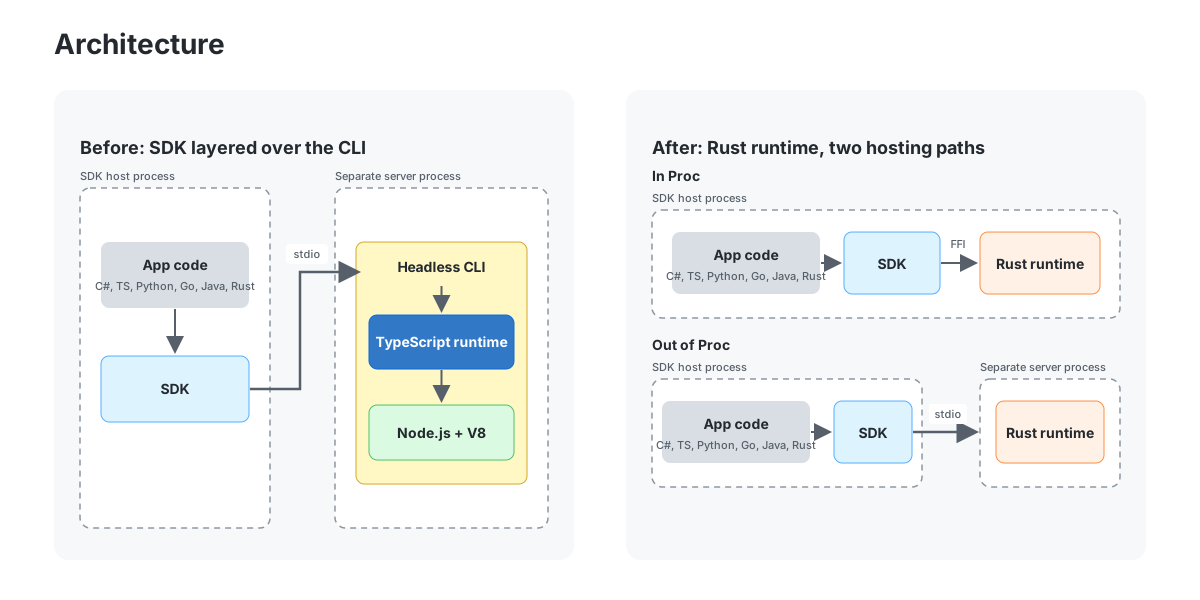
For years, the idea of rewriting a massive, battle-tested codebase in a different language felt like a suicide mission. We were talking about 800,000 lines of production code, a system that had to handle the nuances of thousands of developers worldwide. Before the concept of AI agents, such an undertaking wasn't just expensive; it was fundamentally unaffordable. The cost in engineering hours, the risk of breaking features, and the sheer logistical nightmare of coordinating a full-scale migration made the Rust rewrite of the GitHub Copilot runtime seem impossible.
That changed when we stopped trying to move the code by hand and started asking Copilot to do the heavy lifting. The premise was simple yet audacious: use the very system we were building to build itself. By feeding the existing Python runtime into Copilot with specific instructions to generate Rust equivalents, we transformed a theoretical impossibility into a practical engineering challenge. It wasn't magic, of course; it was the result of a sophisticated loop where the AI generated code, we reviewed it, corrected the hallucinations, and fed those corrections back into the context window to refine the next batch.
The initial results were a mix of brilliance and bizarre incompetence. Copilot excelled at boilerplate and standard library patterns, generating idiomatic Rust that felt almost human in its structure. However, it frequently misunderstood the subtle dependencies and edge cases that seasoned developers had spent years hard-coding. We found ourselves in a constant dance of correction, where the AI would generate a perfect-looking function only to miss a critical type constraint that the original Python code handled implicitly. This forced us to develop a rigorous review process, treating the AI not as a replacement for engineers, but as a highly capable, albeit occasionally distracted, intern.
As the rewrite progressed, the performance gains became undeniable. Rust offered a level of memory safety and execution speed that Python simply could not match, crucial for the low-latency requirements of the Copilot agent. The migration wasn't just a cosmetic change; it was a fundamental upgrade to the reliability and efficiency of the entire platform. The ability to reason about memory ownership and eliminate garbage collection pauses allowed us to push the limits of what the agent could do in real-time, ensuring that suggestions arrived faster and more accurately than ever before.
The story of this migration is less about the technology we used and more about the shift in how we approach complex software evolution. We proved that with the right tools and a structured workflow, the barriers to massive-scale refactoring can be lowered significantly. It wasn't a perfect process, and we still spent countless hours debugging the output, but it opened a door that was previously locked. The future of large-scale codebases might not lie in hiring more engineers to write more lines, but in leveraging intelligent agents to help us rewrite the ones we already have, one file at a time.
On Bluesky? Meet HomeSky.
Follower analytics, a growth toolkit, scheduling and AI posting — built for Bluesky. Connect your account and use everything free for 60 days.
Try HomeSky free →