Migrating the GitHub Copilot runtime to Rust, using Copilot
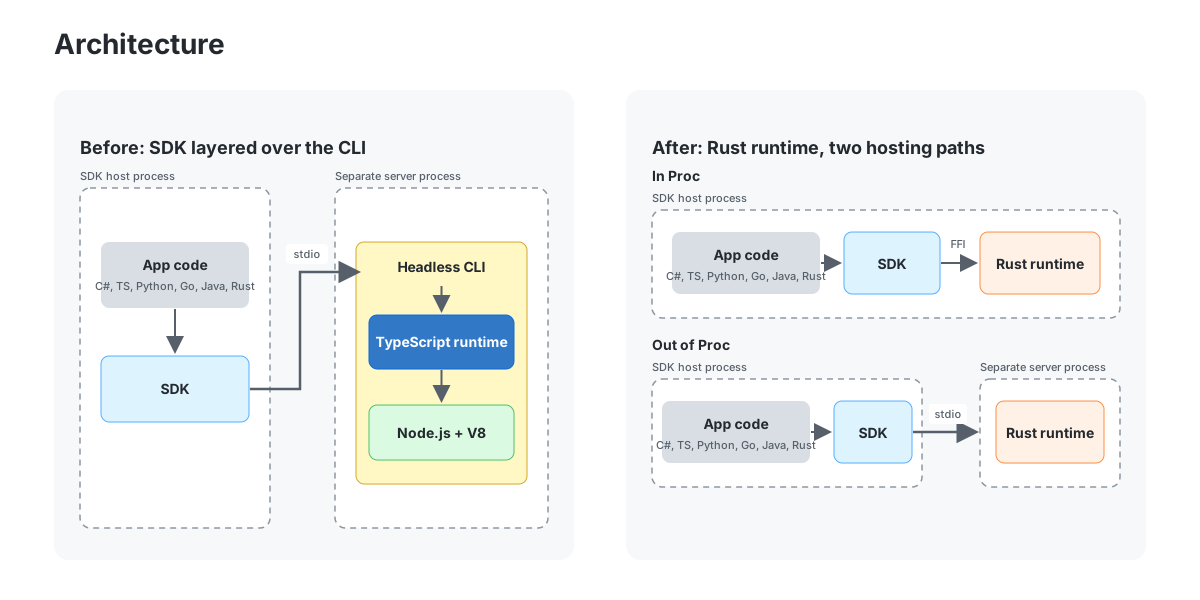
For decades, the architecture of large-scale development tools was bound by the inertia of legacy languages, creating a ceiling on performance and safety that felt almost physical. The GitHub Copilot runtime, a critical engine powering code generation for millions of developers, was no different, built upon a foundation that, while functional, was increasingly untenable for the demands of modern AI. The decision to rewrite this system in Rust was not merely an exercise in refactoring; it was a strategic pivot to eliminate memory safety vulnerabilities and drastically reduce latency, a move that required more than just a change in syntax. It demanded a complete rethinking of how an agent-based system could operate at scale without sacrificing the reliability that engineering teams depend upon.
The sheer volume of the undertaking was staggering, involving approximately 800,000 lines of production-grade Rust code. This was not a side project or a weekend hackathon entry; it was a full-scale migration of a core platform component that required a level of precision and rigor that traditional languages often lacked. Before the advent of modern AI agents, such a rewrite would have been prohibitively expensive in terms of time and human resources, likely requiring a team of senior engineers working for months in a state of constant vigilance. The manual process of translating complex logic, handling edge cases, and ensuring type safety across such a massive codebase was a logistical nightmare that threatened to stall progress indefinitely.
The introduction of Copilot agents changed the calculus entirely. By leveraging the very tool we were building to perform the build, we turned the migration from a monumental manual labor task into a collaborative, iterative process. Instead of developers manually transcribing every function and loop, we used AI agents to analyze the existing codebase, generate idiomatic Rust implementations, and even handle the intricate details of memory management and concurrency. This allowed us to maintain a level of velocity that was previously impossible, transforming what should have been a years-long ordeal into a manageable, albeit complex, engineering sprint.
However, the presence of an assistant does not remove the need for human judgment; in fact, it amplifies the requirement for it. The narrative of this rewrite is not one of replacing engineers with machines, but of empowering them to focus on high-level architecture and validation while the agents handle the tedious translation of boilerplate and standard patterns. We found that the AI excelled at generating the "glue" code and standard library interactions, allowing our team to concentrate on the unique business logic and the specific safety constraints that Rust's ownership model demands. It was a symbiotic relationship where the machine handled the volume, and the humans handled the intent.
The result is a runtime that is faster, safer, and more maintainable, but the journey itself offers a profound lesson for the industry. It demonstrates that the tools we build today are becoming the scaffolding for the transformations of tomorrow. The ability to use an intelligent agent to rewrite a massive codebase in a language of choice is no longer a futuristic concept; it is a present-day reality that is reshaping how we approach software evolution. As we look forward, the line between builder and built begins to blur, suggesting that the next great leaps in software engineering will come not from working harder, but from working smarter with the very systems we are constructing.
On Bluesky? Meet HomeSky.
Follower analytics, a growth toolkit, scheduling and AI posting — built for Bluesky. Connect your account and use everything free for 60 days.
Try HomeSky free →