Migrating the GitHub Copilot runtime to Rust, using Copilot
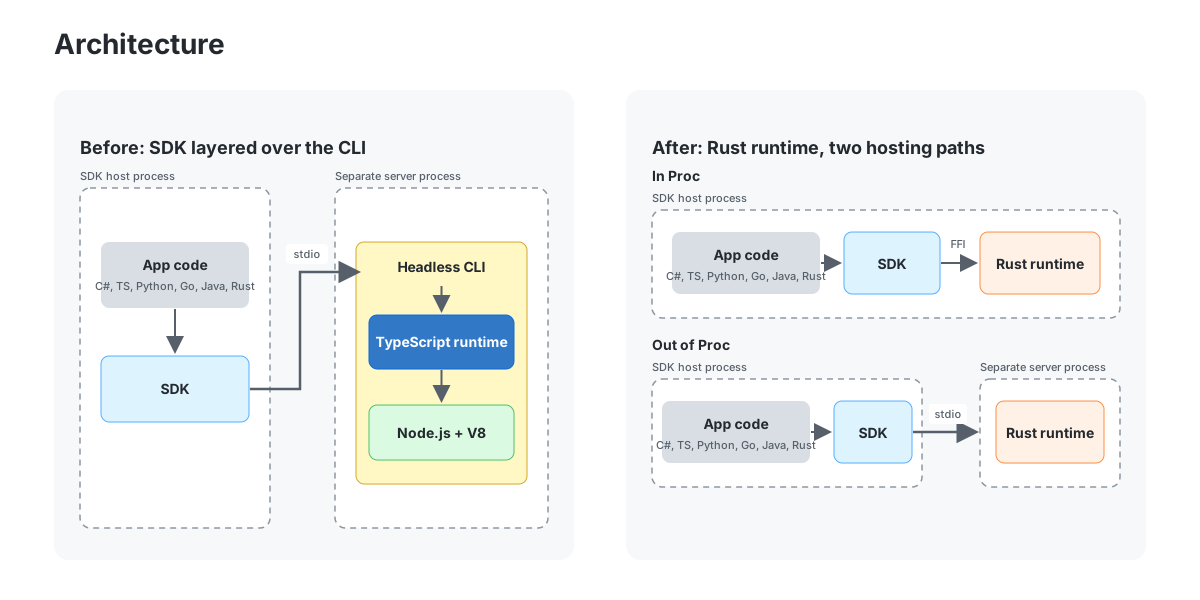
For years, the thought of porting the GitHub Copilot agent runtime to Rust felt like a logistical impossibility, a task so massive that it defied the economic logic of software engineering. We were staring down a wall of 800,000 lines of production-grade code, a monolith that had served us well in Python but was now hitting the friction limits of our infrastructure. The sheer volume of state management, dependency resolution, and concurrency patterns in the original implementation suggested that a rewrite would take a team of dozens years to complete. In the pre-agent era, such a project was simply too expensive to justify the risk of downtime or the potential for regression bugs that could slip through the cracks of a manual refactor.
Then the concept of AI agents shifted the cost-benefit analysis entirely, turning an insurmountable mountain into a manageable climb. By leveraging Copilot itself to architect and generate the Rust code, we effectively created a feedback loop where the tool we were building became the engine that built itself. It wasn't magic; it was a highly directed, iterative process where the AI handled the boilerplate and pattern matching while human engineers focused on the architectural glue and the critical path logic. This symbiotic relationship allowed us to move at a velocity that would have been unthinkable just two years ago, compressing what used to be a multi-year effort into a sprint that felt almost instantaneous.
The transition wasn't without its own unique set of challenges, particularly when dealing with Rust's strict ownership model and lifetime parameters. While Copilot could generate syntactically correct Rust code, ensuring that the generated logic correctly modeled the complex state of the agent runtime required a level of human oversight that was crucial. We found that the AI excelled at implementing standard library patterns and data structures but needed human guidance when navigating the subtle interactions between the agent's memory management and the host environment's security constraints. It became a dance of correction and refinement, where the AI proposed a solution and the engineer validated its safety and correctness against the system's rigorous standards.
Beyond the sheer line count, the move to Rust offered a profound shift in the performance characteristics of the runtime. The language's borrow checker, often a source of frustration for newcomers, became our greatest asset in this migration, forcing a discipline in the codebase that reduced runtime errors before they could ever occur. The resulting application is not just a translation of functionality but a significant optimization, offering lower memory footprints and faster execution times that allow the Copilot runtime to scale more efficiently across distributed environments. This performance leap is critical for maintaining the responsiveness that users expect when interacting with an intelligent coding assistant, ensuring that suggestions appear instantly rather than after a noticeable delay.
Looking back, the journey highlights a pivotal moment in software development history where the role of the engineer is evolving from a purely manual coder to an orchestrator of intelligent systems. We didn't just write code; we guided an AI through the labyrinth of our existing architecture, teaching it our patterns and constraints until it could operate with near-autonomy. This experience serves as a blueprint for the future of large-scale system migrations, demonstrating that the barrier to entry for rewriting legacy systems is no longer limited by human bandwidth but by the quality of the direction we provide to our digital collaborators. The rewrite of the Copilot runtime stands as a testament to what happens when we stop fighting the tools we use and start leveraging them to build the very infrastructure that powers them.
On Bluesky? Meet HomeSky.
Follower analytics, a growth toolkit, scheduling and AI posting — built for Bluesky. Connect your account and use everything free for 60 days.
Try HomeSky free →