Migrating the GitHub Copilot runtime to Rust, using Copilot
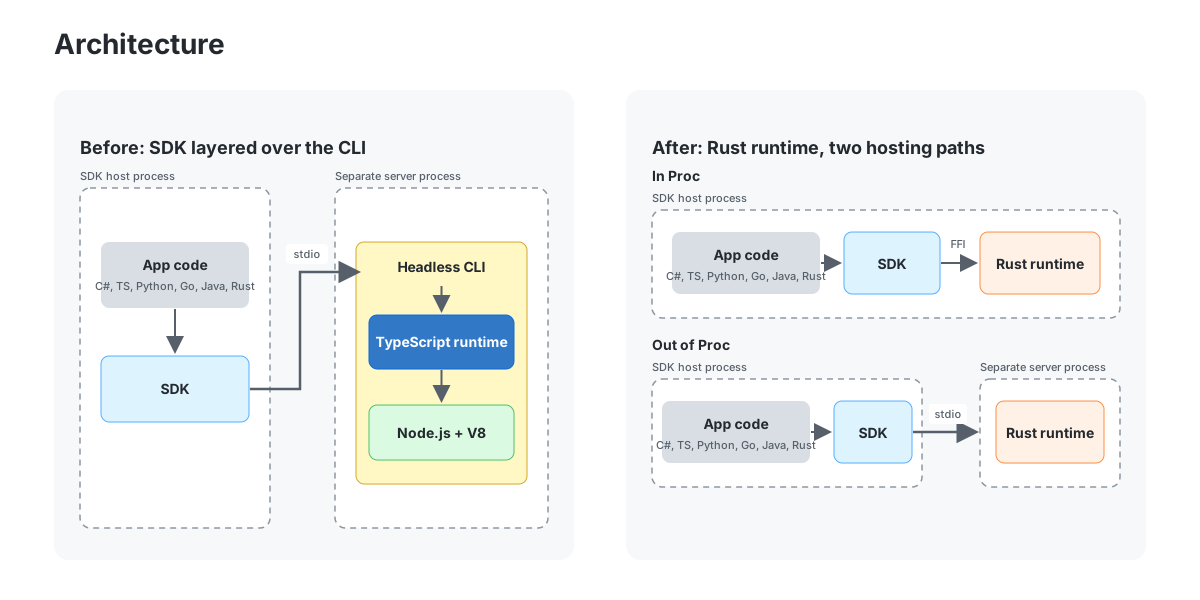
For years, the idea of porting the GitHub Copilot runtime from Go to Rust felt like a luxury we couldn't afford. The sheer volume of code—roughly 800,000 lines of production logic—suggested that a rewrite was a project for a decade, not a sprint. But in the landscape of modern development, the constraints have shifted. What once required months of manual refactoring by a dozen senior engineers can now be accelerated by the very tool being rewritten. The arrival of AI agents changed the economics of software maintenance, turning a prohibitive cost into a manageable, albeit complex, endeavor.
The initial challenge wasn't just syntactic translation; it was architectural translation. Go's concurrency model, built around goroutines and channels, is fundamentally different from Rust's ownership-based, message-passing paradigm. Before leveraging AI agents, this meant mapping every async flow, tracing memory lifetimes, and manually verifying safety invariants. The cognitive load of ensuring that a 100-page state machine in Go would behave identically in Rust without introducing race conditions or memory leaks was immense. We were essentially trying to rebuild the engine while the car was still being driven, a task that historically guaranteed a crash or a significant performance penalty.
Enter the agent. By feeding the existing Go runtime and its comprehensive test suite into an LLM, we effectively created a digital pair programmer with god-like visibility into our own codebase. The agent didn't just write code; it wrote verified code. It could look at a failing unit test, understand the Rust equivalent of the Go construct, and generate the implementation alongside the necessary safety proofs. This wasn't magic; it was the result of a sophisticated prompt engineering loop where the AI iterated through hundreds of small, context-aware patches, effectively compressing years of architectural knowledge into a few months of active development.
However, the narrative doesn't end with a clean "magic button" solution. There were moments of friction where the agent confidently generated code that compiled but failed in edge cases, or where the idiomatic Rust suggestions clashed with the specific legacy patterns of the Copilot runtime. We had to build a rigorous review pipeline, teaching the agent our specific standards and enforcing human-in-the-loop validation for critical paths. The rewrite became a collaboration between human intent and machine execution, where the AI handled the brute force of syntax and pattern matching, while engineers focused on high-level logic and system integration.
The result is a runtime that is not only faster at compile time due to Rust's borrow checker but also significantly more robust in production. Memory safety is no longer an afterthought; it's baked into the language choice, eliminating a whole class of vulnerabilities that were previously mitigated by runtime checks in Go. The 800,000 lines of code are now a fortress, not a liability. This migration proves that the future of large-scale software evolution isn't just about better compilers or faster hardware; it's about changing the fundamental relationship between developers and the tools they use to build them.
Ultimately, this project serves as a microcosm for the industry's shift toward AI-assisted development. It demonstrates that the barrier to entry for massive refactoring has collapsed. We no longer need to wait for the perfect team or the perfect timeline to modernize our stack; we have the capability to tackle the impossible, one agent-assisted commit at a time. The Copilot runtime is just the beginning, but it sets a precedent for what is possible when we stop fighting against our own infrastructure and start building with it.
On Bluesky? Meet HomeSky.
Follower analytics, a growth toolkit, scheduling and AI posting — built for Bluesky. Connect your account and use everything free for 60 days.
Try HomeSky free →