Migrating the GitHub Copilot runtime to Rust, using Copilot
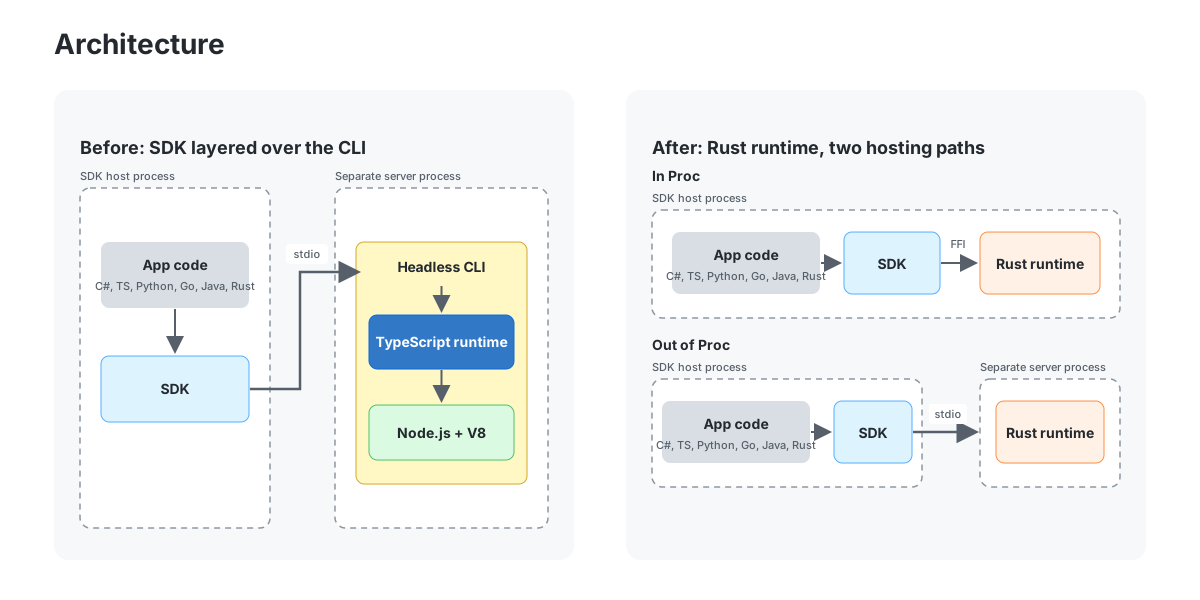
For years, the decision to port the GitHub Copilot runtime to Rust was a non-starter. The sheer volume of legacy code—roughly 800,000 lines of production C++—meant that a human-led rewrite was not just a massive undertaking, but an economic impossibility. The cost in engineer-hours alone would have dwarfed any potential performance gain, making the project a clear "no" in any traditional budget review. It was an insurmountable wall of legacy debt that seemed designed to keep the status quo intact.
That wall crumbled only when the concept of AI agents fundamentally shifted the cost-benefit analysis. By leveraging Copilot's own capabilities to architect the migration, we transformed a prohibitively expensive manual labor project into a scalable, iterative engineering process. The irony was palpable: using an AI agent to rewrite an AI agent's infrastructure. This wasn't just about translating syntax; it was about orchestrating a complex system where the tool doing the heavy lifting was also the product being built, creating a feedback loop of unprecedented efficiency.
The technical challenge lay in the ecosystem dependencies. Rust's strict ownership model and zero-cost abstractions offered a path to lower latency and higher reliability, but the existing C++ codebase relied on patterns that didn't translate cleanly. Instead of manually auditing every file, we deployed a specialized agent swarm to analyze dependencies, generate Rust stubs, and run continuous integration tests in real-time. The agent didn't just write code; it acted as a senior architect, identifying where the Rust idioms clashed with the original logic and proposing nuanced refactorings that humans might have missed in a sea of lines.
What emerged was a runtime that was not only faster but significantly more maintainable. The resulting codebase benefits from Rust's safety guarantees, eliminating entire classes of memory safety bugs that have plagued C++ for decades. However, the real victory was the velocity. We achieved a migration that would have taken years of dedicated engineering resources in a fraction of the time, proving that the right tooling can render traditional constraints irrelevant. The project became a testament to the idea that we are no longer limited by the speed of human cognition, but by the ingenuity of the systems we build to augment it.
Looking back, this rewrite represents a paradigm shift in how we approach massive infrastructure migrations. It validates a new era of software development where agents are not just assistants for documentation or boilerplate, but primary drivers of architectural change. The success of porting the Copilot runtime to Rust demonstrates that with the right leverage, even the most daunting technical debts can be tackled with surgical precision. It is a story not just of code, but of the evolving relationship between human intent and machine execution.
On Bluesky? Meet HomeSky.
Follower analytics, a growth toolkit, scheduling and AI posting — built for Bluesky. Connect your account and use everything free for 60 days.
Try HomeSky free →