Genetically Engineered Yeast Could Build the First Martian Outposts
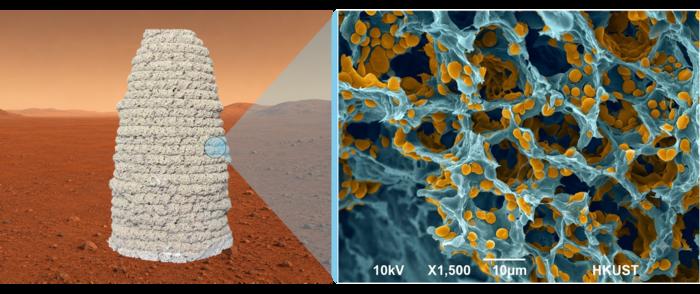
In the cold, dusty silence of the Red Planet, the dream of a permanent human outpost often hits a hard wall of economics. The current reality of space exploration is defined by the tyranny of the rocket: every kilogram of building material launched from Earth costs tens of thousands of dollars, a price tag that makes constructing even a simple pressurized habitat a logistical nightmare. To survive on Mars, we cannot simply bring our homes with us; we must learn to grow them from the very regolith beneath our boots.
This fundamental shift from shipping steel to synthesizing it from local resources is where biology takes the lead over heavy industry. A groundbreaking study led by Ning Liu at the Hong Kong University of Science and Technology, recently published in the journal Chem Circularity, proposes a method that turns this impossible task into a biological inevitability. Instead of relying on massive excavators to crush rocks for construction aggregate, the team has engineered a strain of yeast capable of transforming Martian soil directly into structural concrete.
The genius of this approach lies in its simplicity and scale. The genetically modified yeast acts as a microscopic factory, consuming the iron oxide and other minerals abundant in Martian regolith and excreting a calcium-aluminum-silicate hydrate gel. This substance, known as "Marscrete," possesses the compressive strength necessary for building foundations and walls without the need for energy-intensive kilns or the heavy machinery required to process raw rock on Earth. It is a process that mimics nature's own way of building, using life to bridge the gap between alien dust and human shelter.
The implications for the timeline of Mars colonization are staggering. Current plans often involve years of preparation and the accumulation of vast stores of imported materials. If this biological construction method can be adapted and deployed, the construction of initial outposts could be accelerated by orders of magnitude. We could theoretically turn a barren landscape into a livable environment in months rather than decades, fundamentally changing the equation of when humanity becomes a multi-planetary species.
However, the path from a laboratory petri dish to a city on Mars is fraught with engineering challenges that extend beyond the biology itself. The Martian atmosphere is thin and cold, presenting unique hurdles for maintaining the yeast cultures necessary for construction. Furthermore, scaling this process from a few kilograms in a lab to the tons required for a habitat will require significant optimization. Yet, the principle remains robust: if we can teach microbes to build our shelters, we are no longer limited by the payload capacity of our rockets.
Ultimately, this research represents a profound evolution in how we conceive of space expansion. It moves us away from the image of humans as conquerors who drag their entire civilization with them, and toward a model of integration where we adapt to the environment rather than forcing it to bend to our will. As we look toward the stars, the most powerful tool in our kit may not be a drill or a laser, but a simple, engineered organism that helps us say, "Home."
On Bluesky? Meet HomeSky.
Follower analytics, a growth toolkit, scheduling and AI posting — built for Bluesky. Connect your account and use everything free for 60 days.
Try HomeSky free →