Migrating the GitHub Copilot runtime to Rust, using Copilot
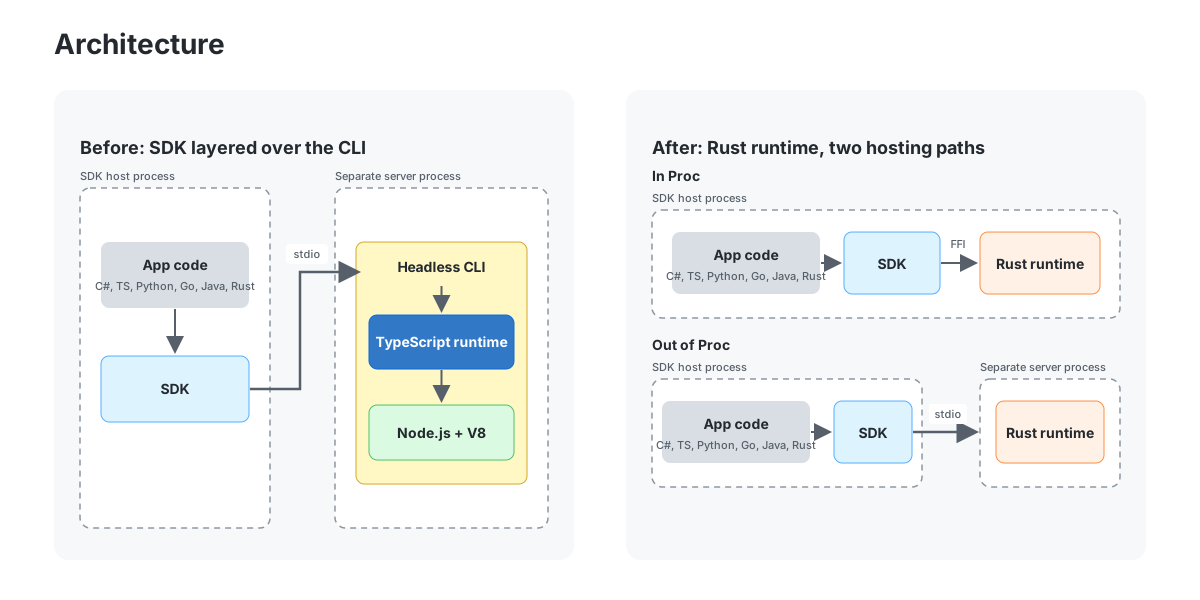
Before the era of autonomous agents, migrating a production system of this magnitude was a logistical nightmare, often requiring weeks of manual refactoring, painstaking code reviews, and a team of senior engineers working around the clock. The decision to rewrite the GitHub Copilot runtime in Rust was not taken lightly; it involved porting approximately 800,000 lines of critical code, a task that previously demanded an immense investment of human time and cognitive bandwidth. The sheer volume of legacy code represented a barrier that simply wasn't affordable to overcome with traditional methodologies, forcing us to reconsider the fundamental economics of software development and maintenance.
Enter the new reality where agents can do the heavy lifting, fundamentally changing the cost-benefit analysis of large-scale porting projects. By leveraging Copilot itself to assist in the migration, we transformed a project that might have taken months or even years of manual labor into a manageable, accelerated process. This wasn't just about writing code faster; it was about shifting the role of the engineer from a typist of syntax to an architect of solutions. The irony of using an AI-powered coding agent to build the infrastructure that powers that same agent is a testament to the recursive nature of modern software evolution.
The technical challenges were significant, extending far beyond simple syntax translation. Rust's strict type system, ownership model, and memory safety guarantees required a deep understanding of the existing C++ implementation, often forcing a complete rethinking of data structures and concurrency patterns. However, having Copilot generate initial scaffolding and suggest idiomatic Rust patterns allowed the team to focus on the complex architectural decisions rather than getting bogged down in boilerplate. It provided a continuous feedback loop where the AI could propose optimizations, and human engineers could validate them against performance requirements and safety constraints.
The results speak for themselves: a more secure, performant, and maintainable codebase that adheres to modern best practices without sacrificing the core functionality that millions of users rely on daily. The migration wasn't just a technical exercise; it was a validation that AI agents can handle the gritty, unglamorous work of legacy modernization with remarkable efficacy. By reducing the human toil associated with such a massive undertaking, we freed up our engineering talent to tackle higher-level challenges, such as enhancing the intelligence of the agent itself.
This shift represents more than just a rewrite in a different language; it marks a paradigm shift in how we approach software lifecycle management. As we look to the future, the boundary between human intuition and machine execution continues to blur, offering a glimpse into a workflow where the friction of building complex systems is significantly reduced. The journey from 800,000 lines of C++ to optimized Rust code, guided by an intelligent assistant, proves that the tools we build today can evolve alongside the very systems they power.
On Bluesky? Meet HomeSky.
Follower analytics, a growth toolkit, scheduling and AI posting — built for Bluesky. Connect your account and use everything free for 60 days.
Try HomeSky free →