Migrating the GitHub Copilot runtime to Rust, using Copilot
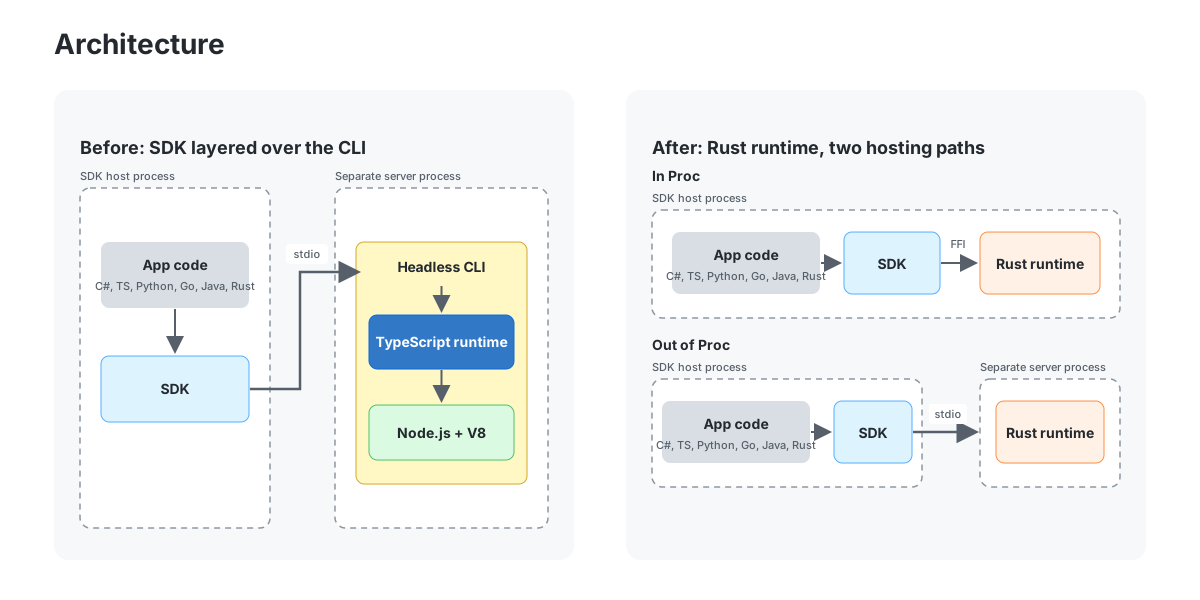
Before the rise of autonomous agents, a rewrite of this magnitude was simply not affordable in terms of engineering hours. The decision to migrate the GitHub Copilot runtime to Rust was not born out of a sudden need for speed, but rather a strategic necessity to secure a foundation that could scale indefinitely. We stood at a crossroads where the limitations of interpreted languages were beginning to chafe against the demands of a production system serving millions of developers. The cost of maintaining a legacy codebase in a different paradigm than the core infrastructure was becoming the invisible tax we could no longer pay.
Porting the Copilot agent runtime to nearly 800,000 lines of production Rust was a monumental undertaking that required more than just syntactic translation. It demanded a fundamental rethinking of how the system interacted with its environment, memory management, and concurrency models. The journey was fraught with the inevitable friction of rewriting business logic, error handling, and state management in a language that prioritizes safety over convenience. Yet, the promise of a type-safe, performant backend that could handle the sheer volume of inference requests without degrading was a compelling enough vision to justify the massive investment of time and resources.
What made this migration unique was the paradoxical use of the tool we were building to build itself. We leveraged Copilot, the very agent runtime we were rewriting, to generate the initial skeleton of the Rust code. This created a fascinating feedback loop where the system was essentially teaching itself to be faster and safer, albeit with significant human oversight required to ensure correctness. The generated code served as a rough draft, a starting point that captured the high-level structure and logic, but it was far from the polished, battle-tested artifact that made it into production.
The process of refining this generated code was where the real engineering magic happened. Developers had to scrutinize every line, injecting the domain-specific knowledge and edge cases that an LLM, trained on general code patterns, would inevitably miss. It was a dance between the probabilistic nature of the AI and the deterministic rigor of Rust's ownership model. We had to manually resolve borrow checker errors, optimize hot paths for real-time performance, and ensure that the new implementation didn't just work in theory but held up under the chaotic load of real-world usage.
The results, however, speak for themselves. The Rust rewrite delivered a system that is significantly more efficient, with lower latency and reduced memory overhead compared to its predecessor. More importantly, it established a robust security posture, eliminating entire classes of runtime errors that are common in dynamically typed environments. The migration proved that even the most complex, agent-driven systems could benefit from the strict guarantees of a systems programming language, paving the way for future iterations that are faster, safer, and more reliable.
This journey underscores a broader truth in modern software engineering: the tools we create today define the constraints and possibilities of tomorrow. By choosing to rewrite the core of our most critical infrastructure with such care, we are not just updating code; we are investing in the long-term health and scalability of the entire developer ecosystem. The path was difficult, the scope was immense, and the outcome was well worth the struggle, proving that sometimes the best way forward is to go back and rebuild from the ground up.
On Bluesky? Meet HomeSky.
Follower analytics, a growth toolkit, scheduling and AI posting — built for Bluesky. Connect your account and use everything free for 60 days.
Try HomeSky free →