Migrating the GitHub Copilot runtime to Rust, using Copilot
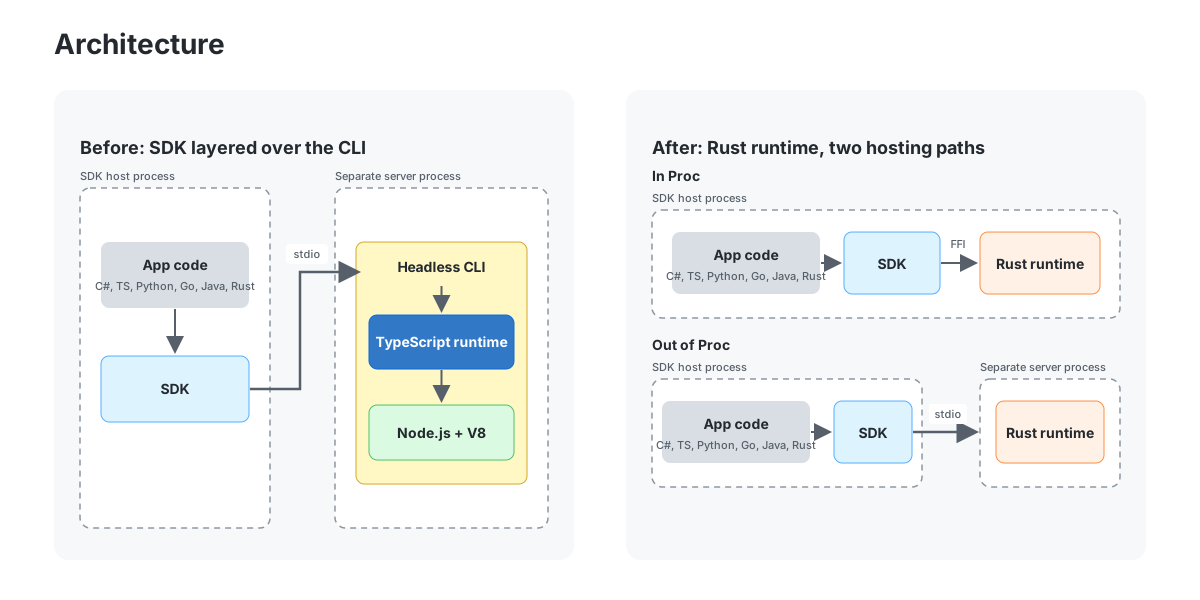
For years, the idea of rewriting a massive codebase using the very AI tool that lives within it felt like a paradox of convenience. It wasn't just a theoretical exercise; it was a practical necessity for the GitHub Copilot team, who found themselves staring down the barrel of a monolithic Java runtime that was becoming too slow and hard to maintain. Before the advent of modern coding agents, such a migration would have required hundreds of engineers working for years, a timeline and budget that simply didn't exist. The sheer scale of the project, eventually spanning eight hundred thousand lines of production Rust, represented a shift where the tool and the task were perfectly aligned in a way that had never been possible before.
The decision to port the Copilot agent runtime wasn't driven by a desire for trendy languages, but by the hard engineering reality that the existing stack could no longer scale with the demands of the platform. The old system was sluggish, bogged down by the overhead of a general-purpose language that wasn't optimized for the specific, low-latency constraints of an AI-driven development environment. Rust offered the memory safety and performance characteristics required to handle thousands of concurrent requests without the fear of crashes or memory leaks that plague interpreted languages. However, translating that vision into reality required a team willing to trust the process enough to let the AI drive the migration while they acted as the vigilant editors.
The actual execution of the rewrite became a fascinating study in human-machine collaboration, where the roles were subtly inverted from traditional development practices. Instead of humans writing code and occasionally asking for help, developers found themselves constantly prompting, correcting, and refining output generated by the system they were building. It was a feedback loop of unprecedented density, where the AI suggested idiomatic Rust patterns that the team had to validate against years of architectural decisions. The process wasn't magical; it was gritty and iterative, filled with moments where the AI hallucinated complex logic that had to be surgically removed, proving that even with advanced agents, human oversight remains the critical component of system stability.
Beyond the immediate technical victory of a faster, safer runtime, the migration revealed something profound about the future of software engineering: the boundary between the coder and the compiler is beginning to dissolve. The ability to leverage an AI agent to perform a rewrite of this magnitude suggests that the next decade of software development will not be defined by how much code individuals can write, but by how effectively teams can orchestrate agents to build complex systems. This isn't just about moving lines of code from one file to another; it is a fundamental shift in how we approach the lifecycle of enterprise software, turning what was once a daunting mountain into a series of manageable, automated steps.
The success of this project stands as a testament to the maturity of both the Rust ecosystem and the capabilities of large language models. It demonstrates that when the right tools meet the right problems, the constraints that once defined industry standards can be rewritten. What once seemed like an insurmountable task of refactoring millions of lines of legacy code into a modern, performant architecture is now a blueprint for how other teams might tackle their own technical debt. The journey from a Java monolith to a Rust-native agent runtime wasn't just a technical upgrade; it was a declaration that the future of coding is already here, running quietly in the background of every pull request.
On Bluesky? Meet HomeSky.
Follower analytics, a growth toolkit, scheduling and AI posting — built for Bluesky. Connect your account and use everything free for 60 days.
Try HomeSky free →