Migrating the GitHub Copilot runtime to Rust, using Copilot
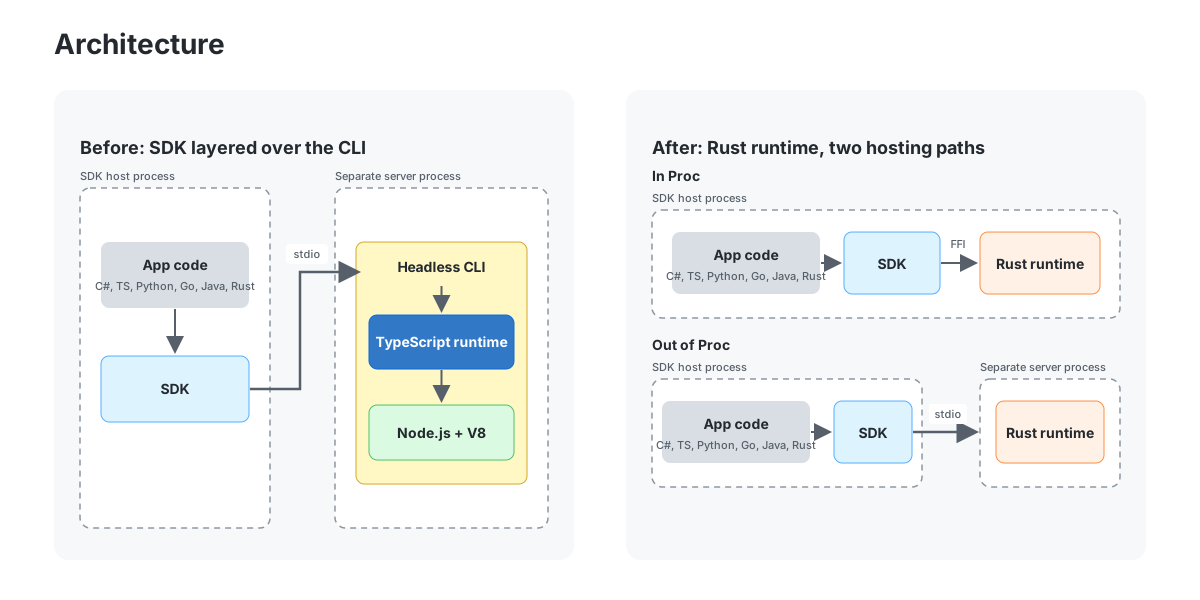
Before the rise of autonomous agents, rewriting a system of this magnitude was a project that could easily span years, requiring a massive team of engineers to painstakingly translate idioms, debug edge cases, and refactor legacy logic line by line. The notion of porting the GitHub Copilot runtime, a complex engine responsible for understanding and generating code, from Python to Rust felt like an insurmountable task until we realized that the very tools we built could be the architects of their own evolution. This shift wasn't just about changing a language; it was about fundamentally altering the architecture of how we build the tools that build our software, turning a theoretical exercise into a tangible reality through the power of self-driving development.
The journey to migrate the runtime to Rust involved a codebase nearing 800,000 lines of production code, a scale that previously demanded a human army to manage. In the past, such a migration would have been prohibitively expensive, risking months of downtime and introducing critical bugs that could compromise the integrity of the entire platform. However, by leveraging Copilot itself to generate the initial translation layers and handle the heavy lifting of syntax conversion, we were able to accelerate the process by an order of magnitude. It was a recursive loop of creation: using the system to rebuild the system, allowing us to focus our human intellect on the architectural nuances rather than the mechanical translation of code.
Rust was chosen not merely for its performance gains, but for the safety guarantees it offers in a system that must remain online 24/7. The strict memory safety and concurrency models provided by Rust addressed long-standing vulnerabilities that were inherent in the earlier implementation, ensuring that the agent runtime could handle the chaotic nature of real-world development workflows without crashing. This migration validated a growing hypothesis in the engineering community: that AI agents are no longer just assistants for individual developers but are capable of orchestrating large-scale infrastructure changes with a level of precision and speed that was previously impossible.
The narrative of this migration challenges the traditional view of software evolution, where every change is a high-stakes event requiring careful planning and manual verification. Instead, we witnessed a fluid transformation where the boundary between the coder and the code began to blur, allowing the development process to become more iterative and less linear. The team didn't just write the new code; they guided the AI, refining its suggestions and correcting its missteps in a continuous feedback loop that felt more like a collaborative dance than a top-down directive. This approach demonstrated that with the right tools, the cognitive load of massive refactoring can be distributed, making the impossible not just possible, but routine.
Ultimately, this project stands as a testament to the accelerating pace of technological capability and the changing role of the software engineer. We are moving away from an era where human effort was the primary bottleneck to one where human intent, amplified by AI, drives the execution. The migration of the Copilot runtime to Rust was not just a technical achievement; it was a proof of concept for a future where the tools we create are smart enough to help us create better versions of themselves, pushing the boundaries of what large-scale software systems can achieve. As we look forward, the implications of this shift suggest a future where the sheer volume of code we can maintain and evolve is limited only by our imagination.
On Bluesky? Meet HomeSky.
Follower analytics, a growth toolkit, scheduling and AI posting — built for Bluesky. Connect your account and use everything free for 60 days.
Try HomeSky free →