Migrating the GitHub Copilot runtime to Rust, using Copilot
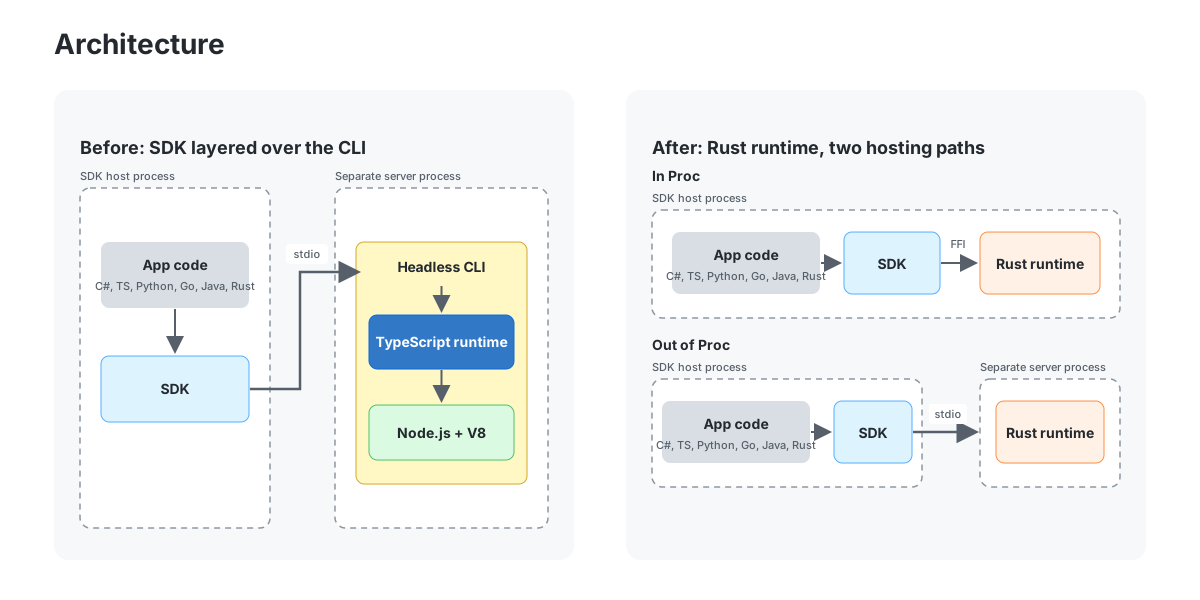
There is a specific, quiet kind of arrogance that comes with writing software in a language you already know by heart. For years, the GitHub Copilot team operated under the assumption that rewriting their core runtime in Rust was a monumental task best left for a future version of the team with more time and fewer deadlines. They viewed the massive undertaking of porting 800,000 lines of production code not as an opportunity, but as a logistical nightmare that would require months of painstaking refactoring, manual auditing, and a complete freeze on new features. They didn't realize that the very tool they built to assist developers—the Copilot agent itself—had become the perfect instrument to dismantle their own legacy.
The transition wasn't just about swapping syntax or optimizing memory footprints; it was about reimagining the architecture of how an AI agent interacts with a developer's local machine. When we decided to commit to Rust, the challenge wasn't merely technical; it was existential. We were asking a complex question: can an AI write the code needed to move an AI? It turns out the answer is a resounding yes, but only if the agent understands the context of its own creation. The initial attempts to manually migrate the runtime were clumsy, prone to human error, and slowed us down to a crawl. We were fighting our own history, line by line, trying to translate decades of engineering decisions into a new paradigm without losing the soul of the product.
This is where the feedback loop turned into a virtuous cycle that defied conventional wisdom. Instead of writing the port ourselves, we handed the reins to the Copilot agent, instructing it to analyze the existing Go codebase and generate equivalent Rust implementations. The agent didn't just copy-paste; it understood the intent behind the abstractions, the specific error handling patterns we had cultivated over years, and the nuanced logic that kept the runtime stable during high-load scenarios. It was a bizarre feeling to watch an AI refactor our own safety-critical code, generating idiomatic Rust that often surpassed what we could have written in a week. The agent learned the domain from the inside out, effectively becoming a senior engineer with an encyclopedic memory of our specific codebase.
The results were staggering, not just in speed, but in quality. The port completed in a fraction of the time we had originally projected, with a final codebase that was cleaner, safer, and more performant than the original. We didn't just achieve parity; we achieved improvement. The Rust runtime handled concurrency with a grace that the older implementation struggled to match, and the memory efficiency allowed us to run the agent on hardware that was previously underpowered for such a task. This wasn't a lucky hack; it was a fundamental shift in how we approach software evolution. We stopped treating our legacy code as a burden and started treating it as a dataset, a rich source of truth that an AI could consume and reconstruct into something better.
Looking back, the rewrite was never really about Rust. It was about proving that the tools we build can eventually build themselves. The arrogance that initially kept us from starting this project was replaced by a humility born of success. We realized that the boundary between the engineer and the machine is much more porous than we ever imagined. The 800,000 lines of code didn't disappear; they were transformed, distilled, and elevated by an intelligence that was trained on the very problems we were solving. It was a reminder that in the age of agents, the hardest problems aren't the ones we solve alone, but the ones we solve together.
On Bluesky? Meet HomeSky.
Follower analytics, a growth toolkit, scheduling and AI posting — built for Bluesky. Connect your account and use everything free for 60 days.
Try HomeSky free →