Migrating the GitHub Copilot runtime to Rust, using Copilot
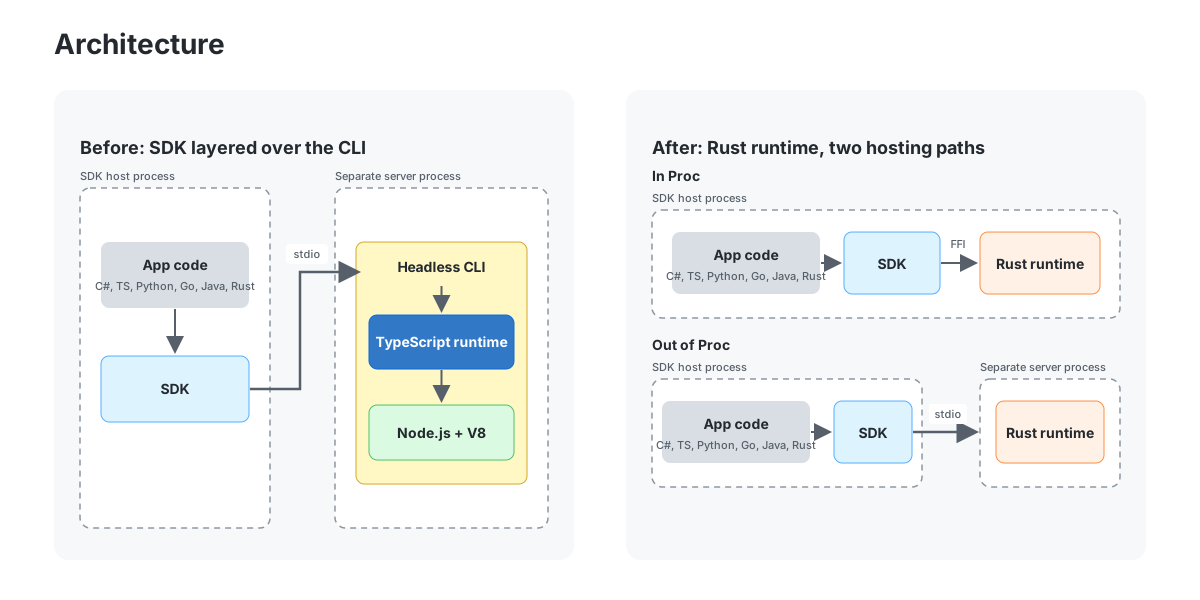
For years, the idea of rewriting the GitHub Copilot runtime in Rust felt like a pipe dream, a theoretical exercise for a future where developer productivity was no longer a bottleneck. The sheer scale of the task—porting nearly 800,000 lines of production code—seemed to defy economic logic. Before the rise of AI agents, the cost of such a massive undertaking was prohibitive; the time required to manually refactor, debug, and validate every single line would have dwarfed any potential performance gains or architectural benefits. It was a job for a hundred engineers over several years, a project destined to burn through budget and morale before delivering a single commit.
That calculation has fundamentally shifted with the advent of Copilot agents. The new reality isn't just about writing code faster; it's about offloading the cognitive load of context switching and architectural translation to the machine itself. We didn't just hand Copilot a specification; we handed it the original TypeScript implementation and asked it to understand the domain, the edge cases, and the specific nuances of our internal standards. The result was a rewrite that felt less like a traditional engineering sprint and more like a guided discovery, where the AI acted as a senior architect translating one language's idioms into another without losing the soul of the application.
The technical challenges were not merely syntactic. Rust's strict ownership model and zero-cost abstractions demand a level of precision that is often at odds with the dynamic nature of JavaScript. There were moments where the agent's initial suggestions were elegant but semantically incorrect, tripping over borrow checker errors that human developers might have spotted in a flash of insight but would take hours to reconstruct from scratch. By providing feedback loops where the AI could generate, we would critique, and it would regenerate, we created a collaborative friction that drove the solution forward. This iterative dance allowed us to tackle complex concurrency issues and memory safety guarantees that were previously buried under layers of technical debt.
What emerges from this process is a profound shift in how we approach legacy modernization. The rewrite wasn't a clean room exercise where we discarded the old system and built a new one from scratch; it was a deep dive into the existing ecosystem, extracting value while simultaneously upgrading the foundation. The resulting Rust runtime is not just faster; it is safer. The strict type system catches errors at compile time that would have surfaced as runtime crashes in the JavaScript version, offering a reliability that is crucial for a service powering millions of developers worldwide. This is the tangible value of agents: they don't just write code; they enable architectural leaps that were previously impossible.
Looking back, the journey from a theoretical impossibility to a concrete reality highlights the transformative potential of AI in software engineering. We are no longer bound by the linear constraints of human effort when it comes to massive refactoring projects. The path forward for the industry lies in leveraging these tools not to replace engineers, but to amplify their ability to build robust, scalable systems. As we continue to port more of our infrastructure to Rust using Copilot, the horizon expands further, proving that the only limit remaining is the imagination of how we combine human intent with machine execution.
On Bluesky? Meet HomeSky.
Follower analytics, a growth toolkit, scheduling and AI posting — built for Bluesky. Connect your account and use everything free for 60 days.
Try HomeSky free →